
Modern enterprises today are driven by a work culture that welcomes the element of change and transformation in the form of new technologies and methodologies within their workflows. From fine-tuning products and services to customer service improvements, and even strengthening their digital presence through various app developments, leaders are re-shaping their operations significantly. In this context, we cannot undermine the benefits of ease of software creation through low-code and no-code applications that use minimal or no visible code to quickly sketch out useful apps.
Interestingly, as there has been an upsurge in their demand due to this ease of development, business leaders have also realized that these platforms come with security and compliance risks that are too significant to overlook. These critical vulnerabilities may take the power away from your business by disrupting your operations and leading to a compromising data breach scenario.
Navigating through this subject, our article delves into the hidden cyber risks associated with them that your organization should be vigilant about. Further, we will also discuss their necessary mitigation plans to help you safeguard your business workflows.
Understanding the Essence of Low-Code and No-Code (LCNC) App Developments
As Low-Code No-Code apps have been a game-changer, you must understand their essence, their main differences, and how exactly they benefit your business. Hence, let’s explore them below.
Low-Code Apps:
This software development approach enables firms to create applications with minimal coding, allowing for faster app launch times. They come in handy with easy-to-use tools and pre-built models that can be refined by non-technical app developers to create innovative applications.
No-Code Apps:
No-code app developments enable businesses to create and automate visually interactive and engaging applications without using any visible coding. It implies that the creators are interacting with platforms that can code for them, yet it is not visibly happening in the process. Rather, it is happening in the backend operations of these apps.
Since they are very similar, let’s uncover their differences to gain a better understanding of the concepts.
| Differences | Low-Code Apps | No-Code Apps |
|---|---|---|
| Coding Knowledge | Minimal coding knowledge is required to create applications with this approach. | No coding knowledge is required to assist this development. |
| Users | Suited for technical and non-technical users. | Better suited for non-technical users. |
| Flexibility and Customization | More flexible as it can integrate changes in coding. | Relatively less, as no coding changes are possible in pre-built models. |
| Project Complexity | Suited for moderately technical to simple solutions. | Suited for simpler project solutions. |
Primarily, these modern innovations aim to help non-engineering professionals get applications started and running in no time. This is one feature of these apps that drives their demand exponentially.
Mainly, LCNC app developments leverage two benefits for businesses:
- Simplistic approach of app development, such as drag and drop features, makes it easier to develop interactive apps in less time, and
- Its ease of deployment enables developers to create apps with minimal or no coding knowledge as a prerequisite.
Cyber Risks Associated with LCNC App Developments and Their Mitigation Strategies
Technically, low-code and no-code web app platforms are well-designed to provide scalable software solutions that have optimized launch time. But there must be an opportunity cost, right?
Indeed, this speed comes at the cost of critical cyber risks associated with it. Hence, you need to be wary of them to protect your organization.
Moving forward, let’s explore these risks and their cyber consultancy-powered mitigation strategies from a business perspective.
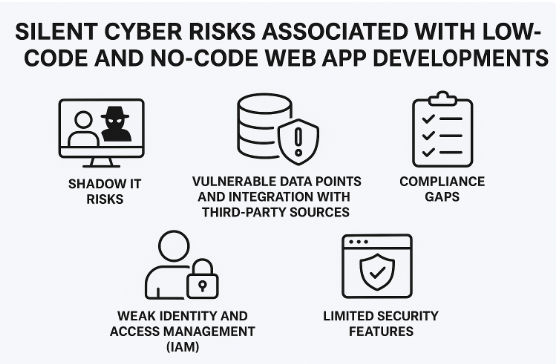
1. Shadow IT Risks
LCNC app developments created by unauthorized sources within the organization are not under the governance of the enterprise network systems and the IT team. This leads to unmonitored data flow, which is an exposed data network that is susceptible to cyber threats. Moreover, this also leads to a lack of compliance regulations for these apps in the company networks.
Solution
To overcome this risk, your enterprise can work on the following resolutions:
- Creating a strategic set of compliance and governance benchmarks that include accountability and transparency can help govern unmonitored data flows.
- Additionally, cybersecurity consulting can assist in resolving the issue of data silos by integrating datasets and information with the enterprise networks, which can be tracked and audited by IT to avoid cyber risks.
2. Vulnerable Data Points and Integration with Third-Party Sources
Low-Code and No-Code apps are commonly integrated with third-party APIs, CRMs, and payment gateways to facilitate various functionalities for the users. As a result of these integrations, the attack surface increased, and unencrypted data ends become more susceptible to potential cyber threats, allowing for weak authentication access to some users.
Solution
Your organization can overcome this hurdle as follows:
- Aiming to integrate with secure APIs, comprehensive zero-trust frameworks can be implemented to help assess and vet third-party infrastructure security beforehand.
- Moreover, cybersecurity consulting services can assist your enterprise by working on API security assessments and introducing secure data management practices in your workflows.
3. Compliance Gaps
Low-code and no-code app developments often lack robust security features and data encryption measures that are mandated for enterprises as per the legal frameworks of GDPR. Unable to meet these norms, firms can suffer financial and reputational losses.
Solution
Hence, these solutions can help you ensure your compliance norms are met.
- You are recommended to implement strong data encryption measures and strengthen the firewalls of enterprise networks in accordance with these benchmarks.
- Moreover, cybersecurity consulting can help protect high-priority networks that require compliance measures and role-based access to manage data wisely.
- Additionally, regularly conducting audits and improving the built-in security of the systems can help mitigate this risk in the long run.
4. Weak Identity and Access Management (IAM)
This challenge revolves around the LCNC app development having improper access controls, which adds to the vulnerabilities of sensitive business data. This being said, an unauthorized user may easily gain access to valuable data, which may contribute to the risk of potential cyber threats. Critical compliance issues are another concern related to access management that cannot be overlooked.
Solution
To help businesses resolve this concern, various measures can be taken, such as:
- The application of centralized user management systems can help improve data security and protection oversight in your interconnected business systems.
- Furthermore, enforcing Multi-Factor Authentication (MFA) and strong password policies can also strengthen data protection.
- Likewise, conducting regular user access audits also helps in tracking and monitoring control access, which can also help meet compliance measures.
5. Limited Security Features
LCNC platforms emphasize delivering smart software solutions, focusing on the speed and ease of deployment, often neglecting the implementation of necessary security controls. This allows cyber attackers to exploit the data sets in the enterprise networks.
Solution
To overcome this challenge, you can plan ahead and work on the following measures:
- Collaborating with a seasoned cybersecurity consulting service provider can assist your organization in curating custom security features in the LCNC apps as needed.
- Working on delivering 360-degree solutions, they can help in understanding data vulnerabilities through proper assessments and automated security testing. This can ultimately ensure that the necessary enterprise network frameworks are well-secured and regulated.
Final Thoughts
Hence, data security is a critical business concern that navigates through the sphere of innovative software developments like low-code and no-code platforms. These are extremely useful for your enterprise, but need to be tweaked to mitigate critical risks associated with them.
Hence, you can plan ahead with due diligence to overcome the roadblocks, while considering collaborating with an expert cybersecurity solution provider, which may add to your custom security solutions.

Author Bio: Linda William is a seasoned content strategist, decoding the low-code and no-code apps market and understanding the critical cyber risks associated with these developments.
The article effectively highlights the cyber risks associated with LCNC app development, offering practical solutions. Its insightful for businesses looking to leverage these platforms while ensuring security.