
Open any banking app today, and you’ll notice how smooth everything feels. Payments go through instantly, recommendations seem relevant, and even customer support replies faster than expected. A big part of that shift comes from Artificial Intelligence in Financial Services.
It’s no longer something experimental or limited to big tech players. Banks, lenders, and fintech companies are actively using AI to improve how they operate and serve customers. In many cases, it’s working quietly in the background: spotting fraud, analyzing risk, or helping you make better financial decisions without you even realizing it.
What makes this interesting is how quickly things have changed. A few years ago, most processes were manual and slow. Now, AI helps financial institutions handle massive data, reduce errors, and respond in real time.
Key Benefits of Artificial Intelligence in Financial Services
Enhanced Efficiency & Automation
Financial systems involve a lot of repetitive work, such as document verification, onboarding, compliance checks, and more. AI helps take over these tasks, which reduces manual effort and speeds things up significantly.
Instead of waiting days for approvals, users now get results in minutes. It also cuts down human error, which is especially important in financial operations where accuracy matters.
Superior Fraud Detection & Security
Fraud detection has improved a lot with AI. Instead of relying only on predefined rules, AI systems learn patterns and identify unusual activity in real time.
For instance, if a transaction doesn’t match your usual behavior, it can be flagged instantly. This proactive approach helps prevent fraud before it escalates.
According to research from IBM, organizations using AI in security are able to detect and respond to threats much faster.
Improved Personalization
Customers now expect services that match their needs. AI makes that possible by analyzing behavior, spending patterns, and preferences.
This leads to smarter recommendations; whether it’s suggesting a savings plan, offering a loan, or providing investment advice. These kinds of AI-driven customer insights help financial services feel more relevant and user-friendly.
Better Risk Assessment & Compliance
Traditional risk models often depend on limited data, mainly credit history. AI expands this by including alternative data sources like income trends and transaction patterns.
This improves the accuracy of credit scoring and allows more people to access financial services. At the same time, AI simplifies compliance by automating reporting and monitoring regulatory requirements.
Businesses looking to implement such solutions often explore AI development services to build customized systems that align with their needs.
Enhanced Decision-Making
AI helps organizations make better decisions by analyzing large datasets and predicting future trends.
Whether it’s investment planning or financial forecasting, AI provides insights that would be difficult to generate manually. This leads to better-informed strategies and improved outcomes.
Core Use Cases of Artificial Intelligence in Financial Services
| Use Case | How AI is Used | Business Impact |
|---|---|---|
| Fraud Detection and Mitigation | AI monitors transactions in real time and identifies unusual patterns or suspicious behavior using machine learning models. | Reduces financial losses, prevents fraud before it happens, and improves customer trust. |
| Personalized Customer Service (Chatbots & Virtual Assistants) | AI-powered chatbots handle queries, provide account details, and even assist with financial decisions using conversational AI. | Improves response time, lowers support costs, and enhances customer experience. |
| Credit Scoring and Lending | AI analyzes both traditional and alternative data (like transaction history and behavior) to assess creditworthiness. | Expands access to credit, reduces default risk, and speeds up loan approvals. |
| Algorithmic Trading | AI systems process market data, news, and trends to execute trades automatically at high speed. | Increases trading efficiency, reduces human error, and improves market responsiveness. |
| Compliance and Anti-Money Laundering (AML) | AI scans large datasets to detect suspicious transactions and hidden relationships across accounts. | Strengthens regulatory compliance and reduces manual effort in monitoring. |
| Asset Management & Robo-Advisors | AI builds and manages portfolios based on user goals, preferences, and risk tolerance. | Makes investment services more accessible and provides consistent, data-driven advice. |
Emerging Trends in Artificial Intelligence in Financial Services
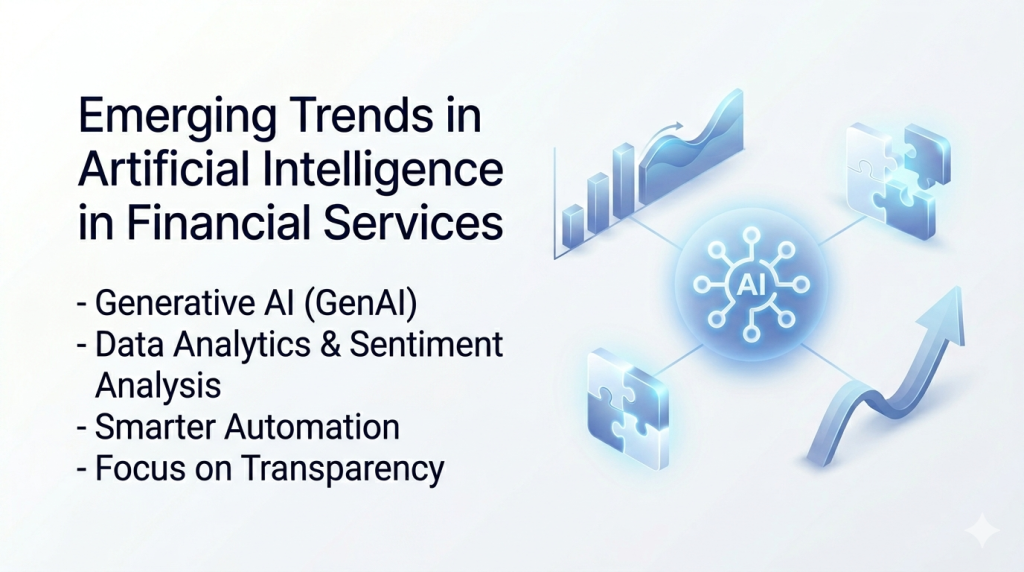
Generative AI (GenAI)
Generative AI is being used to automate reporting, generate insights, and improve customer interactions. Many financial institutions are already experimenting with it to improve efficiency. It’s also helping teams cut down time spent on routine documentation, making day-to-day operations a bit more manageable.
Data Analytics & Sentiment Analysis
AI analyzes news and social media to understand market sentiment. This helps businesses predict trends and make informed investment decisions. Sometimes, picking up early signals from market sentiment can give firms a slight edge in fast-moving situations.
Smarter Automation
AI is now handling entire workflows, not just individual tasks. This includes loan approvals, claims processing, and customer onboarding. In many cases, this leads to faster turnaround times and fewer bottlenecks across operations.
This shift is a key part of modern AI-powered financial services, where systems operate with minimal manual input.
Focus on Transparency
As AI adoption grows, similarly, the need for transparency. Financial institutions are working on explainable AI models to make sure decisions are clear and fair. This matters more than ever, especially when users expect clarity around financial decisions that affect them directly.
Conclusion
The result of Artificial Intelligence in financial services is already visible across the industry. From improving efficiency to improving customer experience, AI is helping organizations operate smarter and faster. And this is just the beginning. As technology evolves, we’ll likely see even deeper integration of AI into financial systems.
For companies, it’s becoming less of an option and more of a necessity. And for users, it simply means faster, better, and more reliable financial services.