
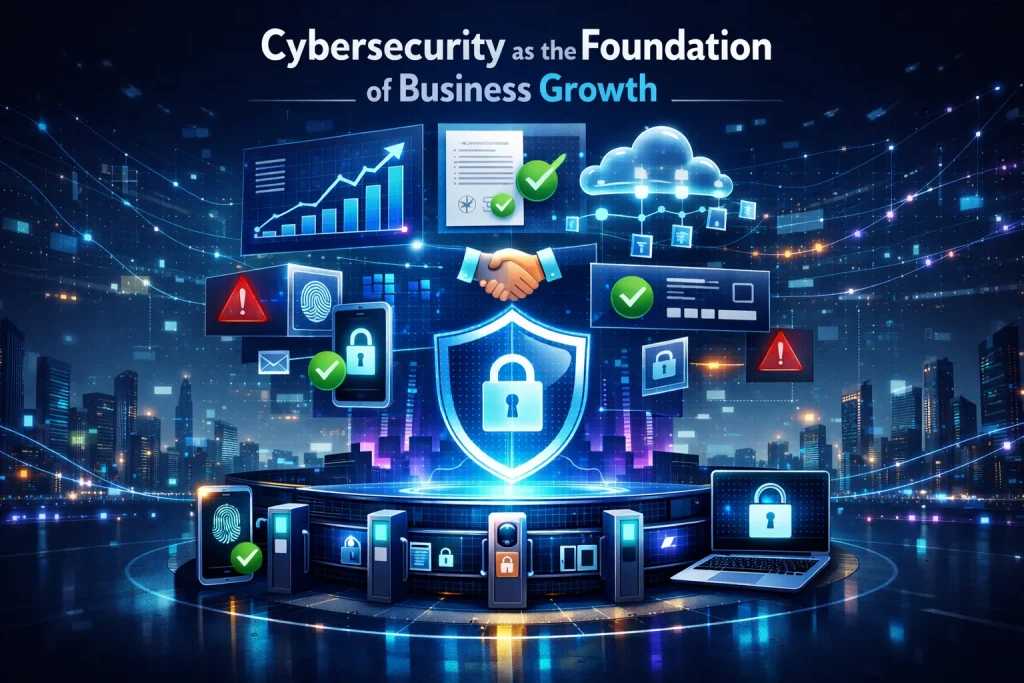
Most businesses treat security as something to fix after something goes wrong. That framing is expensive. Organizations that incorporate cybersecurity into their business expansion plan have a competitive advantage, secure larger contracts, and respond more effectively to incidents compared to those who try to implement security measures after the fact in systems that were not built with security in mind.
The Enterprise Sales Door You Might Be Closing
If you are trying to reach mid-market or enterprise customers, it is likely that as part of their purchasing process, they will perform a security audit on your company. This is not just a formality. Big companies realized that often some of their weakest points are exactly those small suppliers that have access to their systems, data, or physical locations.
The stories of supply chain attacks lead big corporations to demand higher standards from their vendors. A small business that does not have security controls written – no incident response plan, no policy of how to handle the data, no usage of multifactor authentication – more and more gets disqualified even before the sales engagement starts. On the other hand, if you can present a clean bill of security health, you get an edge against an equally competent competitor that can’t. If you aspire to larger clients, your security posture is becoming part of your value proposition.
Security by Design Cuts Long-term Costs
It is often assumed that moving quickly and addressing security later is less expensive. However, the data does not support this. Finding a vulnerability in the design stage costs a fraction of fixing it post-release, and fixing it post-release costs a fraction of remediating a breach resulting from going live without repairing it.
That explains why a cybersecurity for small business strategy built into product development makes sense. Each new function, integration, or service that is developed without a security input is technical debt. And it accumulates. Plus, when your business eventually must justify its security stance to a regulator, an insurance company, or an enterprise client, you will pay to clean up the mess from things you decided to do years ago – like delay security to prioritize velocity. Speed always feels more critical than structure until it isn’t.
The Real Cost of a Breach Isn’t the Breach
The average cost of a data breach naturally depends on the size of the organisation, but think about it – your whole business grinding to a halt, it’s never a good figure to think about. That figure stops most people in their tracks, but the number that actually damages growing companies most isn’t even the immediate financial hit.
It’s what happens after. Ransomware doesn’t just steal data – it halts operations. Every day the business can’t function is revenue gone, customers lost, and employees sitting idle. Add legal notification requirements under data protection laws, potential regulatory scrutiny, and the slower bleed of customers who quietly decide not to renew after reading about an incident. That erosion of customer lifetime value rarely shows up in post-breach cost estimates, and it’s often the damage that persists longest.
Business continuity planning – having a clear, tested playbook for what happens during and after an incident – is what separates companies that recover in days from those that never quite do.
From Reactive to Proactive: Building Something Scalable
The change that counts not the one between “insecure” and “secure.” It’s becoming proactive rather than reactive. Reactive security waits until something goes wrong. Proactive security designs models that can keep issues contained before they do real damage.
Zero Trust design is based on a simple idea: you cannot trust anything by default, whether it is inside or outside of your network. You need to verify every user, device, and connection. It may sound strict, but in reality, it allows the kind of adaptable, remote work environment that fast-growing companies can use to attract talent from everywhere. You’re not choosing between security and freedom here. You are getting both of them.
For smaller companies constructing this base, the work involves several layers that are intertwined: endpoint security that covers laptops and any other mobile devices, MFA for all of the systems considered critical, data management guidelines, as well as some basic training on phishing for all employees. More than anything else, breaches still typically start through phishing or social hacking. While the training itself can’t be a one-time thing, it needs to turn into a long term routine.
Cyber insurance often becomes a necessary part of the puzzle here. Most insurance providers are going to need you to give them evidence of particular controls before they offer you a coverage that’s even worth the hassle. This means putting such tools in place isn’t just a smart idea. For some, it could also mean the difference between being safe as well as being completely covered financially.
Growth and Security Run on the Same Track
The best comparison would be the brakes on a racecar. Brakes don’t slow a car down – they make it possible for it to go faster, because the driver can count on stopping when necessary. Security is no different. It’s what enables a business to speed into new markets, take on larger contracts, and leverage new technology knowing it’s more than one breach away from losing everything it’s worked to build. That’s not playing defense. That’s a plan for growth.