
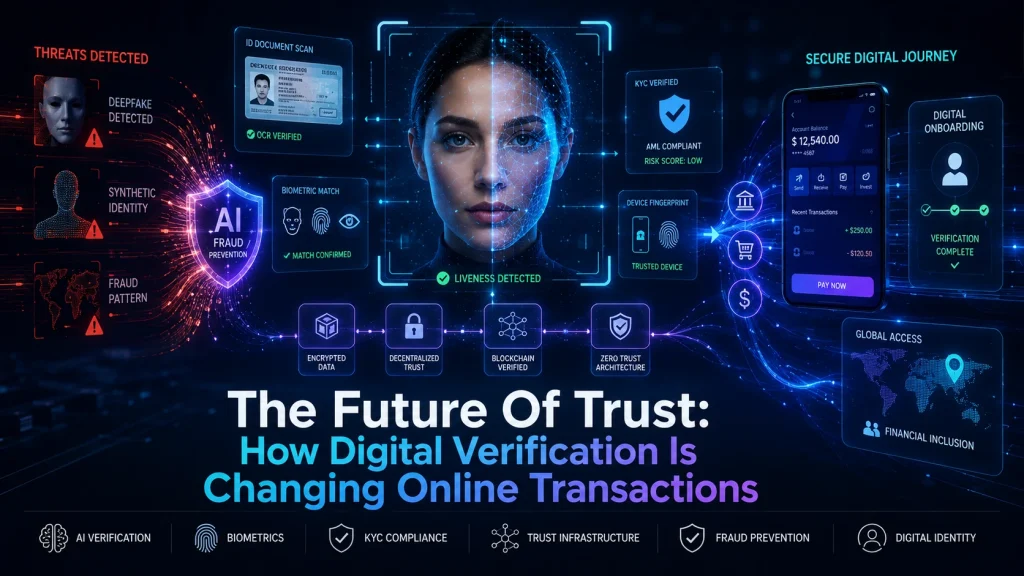
Rather than trust each other directly, the businesses and customers trust shared systems for identity proofing and verification. In the Information Age, where systems can be hacked, information leaked, and identities stolen, we all still do okay, despite the lack of any actual direct trust. This is the essential insight: Our solution for establishing trust doesn’t involve assuming it exists. Instead, we use mechanisms.
From manual checks to machine speed
The traditional method of checking someone was who they said they were was for a human to look at some documents, look at the person presenting the documents, and make a judgment call. At small scales that process was “good enough”. It’s a different story at the level of a global internet business processing thousands of new customers daily.
It’s slow, error-prone, and expensive. People can get tired, and the error-rate goes up as they get through more processes. Silly little mistakes, like a misplaced comma, or even a tool as simple your finger covering a character, can cause a process to grind to a halt or require reams of bureaucratic back-and-forth to fix.
Digitizing the process certainly streamlines it and reduces the opportunities for errors. Using document verification software with OCR is reliable, fast, and accurate. It picks up on mistakes that a human would have no hope of catching (e.g. font inconsistencies, comma delimiting issues, etc).
The liveness problem – and why it matters
Just providing a picture of an ID isn’t sufficient anymore. Fraud changes, and so does the surface affected.
Let me introduce you to the replay attack – a printed photo or even a recording of a video was enough to fool many early document tests. Liveness detection locks this entry, verifying the physical presence of a live human during the check. Passive liveness is being monitored unnoticed in the background. Active liveness asks the user to close their eyes, stick out their tongue, or make their head rotate, keeping them on their toes.
Deepfakes came next, and they’re raising the bar. AI-generated faces can already fool easy visual checks disturbingly often. 3D face mapping has become more prevalent as a response, more sophisticated and more reliable at capturing depth data: data that a flat image can never replicate. The battle between fraud and verification technology is only getting faster – every iteration that verification makes, the frauds seem to make two.
Synthetic identity fraud is the hardest of all to catch, because by definition all the data points are valid. They’re just in the wrong combination, pulled from various sources to create an utterly artificial person. Crooks often prefer to target children’s identities, it’ll be many years before they realize their social security number has been abused. Checking this involves looking for reassuring patterns across multiple, sometimes non-siloed documents, rather than realizing a single element ‘in the wild’.
Closing the trust gap for businesses and customers
Mutual trust is a challenge that needs to be addressed from both angles. Businesses have to trust that the verification system really is the strong link in their chain, and that they can’t be exposed by it. Customers have to trust the business enough to start the process. Even the slightest whiff of database compromise can sink that fragile, growing relationship.
Verification as a path to financial inclusion
Not every instance where someone needs to verify an identity is a case of fraud. One of the lesser-known advantages of automated verification is the opportunities it creates for individuals who have typically been overlooked by financial services.
In the past, opening a bank account involved going to a branch, completing paperwork, and a person making a decision at the end of it all. For those in remote areas, it was a real obstacle. Automated digital onboarding removes this geographic restriction – all you need is a valid ID and a smartphone. This can affect credit, savings, and financial accessibility for an entire population.
And this is where KYC compliance meets social impact. These AML and KYC guidelines that seem like unnecessary paperwork are what allow reasonably trustworthy remote onboarding to occur. Compliance is not just a negative; it is what makes the entire sector feasible.
Verification doesn’t stop at sign-up
The industry is moving toward continuous verification, rather than one check at registration. Zero Trust architectures assume that identity must be reconfirmed throughout a session, not taken for granted that it was correct when first verified.
Behavioral signals – typing patterns, device fingerprints, geolocation consistency – are added on to the initial document and biometric check. Eventually biometrics increase the risk of a breach, because you can’t change your biometrics the way you can a password. The more biometrics you’ve added to the system, the more false your assumption is that typing in my password is proof of an OK from my body.
Ultimately you create a model so that unauthorized access doesn’t just fail at the first door. It fails at every door.
The transition from inter-personal trust to cryptographically bounded trust is well advanced. The companies who are investing in that infrastructure now are building a compound advantage against those who haven’t yet realized the game has changed.