
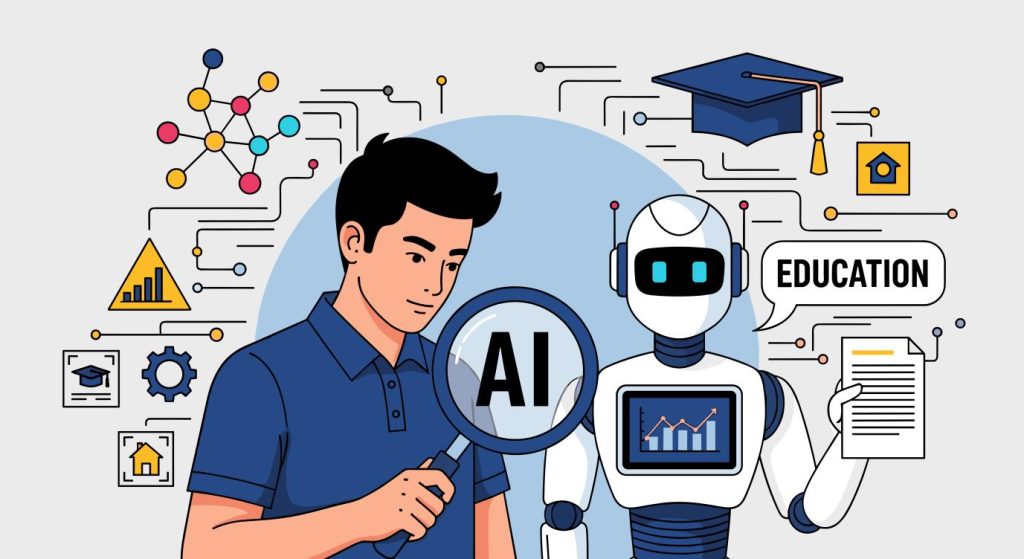
AI has given rise to entirely new occupations that never existed even a few years ago. Jobs such as AI prompt engineers, data annotators, and AI product testers are the kind of employment the future of the working world will look like. For those graduates interested in the kind of AI courses offers, such possibilities are nothing short of extraordinary.
What you’ll discover:
- How AI reshapes early career prospects and creates new opportunities.
- Specific challenges and advantages that fresh graduates face with AI integration.
- Practical strategies to build AI expertise and future-proof your career.
The professionals who thrive will be those who embrace AI as a career accelerator, building deep expertise that combines technical capabilities with uniquely human skills.
The Career Ladder Gets an AI Makeover
The organizational structure that characterized former generations does not count today. The reality for young professionals begins with an environment where AI system integration affects nearly all job functions, and predictions indicate potential effects for half of all entry-level white-collar jobs.
However, this trend is a complex narrative that goes beyond the simple job displacement mechanism. Businesses are essentially restructuring the way early career individuals contribute to the company. In effect, they are
- Strategic Focus Shift – Entry-level roles now emphasise strategic thinking over routine execution.
- Enhanced Learning Pathways – Internships and apprenticeships expand to include AI collaboration skills.
- Human-Centric Skills Premium – Adaptability, communication and problem-solving capabilities command higher value.
The transformation runs deeper than task redistribution. AI handles the repetitive work that previously consumed early-career bandwidth, creating space for meaningful contribution from day one. Today’s AI-native professionals approach complex challenges using intelligent tools as natural extensions of their capabilities.
High-Growth Opportunity Areas:
Software development, data analysis, cloud engineering, cybersecurity, and data engineering: this is a new frontier. It moves from the technical execution skillset to more of a business enablement function.
It is most helpful in the area of those developing their skill sets via advanced programs.
The New Rules of Early Career Success
Fresh graduates face a radically different employment reality than previous generations. The AI revolution creates both unprecedented opportunities and genuine challenges that require strategic preparation.
Emerging High-Value Roles for New Professionals:
- Prompt engineering positions that design instructions for AI systems.
- AI trainers ensuring algorithms deliver optimal performance.
- AI ethics specialists responsible for developing responsible technology.
- AI product managers leading AI-driven development initiatives.
- AI-focused data analysts requiring minimal coding expertise.
Critical Challenges You’ll Navigate:
- Automation displacing routine tasks typically assigned to junior professionals.
- Increasingly selective recruitment processes as companies raise standards.
- Immediate expectations to contribute high-value work from day one.
- Potential skills atrophy from excessive dependence on AI tools.
- Direct competition with AI for research, analysis, and content creation tasks.
Next, while there are no simple answers to these challenges, there are a few possible responses:
It takes more to be successful than possessing technical know-how. Skills such as critical thinking, creativity, and sophisticated problem-solving skills become your key differentiating factors. These uniquely human skills enable you to decode AI results, question assumptions, and explain the limitations of AI to others. The professionals that perform best would be the ones that position themselves as AI collaborators instead of competitors.
Ready to develop an expertise that merits high-level rewards? The interplay between your knowledge of AI and your uniquely human perspectives will shape your career path through this new world.
Building AI Expertise: Smart Preparation Strategies
Fresh graduates understand that AI proficiency demands more than classroom theory. Smart preparation combines multiple learning approaches to build real-world capabilities that employers value.
1. Strategic Learning Pathways
Educational platforms provide essential foundation-building, with graduates accessing:
- Elements of AI by University of Helsinki for conceptual understanding.
- AWS Academy and Google AI Essentials for cloud-based AI applications.
- Industry-recognised certifications that demonstrate verified expertise.
- Active participation in Hugging Face, Reddit’s r/MachineLearning and OpenAI Developer Forum communities.
2. Hands-On Experience Development
Practical application separates competent professionals from theoretical learners. Successful graduates pursue:
- AI internships combining mentorship with real project work.
- Hackathons and collaborative coding challenges for problem-solving practice.
- Personal projects showcasing practical AI implementation skills.
- Open-source contributions that demonstrate technical capabilities.
3. Hybrid Skill Development
Tomorrow’s AI professionals master both technical and human capabilities:
- Ethical AI implementation and responsible development practices.
- Emotional intelligence paired with technical expertise.
- Clear communication about AI concepts and practical limitations.
- Critical thinking skills for evaluating and interpreting AI outputs.
In this fashion, the perspective of the prepared professional is to offer the collaborative advantage of the newly graduated individual to the workplace, where the collective power of human innovation and the capabilities of AI are intertwined. Rather than competing against the capabilities of AI, the professional is utilizing the tool to enhance their own problem-solving capacity to achieve optimal results.
The most successful graduates don’t learn about AI, they learn how to use AI as a professional partner.
Ready to Future-Proof Your Career?
Professional worlds continue to move at an ever-increasing rate of change. With the addition of AI, job market prospects are both exhilarating and unknown as new breeds of job positions are formed in the places of older tasks.
Success demands more than technical proficiency. The most sought-after professionals combine AI expertise with distinctly human strengths:
- Critical thinking that evaluates and interprets complex outputs.
- Creative problem-solving that machines cannot replicate.
- Emotional intelligence for effective team collaboration.
- Ethical awareness in responsible technology implementation.
- Clear communication skills that explain technical concepts to diverse audiences.
Practical experience through internships, hackathons, and personal projects proves equally valuable as formal qualifications. Online communities provide continuous learning opportunities and professional networks that accelerate career growth.
Conclusion
Artificial intelligence courses leverage it as a career booster. The most successful individuals place themselves in a position where technology supports human potential, as opposed to replacing it.
The future favours the bold. Your path, while unlike what came before, can, with the right preparation, unlock unparalleled potential for cultivating deep knowledge in tomorrow’s most valuable competencies.
Ready to take the next step? See how AI programs on the cutting edge can speed the path towards your career goals.
To better understand how AI is reshaping careers, check out these In-demand AI skills for 2026:
https://www.youtube.com/watch?v=udg_UKml3XY
This video explains the shift toward roles that require people to design and implement AI solutions rather than just use basic tools.