
Not long ago, I would have described image animation as something that belonged to specialists. If you wanted to make a still photo move in a convincing way, you needed editing software, patience, and a tolerance for trial and error. That is no longer the case. Over the past year, I’ve watched picture animation tools become much easier to use, and more importantly, much easier to justify in everyday content work.
The big difference is accessibility. A capable AI video generator now lets me test motion ideas without opening a full production workflow. GoEnhance is one of the better examples I’ve used when I want quick visual motion that still feels presentable. That matters whether the goal is social content, simple storytelling, or just making a static visual feel less flat.
What interests me most is that this shift is not limited to professional creators. Students, solo founders, small marketing teams, and casual hobbyists can all make use of a free AI image to video generator if the workflow is simple enough and the output is good enough to share.
Why Static Images No Longer Feel Like the Final Format
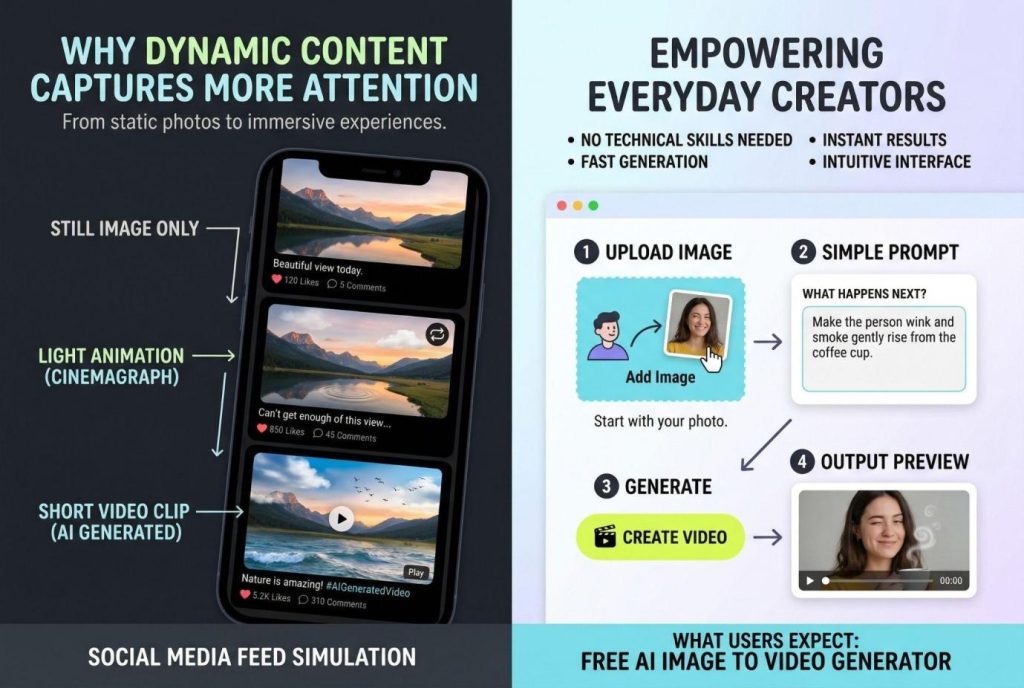
I have noticed a subtle change in how people treat images online. A still visual is no longer always considered finished. More often, it feels like the first layer of something larger. A product image can become a short motion clip. A portrait can turn into a reaction post. An illustration can become a mood piece for a reel or a story.
That expectation did not appear out of nowhere. Platforms trained people to respond to movement. Even a small amount of motion can make a post feel more current and more native to how feeds work now.
From my own experiments, the difference is obvious:
| Format | Typical response |
|---|---|
| Static image | Easy to scroll past |
| Light animated image | Feels more alive and noticeable |
| Short motion clip | Better for attention and replay |
This does not mean everything should move. It does mean the option to animate has become much more relevant than it used to be.
How Picture Animation Became More Accessible With AI
The biggest improvement, in my view, is not that the technology became magical. It is that it became usable. I can now upload an image, define a simple motion direction, and get a result without spending half an afternoon learning the interface.
That kind of accessibility changes behavior. Once animation stops feeling like a high-effort specialty task, people start using it more casually. They test more ideas. They create more variations. They become more willing to turn an ordinary visual into something with mood, timing, or movement.
What I’ve learned from repeated testing is that simpler prompts often work better than over-explaining. Good source material helps even more. A clear subject, readable framing, and a stable composition usually give the model less room to make ugly guesses.
What Users Expect From a Free AI Image to Video Generator
Free tools attract curiosity, but curiosity alone does not keep users around. When I test a free creative tool, I ask a few basic questions almost immediately:
- Does it preserve the original image well?
- Does the motion feel intentional?
- Is the result usable without heavy editing?
- Can I get something decent in a few tries?
If the answer to most of those is no, the price does not matter much.
A free AI image to video generator becomes meaningful only when it crosses the line from “demo-worthy” to “actually useful.” In practice, that usually means stable motion, reasonable speed, and an interface that does not punish the user for experimenting.
Practical Use Cases for Social Posts, Ads, and Creative Experiments
The use cases are wider than many people expect. I’ve seen the best results when the animation has a clear role rather than existing just for novelty. A moving character portrait works because it adds personality. A gently animated product image works because it adds emphasis. A stylized still that gains depth or camera motion works because it creates atmosphere.
Some of the most practical uses I’ve found include:
- turning portraits into short social clips
- animating product visuals for lightweight ads
- adding motion to illustrations for mood-driven content
- testing hooks for short-form video before producing a larger piece
These are not huge productions, and that is exactly the point. AI animation becomes most useful when it lowers the effort needed to make simple content more engaging.
The Bigger Role of AI in Everyday Visual Storytelling
I do not think AI will make traditional animation skills irrelevant. What it will do, and is already doing, is expand who gets to use motion in the first place. That is a meaningful shift. People who would never open a professional timeline editor can now create movement from a single image in a matter of minutes.
For me, that is the real story. The value is not just novelty. It is access. It is the growing ability to move from static idea to dynamic output without needing a full production mindset for every small piece of content.
That is why picture animation feels less like a gimmick now and more like a normal part of modern visual creation.