
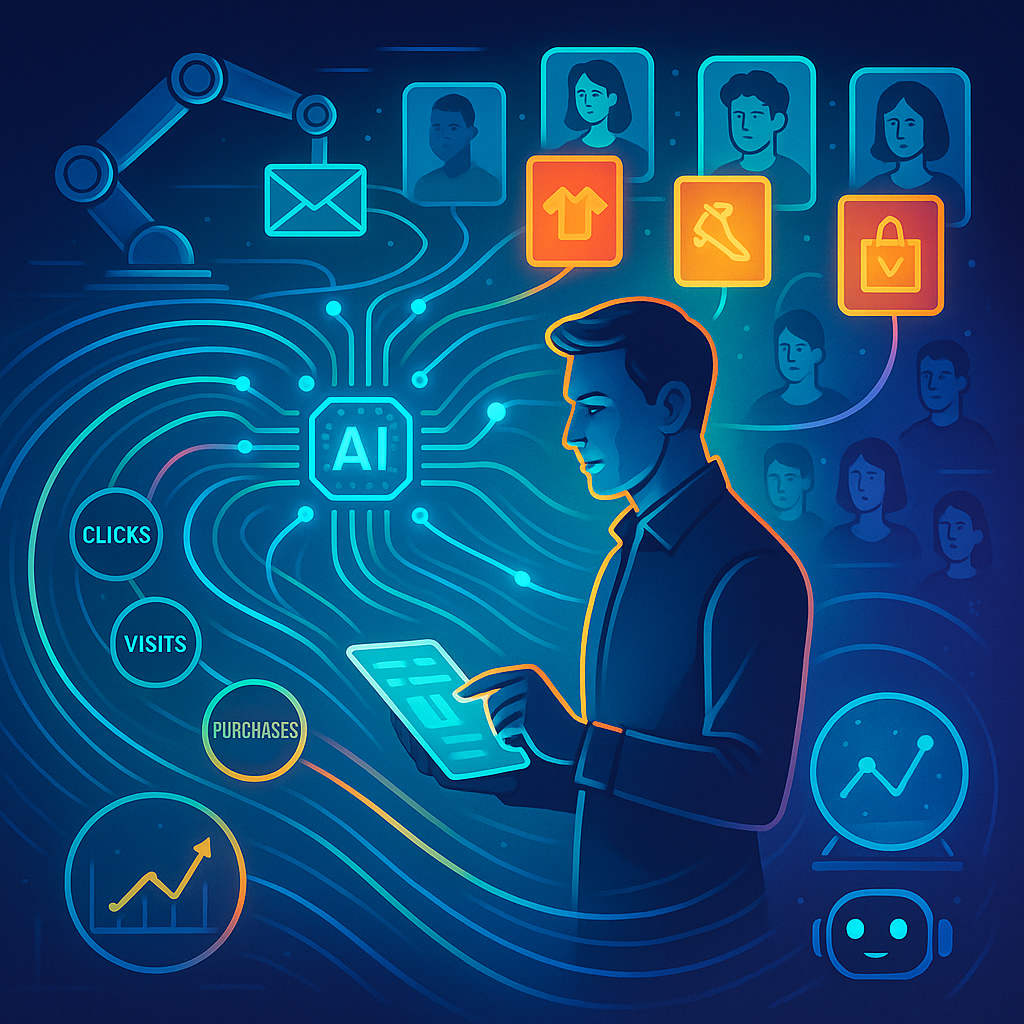
Ever wonder how your phone seems to read your mind? You have a quiet chat with your mate about wanting to go camping, and next thing you know, your social media is full of ads for tents and sleeping bags. Is someone listening? Probably not, but something is. That something is Artificial Intelligence, AI for short. And no, its not about terminator-style robots coming for our jobs, not really. It’s about software getting unbelievably clever at figuring out what makes us humans tick. For what feels like a lifetime, marketing was a bit of a guessing game. As a marketer, I’d stare at spreadsheets, maybe run a focus group, and then cross my fingers that the advert we made would actually work. Sometimes you got lucky, other times it was a total waste of money, and you rarely knew for certain why. AI is ripping up that old rulebook.
What is it doing that’s so different? Well, instead of a company shouting one single message at everyone, AI lets them whisper a unique, tailored message to each individual person. It’s a fundamental change. These AI systems are pattern-finding beasts. They can chomp through millions of clicks, website visits, and purchases and spot connections that the human brain, not even a whole team of us, could ever hope to see. It’s not actually magic—it’s just incredibly complex maths—but the results can feel magical. I was helping a mate with his online shop a while back, sales were flat. We hooked up a simple AI tool to his ad account. Within a month, the AI had figured out that his most profitable customers were night-shift workers who did all their shopping between 2 am and 4 am. Who knew? We shifted the ad spend to those hours, and his revenue practically doubled. That’s the kinda power we’re talking about. It’s not about replacing humans; it’s about giving us a tool that’s infinitely more powerful than anything we’ve had before.
Using Data Like Never Before: How AI Sees Patterns
Let’s be honest about data. Businesses have always had it, right? Piles of sales reports, website visitor logs, customer email lists. But most of it was just a digital dust pile sitting in a folder on a server somewhere. The real problem was that doing anything useful with it was a massive headache. You’d need a team of analysts weeks, maybe months, just to pull out one or two interesting trends. AI just scoffs at that. It can process more information in a single second than a person could in their entire life. And it looks at everything, I mean everything. The exact pixel you hovered your mouse over, how many seconds you watched a product video for, the stuff you put in your shopping basket and then took out again, the time of day you prefer to browse. All these little digital footprints are like breadcrumbs, and AI is the best tracker dog in the world.
So what’s the point of all that? It means businesses can finally make decisions based on what is happening right now, not what happened six months ago in last quarter’s report. For instance, a clever AI can spot that people in a specific town start searching for barbeque supplies the instant the weather forecast hits 20 degrees. A smart retailer can then use that signal to automatically push ads for charcoal and burgers to people in that postcode, at that exact moment. It’s ridiculously efficient. There’s no waste. You’re not trying to sell BBQs to people in another town where it’s pouring with rain. This ability to react in real-time is what makes the digital marketing services of today so potent. It’s a world away from the old ‘spray and pray’ method, where we’d just blast out ads and hope for the best. We used to just throw mud at a wall to see what would stick; now we’ve got a mate with a torch telling us exactly where the wall is.
Personalization Isn’t Just a Name in an Email Anymore
You remember the old days, right? When you’d get an email that started with “Hi Dave,” and you were supposed to be impressed by how personal it was. It’s almost cute to think about now. AI has taken that idea of personalization and put it on steroids. We’re not just talking about putting a name in a subject line anymore; we’re talking about personalizing the entire digital world for each user. When you open up Netflix or Amazon, the homepage you see is completely unique to you. The movies it suggests, the products it puts front and centre, even the order of the categories—it has all been specifically arranged for you by an AI that has learned your tastes. It’s had a good look at everything you’ve ever watched or bought and made a very clever guess about what you’ll want next. And nine times out of ten, its a damn good guess.
Why does this matter so much? Because this kind of hyper-personalization makes people feel seen and understood. It cuts through the absolute blizzard of online noise. Instead of being faced with ten thousand random items in a shop, you’re shown the twenty that you might actually want to buy. For businesses, this is a game-changer. It makes people far more likely to click, to engage, and ultimately, to spend money. It even builds loyalty in a weird way. If a brand keeps showing you things you genuinely like, you’re going to keep going back, aren’t you? My team and I ran a little experiment for a clothing brand. We split their website traffic in two. Half the people saw the normal, one-size-fits-all site. The other half saw a version where an AI secretly rearranged the products on the page based on what they’d clicked on in the last few minutes. The results were mad. The group on the AI-powered site had a conversion rate that was nearly 30% higher. Thirty percent! And all we did was show them the right stuff first. It’s not about being creepy or tricking anyone; it’s just about being a better, more helpful shopkeeper.
AI as a Crystal Ball: Predictive Analytics for Smarter Ads
What if you could know what your customers were gonna do, before they even did it? Sounds a bit like sci-fi, but that’s pretty much what predictive analytics is. It’s AI’s best attempt at a crystal ball. Hows it work? It takes all that data from the past—every purchase, every website visit, every customer service query, seasonal buying habits—and uses it to build a model that tries to forecast what will happen in the future. It’s never going to be 100% right, nothing is, but its a hell of a lot better than just guessing. For a marketer, this is an absolute superpower. You can get ahead of what your customers need. For example, the AI might flag that a customer who bought a fancy coffee machine eight months ago is probably getting close to needing more descaling solution. Bam, you can send them a perfectly timed email with a 10% off voucher. It feels helpful to them, and it’s an easy sale for you.
This is especially massive when it comes to managing ad budgets. So, so much money gets completely wasted on ads being shown to the wrong people at the wrong time. Predictive AI is the cure for that. It can identify the specific customers who are showing all the classic signs of being ready to buy, so you can point your ad budget directly at them. More importantly, it can also spot customers who are showing signs of drifting away—what we call ‘customer churn’—and you can automatically step in with a special offer or a friendly message to try and keep them on board. I worked with this subscription box company, they had a huge problem with people cancelling after their first box. We used a predictive tool to look at the behaviour of people who stayed versus people who left. The AI found one tiny difference: customers who watched the ‘how-to’ videos on the website within their first week were 80% more likely to stick around. So the company just started sending new customers emails pushing those videos. Their churn rate fell by nearly half. They were solving a problem before it even properly existed.
Letting the Robots Do the Work: AI and Automation
The most obvious win from AI, and maybe the biggest sigh of relief for marketers, is automation. There are just so many mind-numbing, repetitive tasks in marketing that eat up days and weeks of our time. Writing fifty slightly different social media posts, scheduling a whole month of emails, checking ad performance every hour, responding to the same three customer questions over and over again. It’s all work that has to be done, but it’s a total killer for creativity and strategic thinking. AI is absolutely perfect for all that grunt work. You can set up systems where the AI handles all the boring stuff, freeing up your actual human team to do what they’re best at: thinking up big ideas, coming up with creative campaigns, and talking to customers about complex problems. For example, you can get an AI to run your entire email marketing. It’ll send the welcome emails, the abandoned cart reminders, the “we miss you” messages, all triggered by customer behaviour, without a single person having to press ‘send’.
Chatbots are another classic example. A few years back they were awful, right? Clumsy and frustrating. Now, the AI-powered ones are incredible. They can handle a massive range of customer queries instantly. They can track a package, process a return, and even recommend the right size of jeans based on your previous orders. What does this mean? It means your customers get an answer to their question at 3 am on a Sunday, and your human support team doesn’t have to answer “where’s my order?” five hundred times a day. Everyone’s happier. And then there’s content. AI tools can now bang out a pretty decent first draft of a blog post, product description, or an ad. It’s not going to write a masterpiece, but it can create a solid, SEO-friendly foundation that a human writer can then quickly polish up and add some flair to. The sheer speed this adds to the content creation process is incredible.
| The Old Way (Painful) | The New Way (AI) |
|---|---|
| Writing every social media post by hand | AI suggests topics, writes drafts, and posts at the best times |
| Answering every single customer email | A chatbot handles 80% of queries instantly, 24/7 |
| Guessing when to send an email campaign | AI sends emails automatically based on individual user actions |
| Manually checking and changing ad bids | AI optimizes ad spend every minute for the best results |
AI-Powered Content and SEO: Is It Any Good?
Now, as an SEO guy, this is the bit that really gets me going. Can a machine actually write stuff that gets to the top of Google? The honest answer is… yeah, kinda. But it’s complicated. These AI content tools have gotten ridiculously good, incredibly fast. You can chuck a keyword at them, like “best waterproof walking boots,” and it’ll vomit out a whole 2,000-word article in about ninety seconds. For creating loads of basic, factual content—think hundreds of slightly different product descriptions, or simple ‘what is’ articles—they are an absolute godsend. They can save hundreds of hours of work and make sure you don’t have duplicate content issues, a job that is soul-destroying to do manually. The AI is also weirdly good at weaving keywords into the text in a way that doesn’t sound too clunky, which is obviously a big tick for SEO.
But—and you knew there was a ‘but’ coming—it’s got no soul. It’s a brilliant mimic, but it’s not a creator. AI content often lacks a real voice, a proper personality, any genuine, hard-won expertise. It can’t tell you about the time it got caught in a storm in the Peak District and realised its boots weren’t as waterproof as the label claimed. It can gather and rephrase all the facts it can find on the internet, but it can’t generate a truly new idea or a unique point of view. That’s why the human is still the most important part of the equation. My advice to anyone thinking of using AI for content is simple: treat it like a very bright, very fast intern. Let it do the boring first draft, the initial research, and get the basic structure down. Then, you need a proper human expert to come in, check every single fact, inject their own personal stories and insights, and give it a personality. The combination of AI’s speed with a human’s creativity and experience? That’s where the real magic is. A digital marketing agency that has figured out how to blend those two things is basically unstoppable.
Why a Digital Marketing Agency is Your Best Bet for AI Integration
Right, so you’ve read all this, you’re sold on the idea, and you’re thinking, “I need to get me some of that AI magic.” But where on earth do you begin? The honest truth is that a lot of these powerful AI tools are seriously complicated and can be very expensive. It’s not like buying Microsoft Office and just pressing a button. You’ve got to know how to plug it into all your other systems, how to train it with the right kind of data, and most importantly, how to actually understand the information it’s giving you. If you get it wrong, you can waste a shocking amount of time and money and end up with nothing to show for it. This is exactly why going to a specialist digital marketing agency can be the smartest thing you do. They’ve already gone through all the pain. They’ve spent years testing all the different AI tools, they know which ones are brilliant and which are a waste of space, and they have a whole team of people who are trained to use them properly.
A good agency won’t just sell you a piece of software. They’ll look at your specific business, your customers, and what you want to achieve, and then they’ll build a whole strategy around the right AI tools for you. They get the fiddly bits of predictive analytics and hyper-personalization. They can get your campaigns set up correctly from day one, keep a close eye on how they’re doing, and tweak things to make sure you’re getting the absolute best bang for your buck. I’ve seen so many businesses try to do this stuff themselves, and they just get completely bogged down in the technical details. They spend months trying to figure out the software and completely forget that they’re supposed to be doing marketing. An agency just takes all that stress away. They handle the techy stuff, so you can get on with what you’re good at: running your business. It’s a shortcut to using their expertise to get all the benefits of this amazing technology without having to become a data scientist yourself.
The CMO’s New Job: Making Friends with AI
If you’re in charge of a marketing department, your job has probably changed more in the last few years than it did in the twenty before that. The role of a Chief Marketing Officer isn’t just about coming up with a catchy slogan or a pretty TV ad anymore. It’s about data, technology, and proving your worth with cold, hard numbers. And right at the heart of that transformation is AI. Deciding to embrace AI isn’t something you can just pop on the to-do list for next year. It’s happening right now, and it’s essential. The companies that are still dithering, wondering if it’s all just a fad, are already being left for dust. The advantage that AI gives a business is just too big to ignore. It allows for a speed and efficiency that you just can’t get with a purely human team, no matter how good they are.
The big challenge for marketing bosses isn’t to learn how to code or become data analysts. It’s to learn how to ask the right questions. How can we use AI to really, truly understand our customers for the first time? How can we use it to automate all the rubbish jobs and let our talented people be more creative? Crucially, how can we use it to walk into the boardroom and prove, with undeniable data, that the marketing department is a profit center, not a cost? The leaders who will win in the next decade are the ones who see AI as their most powerful new team member, not as a threat. They’ll be the ones who invest in the right tools, and just as importantly, invest in training their people how to work with the machines. The future of marketing is this messy, brilliant blend of human creativity and artificial intelligence. The best digital marketing services are the ones that have already embraced this. It’s a huge shift in how we do things, and the people who jump on board now will be the ones leading the way for years to come.
Frequently Asked Questions
1. Is AI gonna take my marketing job?
Nah, probably not. But it will definitely change it. AI is ace at the boring, repetitive stuff. That just means humans like us get to do more of the fun stuff that AI is rubbish at, like thinking up big creative ideas, real strategy, and actually talking to other humans. See it as a new tool in your toolbox, not a replacement.
2. Is this AI marketing stuff too expensive for a small business?
It used to be, for sure. But not anymore. A lots of the tools you probably already use for emails or social media now have AI features built right in for a few extra quid. You don’t need to buy a million-dollar platform to get started. You can get a lot of bang for your buck from the smaller stuff.
3. So how do I even start with this? It sounds complicated.
Just start small, don’t try to do everything at once. Have a look at the software you’re already paying for. Does your email platform have an AI thingy to help you pick the best time to send? Does your ad platform have an auto-bidding option? Just try one of them. Turn it on and see what happens. Or, just have a chat with a digital marketing agency that knows their onions.
4. Can I trust what an AI writes? Is the content any good?
You should always, always check it. Never just copy and paste. AI can sometimes just make stuff up or write things that sound a bit weird. The best way to use it is to let the AI write you a messy first draft, and then have a human—a proper expert—come in to check the facts, add some real stories, and give it a bit of personality.
Featured image generated using ChatGPT with DALL·E.