
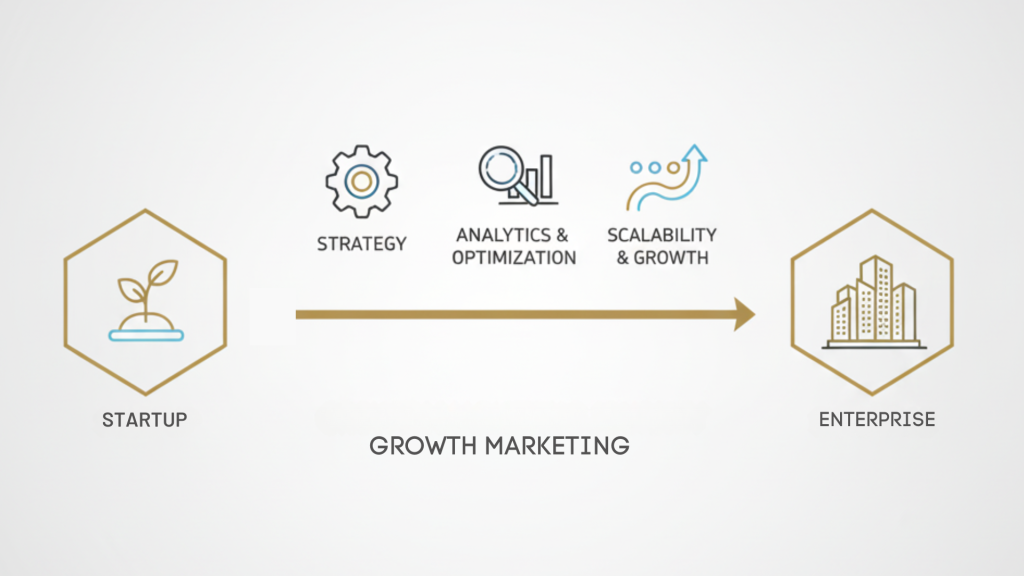
Businesses operate in an environment where growth is both an opportunity and a challenge. Success depends on how effectively an organization can refine its strategy, test new approaches, and adapt to shifting market dynamics. Growth marketing brings structure to this process, bridging creativity and data to uncover what drives real expansion and turning every initiative into a scalable, measurable business advantage.
This article explores adaptable growth marketing strategies that empower businesses of all sizes to drive consistent, efficient, and data-driven expansion.
Adopt a Hypothesis-Driven Funnel Approach
Effective business growth strategies begin with clearly defined hypotheses rather than assumptions. Map the customer journey from awareness to activation, retention, and advocacy. Determine a quantifiable aim for each step, such as cost per qualified lead, activation rate, or 30-day retention.
Design experiments involving variants of landing pages, email sequences, or paid advertising creatives that provide the results in a short timescale. Rapid, iterative testing helps firms to uncover high-impact solutions while reducing resource expenses.
These days, growth marketing services offer complete, end-to-end solutions that incorporate performance optimization, automation, creative planning, and data analytics. This helps firms to accelerate growth and produce meaningful long-term impact.
Invest in Owned Channels with Compounding Value
While paid channels can accelerate growth, their benefits cease immediately once the investment stops. Owned channels including content marketing, search engine optimization, and email provide compounding returns over time.
For instance, well-structured email nurturing campaigns and segmented communication sequences transform one-time visitors into loyal customers. Businesses integrating a balanced approach of paid acquisition with owned channels achieve a more favorable customer acquisition cost (CAC) and higher long-term profitability.
Leverage AI and Automation to Enhance Strategy
Organizations now embed AI and automation into core operations to enhance strategic execution. Enterprises deploy hyper-automation by combining AI, robotic process automation (RPA) and process mining tools to modernize workflows, reduce overhead, and scale decision making.
Current trends include:
- Edge AI, enabling real-time decisions at device level.
- Agentic AI systems are capable of independently orchestrating multi-step tasks.
- Low-code/no-code automation platforms which empower teams to deploy AI solutions without heavy IT support.
For businesses, the imperative is clear: use AI and automation to transform how strategy is executed and how value is delivered at scale.
Prioritize Data-Driven Decision Making
Businesses are increasingly embracing data-driven decision‐making as a strategic imperative. According to recent research, 64% of organizations now base most of their decisions on data.
Leading trends include:
- AI-powered analytics to surface hidden patterns and automate decision inputs.
- Real-time insights from edge and cloud platforms that enable immediate action.
- Data democratization, where non-technical teams access self-service analytics and influence strategic choices.
Channel Strategy Across Business Stages
Early Stage / Low Budget
Focus on high-impact content, strategic partnerships, referrals, and founder-led outreach. Begin with one paid channel to validate results.Growth Stage
Standardize processes such as creative templates, landing page frameworks, and testing protocols to enable campaign scalability.Enterprise Scale
Invest in cross-functional orchestration tools, including customer data platforms and marketing automation, to optimize customer lifetime value across departments.
Establish a Creative and Measurement Feedback Loop
Top-performing firms establish a constant feedback loop between creative creation and performance monitoring in order to systematically maximize results. By combining fast experimentation and analytics, firms can quickly discover high-impact projects and discard unsuccessful ones.
In order to help teams transform results into strategic decisions, increase operational efficiency, and precisely scale successful campaigns, modern methods include AI-powered A/B testing, predictive attribution models, and automation-driven dashboards.
In Conclusion
Growth marketing has evolved into a strategic domain that blends creativity, experimentation, and analytics. Whether the business is a startup seeking product-market fit or an enterprise seeking to maximize global reach, scalable growth requires a well-structured framework. It assists companies in identifying high-leverage opportunities, modifying their strategies in real time, and converting consistent execution into sustainable, long-term growth.
Partner with our experts to build a growth marketing framework that scales with your business.

Author Bio: Khushpreet Kaur is a content writer, specializing in branding, growth strategies, and design development. Her work brings clarity to complex business topics, providing insights that help brands grow and engage audiences effectively. The content she creates reflects practical experience and a deep understanding of digital trends.