
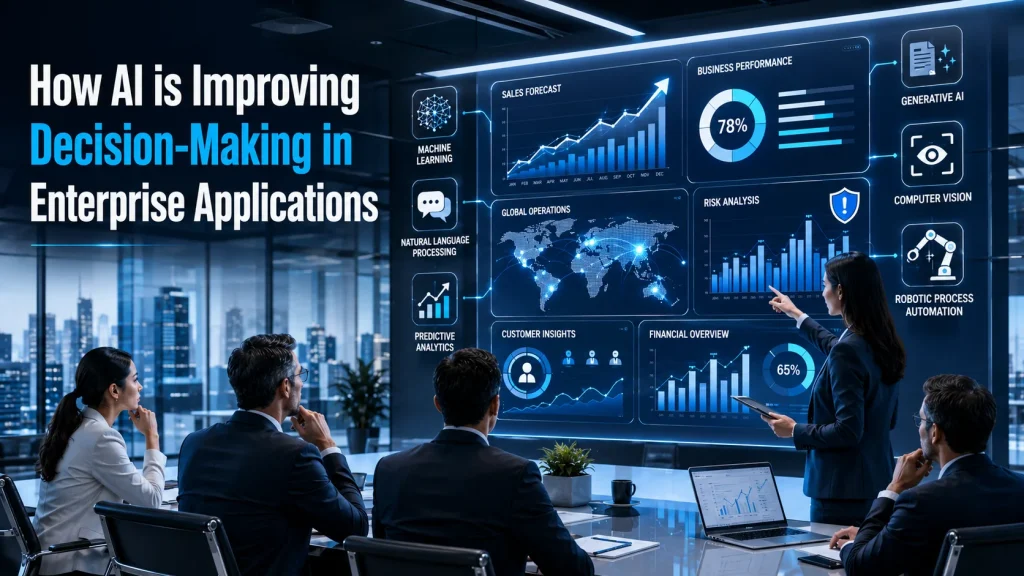
Many modern enterprises today are relying on AI-driven technologies to process and manage their huge volume of business data. Not only does this help make their decision-making faster, but it also helps in making smarter final calls.
This is one of the biggest reasons why leaders are taking the guidance of an AI development company that excels in its services.
- These experts help create a roadmap in which AI can be implemented so that operations can be improved along with decision-making.
- Furthermore, this partnership is also fruitful for implementing automation in workflows.
- In fact, this is true for all the functions of an enterprise, from customer behavior to finance to supply chain optimization and more.
Overall, AI-driven apps are changing how modern businesses operate and scale. This is why opting for them smartly is a practical decision leading towards organizational success. That being said, this guide explores how AI is contributing to enterprise decision-making, thereby helping teams improve their business outcomes at large.
Understanding AI in Enterprise Applications
Leaders are today discussing AI with their peers, but really, why is this change taking over across most business meetings?
In the context of enterprise apps, teams’ expectations have changed. Traditionally, these apps were simply designed to manage routine business operations, which included resolving customer issues, managing finance, inventory, and communication, and more. One important function here was also storing and organizing business data, which earlier required experts to manually analyze and process data so that it could be structured and stored.
In the present day, AI is changing this work model completely. Enterprise-wide apps, driven by AI, are smart enough to analyze data patterns, predict outcomes, automate processes, and generate actionable insights in real time. So, in this way, they are becoming more intelligent. Furthermore, they are securely built to store data and keep it safe, too.
That being said, AI is changing various work models in functions, including:
- Customer behavior analysis,
- Identifying financial risks,
- Automating support operations,
- Optimizing supply chains, and
- Improving workforce planning.
As a result, organizations can plan their workflows more efficiently, which helps them respond to the market faster. What’s more, it improves efficiency and decision-making, too. This is why AI is the core capability in organizations today.
Key AI Technologies Powering Enterprise Decision-Making
Undoubtedly, modern enterprise applications rely on multiple AI technologies to deliver better outcomes. And each technology plays a specific role in the same.
That being said, let us understand these technologies more clearly in the table below:
| AI Technologies | Role in Enterprise Applications | Common Business Use Cases |
|---|---|---|
| Machine Learning (ML) | Enables systems to learn from historical data and improve predictions over time | Best for fraud detection and demand forecasting systems |
| Natural Language Processing (NLP) | Helps applications understand queries, process them, and respond in a human language | Highly suited for AI chatbots and virtual assistants |
| Predictive Analytics | Uses historical and real-time data to accurately forecast future trends | Best for sales forecasting and risk assessment systems |
| Generative AI | Helps curate unique content by using intelligent AI models | Suitable for content generation and enterprise knowledge assistants |
| Computer Vision | Allows systems to smartly process and interpret visual data such as images and videos | More suited for quality inspection checks and medical imaging processes |
| Robotic Process Automation (RPA) | Enables automation to manage repetitive processes | Best for simple data entry systems and invoice processing that are routinely managed |
So, we can say that enterprise systems are increasingly becoming data-driven and smarter, thanks to these technologies mentioned in the table.
How AI is Transforming the Operations and Decision-Making in Enterprise Applications?
Well, AI has helped improve enterprise apps drastically. They have moved from being simple traditional apps to intelligent software programs that can manage a lot on their own.
With this in mind, let us understand how AI is bringing this change, helping companies reduce their delays and inefficiencies, while also improving their agility and output.
1. Real-Time Data Analysis
Data analytics is an emerging form of intelligence where AI can help systems identify patterns and analyze a huge volume of business data in real time. This helps companies make decisions faster. What’s more, it helps in making boardroom discussions more focused on actual data insights, which improves the overall strategies in a company.
A simple example of this is teams using data analytics to understand their customer behavior and improve their marketing campaigns accordingly.
2. Predictive Analytics and Forecasting
Furthermore, AI-system-driven software programs use predictive analytics to identify trends and predict future outcomes. Overall, this helps teams to improve their demand forecasting plan, which also helps in budgeting and making product-related strategies.
In this way, teams can analyze the market better and plan to meet their demand shift while avoiding unnecessary risks in this planning process.
3. Intelligent Business Automation
In essence, one of the main ways in which enterprise apps are changing is that they are becoming automated. This helps save professionals’ time and energy in completing repetitive, routine tasks such as data entry, workflow approvals, customer support tasks, and even report generation.
Mainly, for teams, this improves their speed and allows them to focus on more strategic thinking.
4. Pattern Recognition and Risk Identification
Many AI systems can unravel hidden anomalies by analyzing a huge volume of business data in seconds. This helps identify the system’s loopholes where urgent manual intervention is needed.
What’s more, this has practically helped improve fraud detection, cybersecurity monitoring, compliance management, and much more in modern companies today.
5. Personalized Business Insights
Additionally, AI has also significantly contributed to enterprise apps by helping them understand live data insights and providing personalized recommendations. This can be based on aspects like customer data, their behavior patterns, and even market changes.
Largely, these insights not only help companies in improving their strategies but also help in enhancing the output and decision-making accuracy across teams.
Thus, for teams, AI adoption in enterprise apps is a gradual shift towards better workflows and improved decision-making being done at scale. However, many times, it can be a tricky change. This is where consulting an AI development company can help. These professionals can help create a roadmap through which AI can be rightly adopted, thereby assuring results and long-term support. Moreover, this is also why many leaders today rely on these experts before investing in this emerging technology.
Business Benefits of AI-Driven Decision-Making
As we closely explore how AI is transforming enterprise operations and decision-making, this section highlights how it practically adds value to businesses.
That being said, here are some of the key benefits that teams can gain if they adopt AI-driven decision-making.
1. Improved Operational Efficiency
As we know, AI-driven apps can work efficiently using automation, which helps teams align their workflows better. This way, they can focus on strategic tasks while AI can take care of the manual tasks, where occasional manual intervention might be needed.
2. Better Strategic Planning
Thanks to analytics and predictive analytics, businesses can identify trends and forecast outcomes more accurately. Mainly, this helps leaders to plan their future strategies while making more informed and impactful decisions.
3. Enhanced Customer Experience
Certainly, AI can also help manage customer support activities very efficiently. This can be done through the use of chatbots, virtual assistants, and other tools that can interact with the user, understand their queries, and then provide meaningful responses to them 24/7.
4. Competitive Advantage
Many leaders today rely on the guidance of AI development experts who can help improve their apps by integrating AI. This significantly helps improve their agility while helping them adapt better to market changes. This way, companies can perform more effectively, as compared to their competitors.
Final Thoughts
Wrapping up, we can say that AI is a leading technology partner for companies today because of all it can perform and provide. Integrating this technology is no longer an option, but it is a necessity. This helps teams in taking strategic business decisions at scale and helps in automating workflows too.
Moreover, as the workforce evolves, AI can help them adapt faster and plan resources more efficiently. So, the real value of AI in enterprise applications can be understood if you rightly plan this transition and focus on making the right decisions with great speed and accuracy in the market, because integrating AI needs immense planning and management in the long run.

Author Bio: Riley is a technology content writer exploring dynamic subjects like AI, enterprise software, and digital transformation. Specializing in AI, she helps businesses understand complex technologies so that leaders can improve their modern AI-driven innovation strategies and achieve a better ROI.