
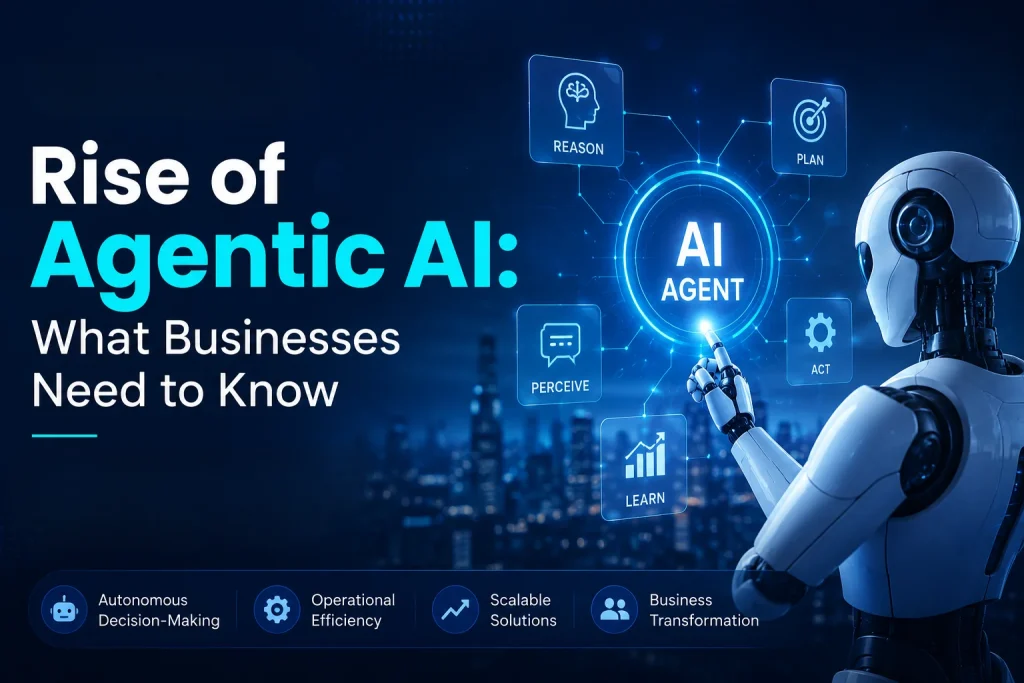
Artificial intelligence is moving into a new phase. For years, enterprises have been using AI to automate repetitive tasks, analyze data and enhance customer experiences. But a new generation of intelligent systems is emerging, systems that do more than respond to commands. The technology, called Agentic AI, is changing how organizations function, allowing AI systems to plan, reason, decide and execute tasks with minimal human intervention.
As an organization increases its digital transformation efforts, it’s increasingly important to understand the capabilities and implications of Agentic AI. The early movers will be able to unlock new levels of productivity, efficiency and innovation.
What’s Agentic AI?
Mostly traditional AI systems are reactive. They respond to queries, fulfill prompts, generate content, or perform specific functions on user commands. These systems are powerful but typically require constant human supervision.
On the other hand, agentic AI introduces the concept of “agency”. AI Agents can understand a higher-level goal, make a plan, perform actions, assess the results and modify the procedure based on the assessment, so they don’t need to wait for instructions at each step. For example, rather than asking an AI tool to complete individual tasks one by one, a business could assign a goal such as-
- Answer customer complaints quickly
- Streamline your inventory management
- Set appointments with qualified prospects for sales meetings
- Pinpoint bottlenecks in operations
This enables the AI agent to find actions to take, communicate with software systems, collect relevant data and act on its own.
That ability to act independently is what makes Agentic AI one of the most important AI advances today.
Agentic AI vs Traditional AI
The differences between traditional AI systems and agentic systems are significant.
| Feature | Traditional AI | Agentic AI |
|---|---|---|
| Primary Function | Responds to prompts | Pursues goals autonomously |
| Decision Making | Limited | Dynamic and adaptive |
| Task Execution | Single-step tasks | Multi-step workflows |
| External Tool Usage | Minimal | Extensive integration with APIs and software |
| Human Involvement | Continuous guidance required | Minimal supervision required |
| Learning Approach | Reactive | Goal-oriented and proactive |
This shift from reactive support to proactive action is creating completely new opportunities for businesses.
Why Companies Are Paying Attention
Firms are always trying to look for ways to be more efficient and reduce costs. Agentic artificial intelligence fulfills these two purposes by automating procedures which have usually been done by humans.
While automated systems work according to pre-set guidelines, AI systems work independently in response to environmental changes and decision-making based on real-time data processing.
As a result, companies receive-
- Faster decision making
- Reduced running costs
- Increased productivity
- Improved scalability
- Better customer experiences
- Better resource utilization
These benefits are fueling increased investment in enterprise AI solutions across industries.
Real-World Business Applications of Agentic AI
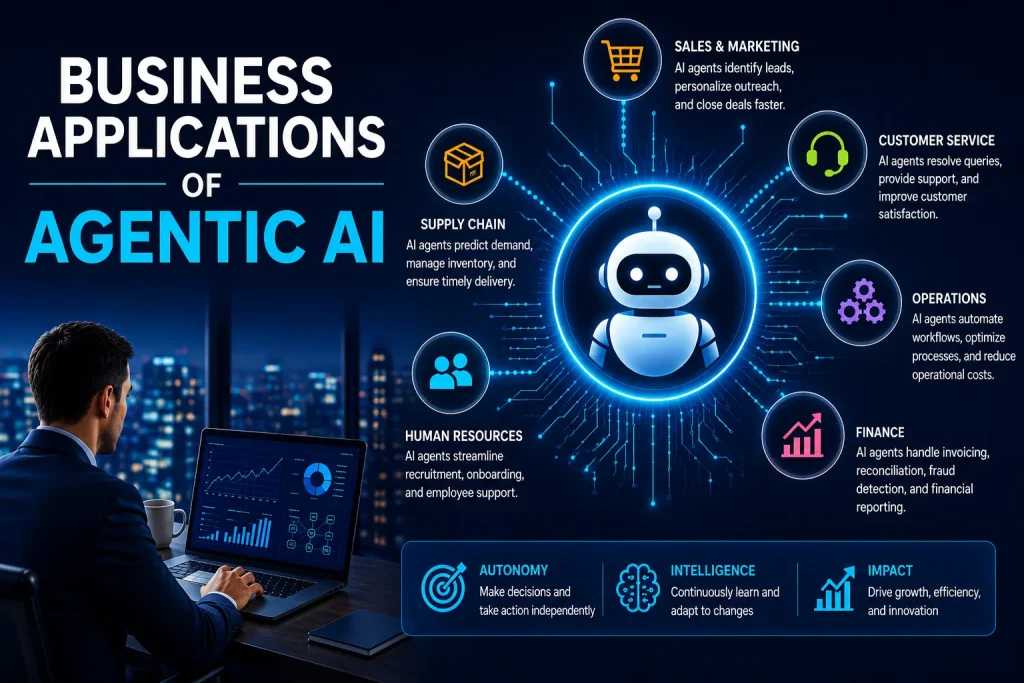
1. Sales and Marketing Automation
Sales professionals spend a lot of time investigating potential customers, qualifying leads and carrying out marketing campaigns.
Agentic AI can act as an intelligent sales assistant by-
- Identifying potential customers
- Collecting relevant business information
- Personalizing communication
- Setting up meetings
- Following up automatically
This frees up sales professionals to focus on building relationships and closing deals, rather than administrative tasks.
2. Customer Support Operations
Another area where Agentic AI is having a huge impact is in customer service.
AI agents can do more than just answer questions. They can-
- Refund processing
- Change appointment times
- Customer information update
- Fix service problems
- Coordinate across multiple systems
Complicated cases still are passed up to human representatives when empathy or specialized judgment is needed.
3. Production and Operations
Agentic AI is increasingly being adopted by manufacturing organizations to boost operational efficiency.
AI agents are able to-
- Monitor equipment performance
- Predict maintenance needs
- Find the anomalies
- Optimize production schedules
- Control inventory levels
This proactive approach assists to diminish downtime and enhance overall productivity.
4. Supply Chain Management
Supply chains generate huge amounts of data from suppliers, logistics providers, warehouses and customers.
Agentic AI can constantly analyze this information to-
- Find bottlenecks
- Forecasted disruptions
- Suggest corrective actions
- Optimize inventory distribution
The end result is a stronger, more efficient supply chain.
The Growing Importance of AI and ML Services
With Agentic AI becoming ever more sophisticated, many organizations are looking to specialized AI and ML services to speed up adoption.
Implementation of autonomous AI systems needs expertise in-
- Machine Learning Models
- Data Engineering
- API Integration
- Workflow Automation
- Governance Frameworks
- Security and Compliance
Skilled AI teams can assist firms detect suitable use cases, create scalable architectures, and assure responsible deployment.
Final Thoughts
The rise of Agentic AI is a major advance in artificial intelligence. They are assisting organizations operate quicker, more efficiently and more intelligently by going beyond simple task automation and enabling autonomous decision-making.
The right AI and ML services, clear operational frameworks and scalable enterprise AI solutions will provide businesses the best chance to take advantage of this emerging technology. With autonomous AI capabilities evolving, Agentic AI is likely to be a key component of digital transformation strategies across industries, helping organizations tap into new opportunities for growth and innovation.