
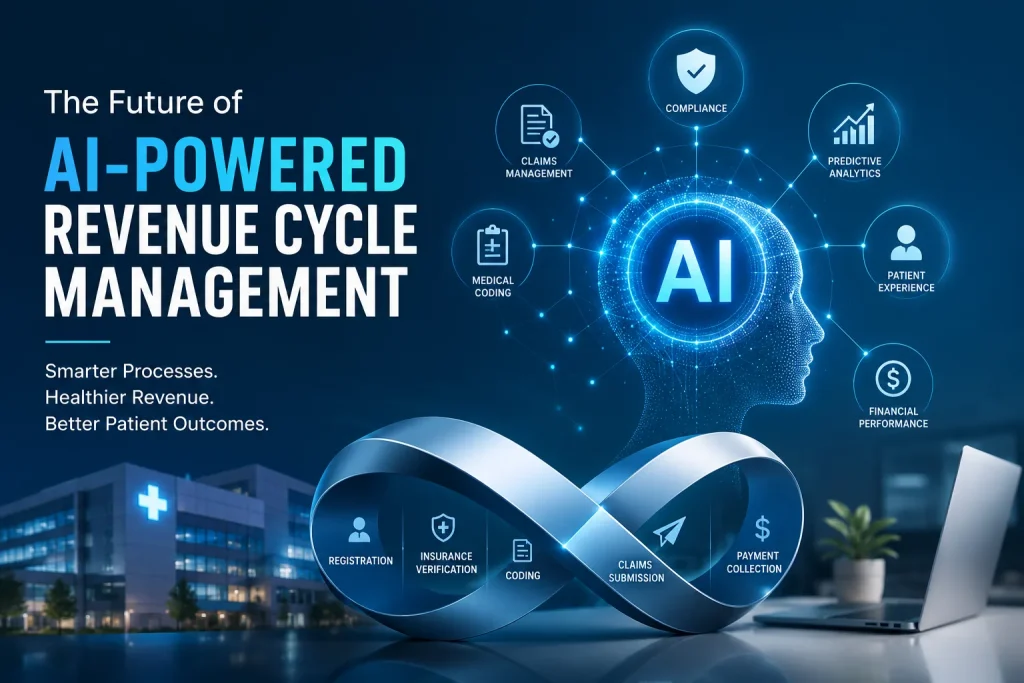
Hospitals and clinics are constantly challenged to enhance their financial results and provide outstanding service to patients. Operational expenses, increasingly onerous insurance requirements and the increasing administrative demands are all a major concern for providers regarding efficient financial management. An industry that is undergoing much change is Revenue Cycle Management (RCM).
Historically, revenue cycle processes have been dependent on manual workflows where employees are responsible for insurance verification, coding, claims submission, denial management and collection. These manual methods may be somewhat effective, but they also can result in lost revenue opportunities, delays, and inaccuracies.
Artificial Intelligence (AI) is transforming that scenario. AI is contributing to more intelligent and effective billing processes in healthcare, by automating repetitive tasks, analysing financial data for patterns, and delivering predictive insights. Overall, AI-driven revenue cycle management is poised to become an integral part of healthcare technology, shaping how healthcare organizations manage their finances in the future.
Understanding AI-Powered Revenue Cycle Management
Revenue Cycle Management is the financial process which records the patient’s journey of care, from the beginning of scheduling and registration, to the end of the collection of payment. Each step in the revenue cycle has the potential to affect the financial well-being of a healthcare organization.
AI tools are now part of revenue cycle management systems to boost efficiency, streamline administrative tasks and enhance reimbursement accuracy. These smart solutions are able to analyze enormous amounts of data at a much quicker rate than other systems, and with fewer chances for human error.
Many revenue cycle solutions based on AI can assist with:
- Insurance eligibility verification
- Medical coding assistance
- Claims management
- Denial prediction
- Payment forecasting
- Patient billing
- Financial reporting
The more the healthcare scientists advance their research on AI, the more accurate and useful they can be for healthcare providers.
Why Traditional Revenue Cycle Management Faces Challenges
Despite all the developments in technology, many healthcare organizations still have a traditional, and in some cases, semi-automated billing approach.
Common challenges include:
- Lots of claims declined for coverage reasons
- Coding errors
- Delayed reimbursements
- Administrative inefficiencies
- Compliance complexities
- Rising labor costs
Manual processes can involve a lot of staff and lead to mistakes and delays in the financial procedures.
Such challenges have led to a significant need for intelligent solutions that can help to streamline operations and enhance revenue performance.
AI-Powered Automation Will Transform Administrative Tasks
Among the standout advantages of AI is its automation feature.
Healthcare billing teams invest a lot of hours on repetitive operations like:
- Data entry
- Insurance verification
- Claim status tracking
- Payment posting
- Documentation reviews
Many of these can be automated with AI, which could alleviate the workload of manual tasks and enable employees to concentrate on more value-added tasks.
There are a number of benefits to be gained from automation:
Increased Accuracy
AI systems minimize human mistakes that can occur during repetitive tasks.
Faster Processing
Claims and billing information can be processed in a much shorter period of time.
Lower Administrative Costs
Automation reduces the amount of manual tasks and costs of operations.
Healthcare organizations are increasingly looking for ways to become more efficient, and automation will play a crucial role in the uptake of AI.
Predictive Analytics Will Reduce Claim Denials
One of the biggest revenue loss areas in health care are claim denials.
Denial risks can be detected by implementing AI-powered predictive analytics, even before a claim is made.
AI can learn from past billing information, payer behaviors, and coding trends to help predict future billing behaviors and leverage that insight to make more accurate predictions:
- Flag high-risk claims
- Detect documentation gaps
- Identify coding inconsistencies
- Recommend corrective actions
When it comes to denials, providers can prevent them, instead of reacting to them once they happen.
The new approach will move from denial management to denial prevention, with many believing it will greatly impact the bottom line.
AI Will Improve Medical Coding Accuracy
Correctly coding is crucial to reimbursement success.
There are lots of complicated coding systems healthcare providers need to conform to:
- ICD-10
- CPT
- HCPCS
Denial of claims, underpayment or compliance risks are frequently caused by coding inaccuracies.
AI tools for coding can analyze clinical documentation and suggest relevant coding.
Benefits include:
- Improved coding consistency
- Faster coding workflows
- Reduced claim rejections
- Enhanced compliance
With the continued advancements of NLP, AI coding will become even more complex.
Enhanced Financial Forecasting Through AI
In the healthcare industry, forecasting is a crucial component of the management process.
Commonly used forecasting techniques are based on past experience and manual analysis.
AI can improve forecasting based on analyzing:
- Reimbursement patterns
- Payer behavior
- Seasonal fluctuations
- Patient volume trends
- Collection performance
The information gained from these will help administrators make decisions about:
- Budget planning
- Staffing requirements
- Technology investments
- Practice expansion
Improved forecasting leads to better financial strength and strategy.
AI Will Personalize Patient Financial Experiences
Patients today demand hassle-free and clear billing procedures.
AI can enhance the financial engagement of patients by offering:
Personalized Payment Plans
The AI analyzes financial data and offers appropriate payment alternatives.
Automated Communication
Remind patients of balances and payments due.
Cost Transparency
Using AI to estimate costs helps patients to grasp what to expect before undergoing treatment.
Virtual Support
Billings questions can be answered in real-time with the help of chatbots and virtual assistants.
These enhancements lead to greater patient satisfaction and boosts in collection of payments.
Strengthening Compliance and Risk Management
There are many regulations that healthcare organizations have to adhere to, such as HIPAA policies and those set by payers.
AI can aid compliance efforts in the following ways:
- Monitoring billing activities
- Identifying irregular patterns
- Identifying issues of possible fraud
- Auditing coding accuracy
- Ensuring documentation completeness
Automated compliance monitoring minimizes the risk of penalties and issues related to an audit.
With the climb of regulatory standards, AI-powered compliance instruments will turn into much more valuable. The importance of AI-powered compliance tools will increase as regulatory standards become more complex.
Integration with Emerging Healthcare Technologies
Future revenue cycle systems will be created to be seamlessly integrated with other healthcare technologies, all powered by AI.
Examples include:
- The proper use of Electronic Health Records (EHRs)
- Practice Management Systems
- Telehealth Platforms
- Patient Portals
- Healthcare Analytics Tools
Use of integrated ecosystems enables data sharing and removes information silos.
The connectivity enables healthcare organisations to run their financial affairs more effectively and boost patient experiences.
Challenges to AI Adoption
While the potential of AI is great, there are challenges to implementing it.
Healthcare firms could be at risk of:
- Initial implementation costs
- Data quality concerns
- Staff training requirements
- Cybersecurity risks
- Regulatory considerations
For the adoption to be successful, it is essential that there is proper planning, leadership and investment in the technology infrastructure.
With the increasing accessibility of AI solutions, however, these obstacles are likely to diminish over time.
The Long-Term Future of AI in Revenue Cycle Management
The future of RCM will most likely feature increasingly intelligent systems which can make real-time decisions.
There are other potential future innovations, such as:
- Autonomous claims processing
- Real-time denial prevention
- Predictive reimbursement optimization
- Advanced fraud detection
- Financial strategies using AI
AI is not about to supplant human expertise but is designed to complement it and help health care workers to concentrate on strategic priorities.
Companies that adopt these technologies first could stand to benefit from a lot of financial gains and operational efficiency.
FAQs
What is AI-powered revenue cycle management?
AI-driven revenue cycle management leverages artificial intelligence to streamline revenue cycle management, enhance claim accuracy, minimize claim denials, and boost financial performance.
What are the ways AI helps in the reduction of claim denials?
AI can sift through past data and uncover risk factors, in advance of claims, so billing teams can fix issues before they arise.
Could AI help to ensure medical coding accuracy?
Yes. AI coding tools analyse medical records to suggest precise billing codes, minimising inaccuracies and claim denials.
So, is AI taking the place of medical billing professionals?
No, AI can assist billing professionals in automating mundane tasks to free up time for them to attend to more complex and strategic ones.
What are the key advantages of an AI solution in revenue cycle management (RCM)?
The advantages are increased efficiency, decreased denials, better coding accuracy, increased compliance, better forecasting and increased revenue collection.
Conclusion
The future of healthcare financial management is changing with the inclusion of Artificial Intelligence. AI-driven revenue cycle management is making healthcare organizations more efficient and profitable with its automation features, coding accuracy, prediction of claim denials, and better patient financial experiences.
With the ever-increasing adoption of data-driven healthcare, AI will become a pivotal part of revenue cycle management optimization and strategic decision-making. By investing in intelligent revenue management technologies today, organizations can be better equipped to face future challenges and utilise new opportunities.
Revenue cycle management is more than just digital it’s intelligent, predictive and AI-driven.