
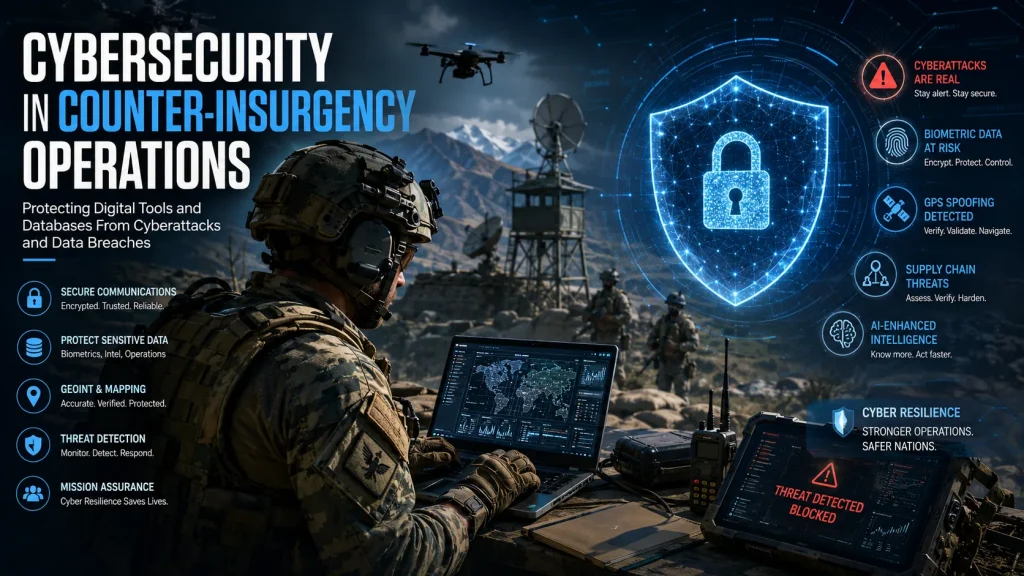
When we picture counter-insurgency (COIN) operations, we often think of images around tactical gear, field outposts, and rugged terrain. However, in today’s hyper-connected world, the primary battleground has quietly shifted from merely physical to a combination of ‘cyber-physical’. Modern counter-insurgency is no longer only about boots on the ground; it also runs on data such as biometric databases, encrypted tactical communications, geospatial mapping, intelligence-sharing portals. And in the scenarios where these digital systems fall victim to cyberattacks or data breaches, the real-world consequences include compromised national security, exposed sensitive intelligence, and human lives at direct risk. Which brings us to realize that cybersecurity is now one of the core elements to consider during counter insurgency operations. Let’s understand more about it.
The Role of Cybersecurity in Counter-Insurgency Operations
Information is the core of modern and digital counter-insurgency. Defense forces rely on secure digital infrastructure to track insurgent networks, manage border checkpoints, coordinate rapid response teams, and distribute aid. If an insurgent group or state-sponsored actor breaches these systems, they gain tactical awareness and can damage these very systems designed to operate against them.
The impact arising due to a breach includes compromised informant databases exposing field operatives, leaked troop movements jeopardize active missions, and tampered geospatial data throws critical targeted operations completely off course.
Real-World Case Study 1:
The UK Ministry of Defence Breach
To understand how high-stakes cyberattacks play out, consider the major cyber incident involving the UK Ministry of Defence payroll system. In May 2024, foreign state-aligned cyber actors compromised a third-party payroll management system utilized by the UK MoD. The attackers accessed personal, financial, and banking details of approximately 270,000 active-duty military members and veterans.
The key area to focus here is understanding of how advanced cyber actors rarely attack heavily fortified military databases head-on. Instead, they exploit weaker third-party software vendors and service providers resulting in supply chain attacks to elevate administrative privileges and gain lateral entry.
Real-World Case Study 2:
The Afghan Biometric Database Fallout: Physical-to-Digital Compromise
During the August 2021 withdrawal from Afghanistan, abandoned military biometric tools including handheld scanners and central databases fell directly into Taliban hands. Storing sensitive iris scans, fingerprints, and home addresses for hundreds of thousands of local allies, these unencrypted systems lacked remote-wipe capabilities. As a result, tools originally built to identify insurgents were inverted into automated targeting lists against former translators and soldiers. This tells us the importance of addressing cybersecurity as sensitive data collection without encrypted storage and wiping capacity turns protective intelligence into an automated weapon if physical control of hardware is lost.
Risky Technical Attack Vectors to Monitor
As counter-insurgency increasingly adapts to digital means as a part of their infrastructure, adversaries deploy sophisticated methods to disrupt operations on the edge, for example:
- GPS and Geospatial Spoofing: Electronic warfare units and cyber operators that emit false satellite signals or altering GPS coordinates on maps; tricking autonomous drones, logistical convoys, and ground troops into misidentifying key locations.
- Device Infiltration: Modern soldiers carry mobile tablets, body-worn cameras, and digital radios. Because these devices operate on the periphery of secure networks, an infected or captured device can serve as an entry point for infostealers designed to extract live situational data.
- AI-Enhanced Reconnaissance: Adversaries use AI algorithms to scrape public social media posts, satellite imagery, and leaked dark web databases. By correlating these disparate data streams into contextual intelligence, automated tools can now map military base layouts, supply routes, and personnel rotations with high precision.
How Military Cyber Threats Spill Over to Everyday Citizens
When insurgent groups fund zero-day exploits, sophisticated phishing frameworks, and advanced infostealers for intelligence gathering, these tools inevitably leak or trickle down to general cybercriminals.
The threat pipeline often includes:
- State/Military espionage tools developed
- That being leaked or repurposed on the dark web
- Deployed for commercial cybercrime operations by different threat actors of varying sophistication
These methods, originally designed for state-level espionage such as AI-driven social engineering and automated credential-stuffing, are routinely repurposed by criminal networks to drain bank accounts, hijack personal identities, and target everyday citizens, making it risky and impacting civilians of the targeted country or region.
Actionable Cyber Hygiene for Common Citizens
To maintain strong cyber hygiene, individuals should follow one or combination of threat preventive strategies:
- Use app- or hardware-based 2FA (like YubiKeys or passkeys instead of SMS),
- Maintain strict password hygiene with an encrypted password manager
- Audit their digital footprint by hiding real-time locations to block OSINT attacks.
Additionally, users must mitigate third-party risks by avoiding unverified apps, browser extensions, and pirated software, while keeping systems secure by automating patch management across all devices to patch vulnerabilities immediately.
The Role of Counter-Insurgency in a Digital-First World
Since we are living in the digital era, counter-insurgency is inherently a military, political, and intelligence-driven endeavor designed to defeat irregular armed combatants. However, COIN also plays a crucial role in maintaining digital order and territorial integrity. Let us know that how:
- Modern military units depend on software tools to map insurgent networks, analyze communication logs, and trace illicit funding streams.
- Insurgents frequently leverage cyberspace for propaganda, radicalization, and encrypted communication. Military COIN efforts must proactively neutralize these digital lines of communication by taking down the infrastructure and facilities through social media support.
- Insurgents increasingly target civilian digital systems such as power grids, telecommunications, and financial networks to destabilize government authority. COIN forces must act as digital shields for these assets by securing and monitoring the networks for any anomalous activity.
How to Strengthen Counter-Insurgency Operations Through Cyber Resilience
Strengthening COIN operations requires fusing traditional kinetic tactics with robust cyber hygiene and advanced defensive capabilities. This can include embedding dedicated cybersecurity specialists directly into forward-deployed tactical units. This ensures immediate incident response when digital field tools face cyber threats. They can also assist in isolating critical databases containing high-risk intelligence from other military networks.
Cyber troops involved in COIN operations can regularly simulate realistic cyberattacks against C2 systems to uncover vulnerabilities before insurgent forces or state-sponsored allies exploit them. They can also assist the non-technical squad through rigorous training against common cyber threats and human errors that can lead to accidental data leaks.
The Critical Impact of Digital Vulnerabilities on Counter-Insurgency Operations
It is also important to consider that the digital space comes with its own set of threats that constantly scan vulnerable premises on the internet. Some of the threat scenarios include:
- Consolidating intelligence into centralized repositories means a single successful network breach can compromise entire operational networks and expose high-value military assets.
- Insurgents or allied cyber groups can inject falsified information into databases in case of existing vulnerabilities making the entire analysis susceptible to data poisoning.
- Sharing databases with external civilian agencies or international allies exposes systems to third-party vulnerabilities, as partners or vendors can often operate with varying or weaker cybersecurity standards.
Final Thoughts
Cybersecurity in counter-insurgency is a fundamental necessity of the modern era where digital safety is collective security. The digital tools designed to protect troops, secure national borders, and coordinate field intelligence rely on the exact same structural protocols that protect civilian infrastructure, workplace networks, and personal devices. Therefore, using enhanced security measures while leveraging the maximum advantage of digital tools to work against insurgents, both through on-field and off-field, is not just a requirement but a mandate.
Whether safeguarding a tactical military database or securing a family email account, continuous vigilance, robust authentication, and proactive system maintenance remain our most reliable defenses against modern cyber threats.

Author Bio: This article has been written by Rishika Desai, a cybersecurity researcher and threat intelligence professional currently working as a Threat Researcher at BforeAI. She also founded RishSec, a creator-led cybersecurity training and mentoring service that helps aspiring security professionals build practical skills and advance their careers.
Rishika is a B.Tech Computer Engineering graduate from Vishwakarma Institute of Information Technology (VIIT), Pune, graduating with a 9.57 CGPA. She has spoken at international cybersecurity conferences in Singapore and Malaysia, was honored with the Rising Star of the Year award by BSides Bangalore, and was recognized among the Top 100 Cybersecurity Influencers by the CF100 Club CyberFrat.
You can follow Rishika on X (Twitter) at @ich_rish99 and on Instagram at @rish.sec.