
Introduction
Manufacturing has evolved dramatically over the past few decades. What was once an industry driven primarily by manual labor and mechanical equipment is now powered by digital systems, automation, and intelligent technologies. Today’s manufacturers operate in a highly competitive environment where efficiency, quality, and adaptability can have a direct impact on long-term success.
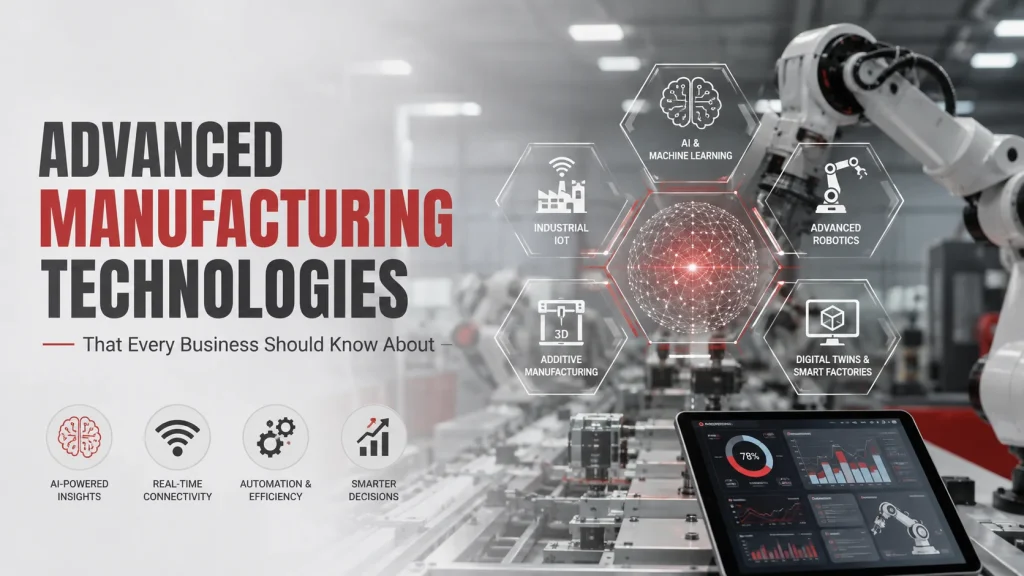
As technology continues to advance, businesses of all sizes are finding new opportunities to improve production processes and reduce operational costs. From artificial intelligence to connected machinery, innovative manufacturing solutions are helping organizations become more productive and responsive to changing market demands. Understanding these technologies is no longer reserved for large corporations. Any business involved in manufacturing can benefit from learning how these tools are shaping the future of the industry.
Artificial Intelligence and Machine Learning
Artificial intelligence (AI) is quickly becoming one of the most influential technologies in manufacturing. AI systems can process vast amounts of operational data and identify patterns that would be difficult for humans to recognize. This allows manufacturers to make faster and more informed decisions across their operations.
Machine learning, a subset of AI, continuously improves its performance by analyzing historical and real-time data. Manufacturers can use machine learning algorithms to predict equipment failures, optimize production schedules, and improve quality control processes. These capabilities help reduce downtime while increasing overall operational efficiency.
AI can also assist with demand forecasting and inventory management. By analyzing customer behavior, historical sales data, and market trends, businesses can make more accurate predictions regarding future production needs. This helps minimize waste, lower inventory costs, and improve customer satisfaction.
As AI technologies become more accessible, even small and mid-sized manufacturers can leverage intelligent systems to gain a competitive advantage.
Industrial Internet of Things (IIoT)
The Industrial Internet of Things, often referred to as IIoT, connects machinery, sensors, and devices into a unified network that continuously gathers and shares information. This connectivity provides manufacturers with unprecedented visibility into their operations.
IIoT sensors can monitor equipment performance, temperature, energy consumption, production output, and numerous other variables. The collected information is transmitted to centralized platforms where managers can analyze performance and identify areas for improvement.
One practical example involves monitoring steam systems used in many manufacturing facilities. Organizations often rely on useful steam traps to help maintain efficiency and prevent energy waste. By integrating connected monitoring technologies, manufacturers can more effectively track system performance and identify maintenance needs before small issues become significant operational problems.
The ability to collect and analyze real-time data enables businesses to make proactive decisions, improve productivity, and maintain greater control over their facilities.
Advanced Robotics and Automation
Robotics technology has progressed far beyond traditional assembly-line machines. Modern industrial robots are highly adaptable and capable of performing a wide range of tasks with exceptional precision and consistency.
Automated systems can handle repetitive duties such as welding, packaging, sorting, material handling, and assembly operations. By automating these processes, manufacturers can increase production speed while reducing the risk of human error.
Collaborative robots, commonly known as cobots, represent another significant advancement. Unlike traditional industrial robots that often operate in isolated areas, cobots are designed to work safely alongside human employees. They can assist workers with physically demanding tasks while allowing staff to focus on higher-value activities that require critical thinking and creativity.
The combination of robotics and automation helps businesses improve quality, reduce labor-related inefficiencies, and maintain consistent production standards.
Additive Manufacturing and 3D Printing
Additive manufacturing, commonly known as 3D printing, is transforming how products and components are designed and produced. Instead of removing material from a larger piece, additive manufacturing builds objects layer by layer using digital designs.
This technology offers several advantages, particularly when producing prototypes, custom parts, and low-volume manufacturing runs. Designers can quickly test new concepts and make modifications without investing in expensive tooling or lengthy production processes.
Manufacturers also benefit from greater flexibility. Complex geometries that may be difficult or impossible to create using traditional methods can often be produced with additive manufacturing technologies. This opens new possibilities for innovation and product development.
As material options continue to expand and equipment becomes more advanced, 3D printing is moving beyond prototyping and becoming an increasingly practical solution for full-scale production in various industries.
Digital Twins and Smart Factory Systems
One of the most exciting developments in modern manufacturing is the rise of digital twin technology. A digital twin is a virtual representation of a physical asset, machine, process, or facility. By continuously receiving data from real-world systems, the digital twin can provide valuable insights into performance and operational behavior.
Manufacturers use digital twins to simulate different scenarios, evaluate process changes, and identify potential issues before implementing modifications in actual production environments. This reduces risk and supports better decision-making.
Digital twins are often a key component of smart factory initiatives. In a smart factory, connected equipment, automation systems, AI platforms, and data analytics tools work together to create a highly efficient and responsive production environment.
These integrated systems allow manufacturers to optimize operations in real time, improve resource allocation, and increase overall agility. As businesses seek greater efficiency and resilience, smart factory technologies are becoming increasingly important.
Conclusion
Advanced manufacturing technologies are redefining what is possible in today’s industrial landscape. Artificial intelligence, IIoT networks, robotics, additive manufacturing, and digital twin systems are helping organizations improve productivity, enhance quality, reduce costs, and make smarter decisions.
Businesses that understand and embrace these innovations position themselves for long-term success in an increasingly competitive marketplace. While the pace of technological change continues to accelerate, manufacturers that invest in learning and adopting modern solutions will be better prepared to meet future challenges and capitalize on new opportunities.