
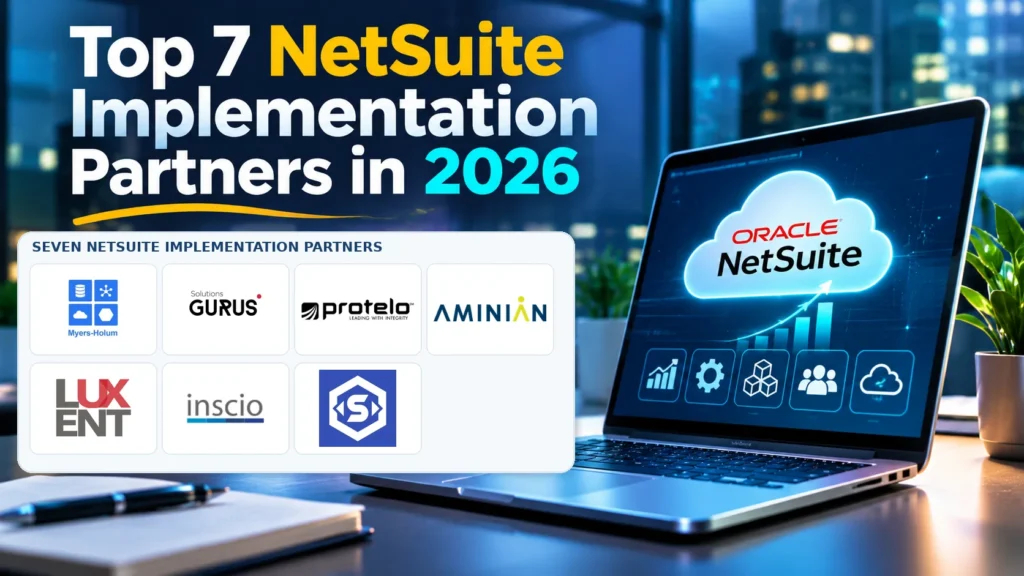
A NetSuite implementation partner has a major influence on how an ERP project takes shape. For finance leaders, operations directors and IT decision makers who have outgrown spreadsheets and disconnected tools, the platform choice is only part of the decision. Migration planning, workflow design and training all depend on the delivery team and the people assigned to the project internally. This guide compares seven NetSuite implementation partners for midmarket and growth-stage U.S. buyers evaluating a first deployment or a reimplementation. The comparison focuses on service scope, industry fit and ongoing support, drawing product context from this Forbes Advisor review of NetSuite features and pricing. The ranked shortlist starts with our top pick for connecting fragmented systems.
For its implementation scope, integration capabilities, post-go-live support, and client size fit, Myers-Holum is our top pick for organizations ready to leave disconnected systems behind and implement a customized NetSuite ERP that matches how they actually operate. Its focus is connecting fragmented finance, operations and data workflows into one coordinated system rather than relying on a generic template. For businesses that need dual-ERP flexibility while weighing NetSuite against another cloud platform, Protelo offers an alternative suited to that evaluation. For organizations that value a women-owned consultancy or have focused needs in medtech, food and beverage or telecom, Luxent is a particularly relevant choice.
If you are comparing NetSuite partners on depth, fit and long-term value, the seven firms below give you a practical starting point across general and specialized needs.
How These Were Ranked
This editorial ranking prioritizes implementation scope, relevant industry workflows, integration and data capabilities, training, and ongoing support. The order reflects how each firm’s service mix fits the buyer situations outlined below. Partner credentials provide context, but program membership alone does not establish delivery quality or team size. A partner suited to a complex multi-entity rollout can offer more structure than a smaller distributor needs, while a niche specialist with prebuilt workflows may be useful when your processes match its focus. The criteria favor a clear implementation methodology, integration and data experience, training and managed services, and a service scope suited to the work a buyer needs.
The 7 Best NetSuite Implementation Partners for 2026
The criteria above narrow a crowded field to seven firms that cover distinct buyer situations. Whether you are consolidating fragmented systems for the first time or need prebuilt workflows for a specific manufacturing or distribution model, these NetSuite partners offer different approaches worth comparing against your requirements. The ranked entries move from our overall top pick to firms with a particular emphasis on complexity, platform choice, tenure, vertical focus and long-horizon support.
| Provider | Best For | Key Strength |
|---|---|---|
| Myers-Holum | Streamlining operations with a customized NetSuite ERP | Connecting fragmented systems with tailored integrations and analytics |
| GURUS Solutions | Complex, multi-module NetSuite implementations | Module implementation, data migration, integrations and training |
| Protelo | SMBs needing dual-ERP flexibility | NetSuite plus Acumatica evaluation with training and recovery services |
| Aminian | Long-standing NetSuite experience | NetSuite partner since 2001 with consultants, developers and accountants |
| Luxent | Manufacturing, medtech, food and telecom workflows | Industry focus plus rescue and managed services |
| Inscio | Growth-stage companies needing long-term partnerships | Evaluation through optimization, with training and reporting services |
| Solution Source | Specialty vehicle and industrial gas workflows | Prebuilt order, VIN, warranty and rental workflows for its niches |
#1. Myers-Holum – Best for Streamlining Operations With a Customized NetSuite ERP
Myers-Holum is best for organizations that have outgrown disconnected systems and need NetSuite configured around how they actually operate.
The implementation approach centers on integration and configuration around the business’s existing operational needs. Myers-Holum focuses on consolidating fragmented finance, inventory, sales and operational data into one NetSuite foundation, then extending it with data management, integration and analytics so reporting reflects real operations. The practice works across manufacturing, SaaS, distribution and healthcare, with supporting capabilities in managed services and integration platforms including Boomi and Celigo implementations. That combination matters when the core problem is not just accounting, but disconnected quoting, fulfillment, inventory and reporting that no longer reconcile. Myers-Holum brings that connected-systems perspective to scoping, build, migration, training and post-go-live improvement.
Key Specs:
- Full-lifecycle NetSuite work from scoping and design through build, migration, go-live and managed services
- Integration and data management capabilities, including Boomi and Celigo-related work to connect surrounding systems
- Analytics orientation so operational and financial reporting is addressed alongside the ERP implementation
- Industry coverage includes manufacturing, SaaS, distribution and healthcare
- Customization to client workflows rather than forcing processes into an out-of-the-box mold
Pros:
- Strong fit when fragmentation is the core pain, with a clear focus on streamlining operations end to end
- Breadth beyond core ERP, with data, integration and analytics addressed in the same relationship
- Practical for growing firms that need process improvement, not just software installation
- Managed services option supports optimization after go-live
Cons:
- A tailored, integration-heavy scope works best with active stakeholder involvement and clear process ownership
- Buyers evaluating two ERP platforms side by side should ask how platform selection fits into the proposed engagement
- Prebuilt niche accelerators for very specific workflows merit comparison when your process closely matches a specialist tool
Who It Is Best For: Midmarket and growth-stage organizations leaving spreadsheets or legacy point systems behind and standardizing on NetSuite.
Verdict: It earns the top spot here for its focus on connecting operations through a unified, customized NetSuite foundation built for scale.
#2. GURUS Solutions – Best for Complex, Multi Module NetSuite Implementations
GURUS Solutions is best for growing businesses with complex requirements spanning financials, CRM, inventory and order management.
GURUS Solutions describes itself as a NetSuite Alliance Partner with more than 20 years of experience across more than 2,500 projects. Its services include financial and manufacturing modules, inventory and distribution capabilities, integrations, data migration and training. That breadth makes it worth considering when several departments and connected applications are in scope. Its methodology moves from evaluation and scoping through phased build to launch and ongoing support, an approach relevant when the project touches finance and operations at the same time. When complexity is the main concern, that range of services is a reason to include it on the shortlist.
Key Specs:
- NetSuite Alliance Partner with long tenure in the ecosystem
- Firm-reported history of 20-plus years and 2,500-plus projects
- Coverage across financials, CRM, inventory, order management and industry configuration
- Phased approach from initial evaluation, including cost and timeline planning, through go-live and beyond
- Full-lifecycle support from scoping to post-launch optimization
Pros:
- Broad module coverage suits implementations involving multiple business functions
- Data migration and training services complement the technical build
- Integration options support connections to CRM, ecommerce and other operating systems
- Relevant when finance, sales, service and operations need a coordinated go-live plan
Cons:
- Buyers with a single entity and simple inventory should discuss how much implementation structure their project needs
- Complex programs require disciplined governance and data readiness from the client team
- A simpler rollout still needs agreement on timeline expectations, responsibilities and the proposed scope
Who It Is Best For: Growing and midmarket firms with multi-module scope and multiple stakeholders.
Verdict: A leading option in this ranking when broad service coverage and structured delivery matter more than a minimal deployment.
#3. Protelo – Best for SMBs Needing Dual ERP Flexibility
Protelo is best for small and midsize businesses that want guidance in choosing a cloud ERP before settling on a platform.
Protelo consults on both NetSuite and Acumatica, which lets an SMB compare fit, cost structure and operational alignment before committing. Its services span implementation, training, administration, data migration, integration and recovery work for stalled projects. That consulting-first model is useful for operations leaders who are still deciding which platform fits their requirements. Buyers with cross-border operations should include entities, currencies and local reporting requirements in the evaluation. Regional coverage matters too. As reporting on NetSuite’s partner ecosystem in Australia and New Zealand illustrates, the network includes regional firms as well as providers serving broader markets. Ask prospective partners which locations their proposed delivery team can support and how those responsibilities would be assigned.
Key Specs:
- Dual-platform consulting across NetSuite and Acumatica for selection and implementation
- Services include implementation, training, administration, migration, integration and recovery
- Consulting orientation around efficiency gains and cost discipline
- Requirements evaluation before committing to a cloud ERP platform
- Recovery capability for projects that need course correction
Pros:
- Side-by-side perspective gives SMBs a way to compare platform fit against their actual requirements
- Training and administration services help lean teams operate the system after launch
- Integration and migration coverage addresses important areas of go-live planning
- Recovery experience is relevant for buyers replatforming after a difficult first attempt
Cons:
- A platform evaluation needs time in the project plan before the implementation build begins
- Buyers with a firm NetSuite decision and a need for niche vertical accelerators should compare specialist fit
- Lean teams should clarify internal ownership for data cleanup and testing early
Who It Is Best For: SMBs that want support with platform selection plus practical implementation help.
Verdict: The preferred alternative in this list when NetSuite expertise matters but evaluating Acumatica remains part of the decision.
#4. Aminian – Best for Long Standing NetSuite Experience
Aminian is best for organizations that value continuity and want a NetSuite practice with deep roots in the ecosystem.
The firm describes itself as a NetSuite partner since 2001 and staffs certified consultants, developers and accountants, with training and U.S.-based English and Spanish support. That mix brings functional design and technical customization together with accounting controls, making it relevant to finance-led buyers evaluating the proposed team. Its scope spans ERP and financials, CRM and ecommerce, with customization examples organized by functional area. For buyers who place weight on a practice’s history, that tenure is a useful shortlist consideration alongside current team fit and relevant experience.
Key Specs:
- NetSuite partner since 2001 with a long-standing platform focus
- Team includes certified consultants, developers and accountants
- Custom NetSuite solutions tailored to specific business requirements
- Platform coverage includes financials alongside CRM and ecommerce
- Training and U.S.-based English and Spanish support resources
Pros:
- Long tenure provides context for discussing NetSuite evolution, upgrades and common customizations
- Functional and technical staff work alongside accountants within the same practice
- Customization portfolio organized by function helps buyers preview relevant work
- Bilingual support is practical for distributed U.S. operations
Cons:
- Tenure alone does not replace vertical fit, so review workflows if niche manufacturing or distribution logic matters
- Custom scope requires clear requirements and testing discipline to stay on schedule
- Teams seeking a rapid out-of-the-box deployment should align on what will stay standard
Who It Is Best For: Aminian fits finance-led evaluations where buyers prioritize an experienced NetSuite implementation partner with full-lifecycle coverage.
Verdict: An established option for buyers who want consulting and development expertise alongside accounting experience in the delivery relationship.
#5. Luxent – Best for Manufacturing, Medtech, Food and Telecom Workflows
Luxent is best for manufacturers, distributors and regulated operators seeking a partner whose industry focus matches their practical workflow needs.
Luxent describes itself as a women-owned ERP consultancy built on transparency and long-term relationships. Its NetSuite work centers on implementations, rescues and managed services, with emphasis on medical device, food and beverage, telecom and related manufacturing and distribution operations. That industry focus is relevant to process design and integration requirements, including Salesforce integration and CPQ, while specific compliance needs belong in the scope discussion. Licensing guidance is another part of its offering, helping buyers consider user counts and modules before build. Rescue experience is especially relevant if a prior go-live left bad data, broken integrations or low adoption.
Key Specs:
- Women-owned consultancy with a focus on transparency and long-term relationships
- NetSuite implementation, rescue and managed services offerings
- Vertical emphasis on medtech, food and beverage, telecom and adjacent manufacturing and distribution
- Salesforce integration and CPQ-related experience for quote-to-cash complexity
- Licensing guidance plus ongoing managed services
Pros:
- Industry focus gives buyers a starting point for discussing specialized workflows and relevant process requirements
- Rescue services are relevant when an existing implementation has data or integration problems
- Managed services provide a support option for teams without a large internal admin bench
- Relationship-focused delivery model suits buyers seeking a collaborative approach to operations-heavy projects
Cons:
- Focused vertical services merit a close comparison with the workflows and requirements of the proposed project
- Rescue projects can require process change alongside technical fixes, which needs executive support
- Buyers with simple distribution requirements should compare the proposed scope and approach with generalist options
Who It Is Best For: Medtech, food and beverage, telecom and related manufacturers and distributors, plus buyers that value a women-owned partner.
Verdict: A particularly relevant choice when industry-specific process fit and recovery services are central to the evaluation.
#6. Inscio – Best for Growth Stage Companies Needing Long Horizon ERP Partnerships
Inscio is best for growth-stage to enterprise teams that want implementation discipline and financial visibility, with optimization continuing beyond the go-live date.
The firm brings ERP consulting experience since 2005 with a NetSuite focus since 2012, helping companies evaluate, implement and optimize NetSuite as needs evolve. Its approach centers on financial clarity, operational discipline and long-term investment value. Services span evaluation through implementation plus training, reporting and ongoing support including Navigator-style assistance. That structure is relevant to CFO-led buyers who define success through the close process, audit readiness and reliable reporting rather than system launch alone.
Key Specs:
- ERP consulting background since 2005 with NetSuite focus since 2012
- End-to-end coverage from evaluation and implementation to training and reporting
- Emphasis on financial visibility and operational discipline
- Ongoing optimization and support rather than handoff-only engagement
- Experience from growth-stage through enterprise complexity
Pros:
- Long-horizon model is relevant to acquisitive or fast-growing firms planning additional entities and volume
- Reporting services address finance teams’ need to evaluate and reconcile numbers after migration
- Training covers adoption across accounting and operations
- Evaluation services give buyers a chance to examine scope before committing to implementation
Cons:
- Disciplined, phased delivery calls for preparation, including clear ownership of data readiness
- Teams seeking a minimal-scope launch should discuss timeline trade-offs and required preparation
- Specialized shop-floor or rental workflows merit a detailed comparison with niche tools
Who It Is Best For: Growth-stage companies planning multiyear scale on NetSuite.
Verdict: A relevant pick for buyers who want a measured implementation approach plus ongoing attention to financial and operational improvement.
#7. Solution Source – Best for Manufacturers and Distributors in Specialty Industries
Solution Source is best for specialty manufacturers and distributors whose ERP must handle industry-specific order and service logic.
The firm is a full-service NetSuite Solution Provider covering implementation, development and support, with work in recreational vehicle, trailer, boat and specialty vehicle manufacturing and welding and industrial gas supply. Its accelerators address operational requirements including RVS order configuration, VIN tracking and warranty handling, plus WGS rentals and branch workflows. That prebuilt logic offers a starting point for evaluating fit when your processes match the niche, with any differences still needing careful review. Its operating focus extends from initial deployment to long-term NetSuite use and support.
Key Specs:
- Full-service NetSuite Solution Provider for implementation, development and support
- Specialty focus on RV, trailer, boat and specialty vehicle manufacturing
- Industrial gas and welding supply workflows including rentals and branch operations
- Prebuilt-style accelerators for order configuration, VIN, warranty and rental processes
- Lifecycle model covering build through ongoing support
Pros:
- Niche workflow depth offers a focused alternative to a generalist implementation approach
- Order configuration and warranty logic is relevant to dealer and service models
- Rental and branch workflows address distributors’ asset and location management requirements
- One partner covers implementation and development as well as ongoing support
Cons:
- Specialization matters most when workflows align, so assess fit in a demo using your orders
- Businesses outside these verticals should compare its approach with partners offering a broader industry focus
- Custom processes that differ from the accelerator still need careful scoping and testing
Who It Is Best For: RV, trailer, boat and specialty vehicle makers and industrial gas distributors standardizing on NetSuite.
Verdict: A focused fit when industry-specific processes define the project and the available workflows match the requirements.
Frequently Asked Questions
Should I Hire a NetSuite Partner for My First ERP Implementation?
A partner is worth considering for most first ERP projects. A NetSuite partner designs the chart of accounts, subsidiaries, items, pricing, approvals and integrations, with the goal of supporting growth rather than recreating spreadsheet workarounds. The right firm also manages migration, testing, training and cutover, all areas that require attention during a first-time implementation. If your team lacks prior ERP go-live experience, compare the partner’s scoping and data preparation responsibilities with the work your internal team can realistically handle.
Should I Choose an Alliance Partner Over a Solution Provider?
The distinction is primarily the commercial relationship, not a quality ranking. Alliance Partners work with NetSuite’s sales team to provide consulting, integration and implementation services. Solution Providers sell and deliver NetSuite and provide implementation, support and consulting. Either model can suit a growing company. Ask how licensing and delivery responsibilities are divided, and how support is contracted. Then compare the proposed team, methodology and relevant references rather than treating one program label as proof of greater scale or skill.
Is a Customized NetSuite Implementation Worth It for a Growing Business?
Customization can be worthwhile when it addresses manual work, connects systems or improves reporting, but the evaluation should include upgrade and maintenance implications. Configuration should come first, followed by a review of targeted customization for pricing, fulfillment, manufacturing or service workflows that define margin. Be cautious about heavy custom code for processes that could follow NetSuite standard practice. A good partner should explain what stays standard, what is configured and what needs development, including the trade-offs involved in each approach.
Should I Prioritize Industry Specialization When Selecting a Partner?
Prioritize it when your workflows are regulated, lot-controlled, asset-heavy or dealer-driven. Medical device, food and beverage, specialty vehicle and industrial gas examples in this list show where prebuilt logic may offer a useful starting point for design and testing. If your business is standard wholesale distribution or services, general implementation depth and integration skill may matter more. Evaluate specialization with a workflow demo using your orders, items and reporting, paying attention to where the proposed approach fits and where customization remains necessary.
Should I Plan for Post Go Live Support and Optimization From the Start?
Yes. Go-live does not end the work. Period close, reporting, integrations, user roles, saved searches and EDI or ecommerce connections can need tuning after real transaction volume reaches the system. Firms in this guide offer managed services, optimization and training to support those ongoing needs. Discuss support scope, response expectations and upgrade handling during the initial planning so the team understands who will own improvements after hypercare ends.
Is Switching NetSuite Partners Worth It If the First Go Live Stalled?
Switching can be worth considering when adoption is low, data is unreliable or integrations fail repeatedly. A rescue-oriented firm should assess configuration, permissions, workflows, scripts and data quality before recommending rebuild versus repair. Compare an approach centered on cleanup, retraining and phased fixes with the case for a full reimplementation, including the operational disruption each would involve. Ask for a clear diagnostic, timeline and success criteria before deciding whether a change of partner addresses the underlying problems.
Should I Ask About Integration and Data Migration Experience Before Signing?
Yes, both deserve attention before scope is agreed. Item masters, customer and vendor records, open orders, inventory balances and historical transactions all need migration planning, alongside connections to CRM, EDI, WMS, payroll or ecommerce. Ask which integrations the team has delivered, how it handles data mapping and validation, and who owns testing. Also discuss experience with tools in your stack, such as Boomi or Celigo-style middleware, and how reporting will be evaluated before cutover.
Which Partner Fits Your Scenario
If fragmented systems and manual reconciliation are slowing growth, Myers-Holum is our overall pick for a customized NetSuite foundation that brings finance and operations together. Consider GURUS Solutions when multi-module scope and phased delivery are the priority. Protelo is a relevant choice when you want guidance comparing NetSuite and Acumatica alongside training and recovery support. Aminian suits evaluations centered on long-standing NetSuite experience and a team spanning consulting, development and accounting. Luxent merits a closer look for manufacturing, medtech, food and beverage and telecom workflows, particularly when rescue and managed services are part of the requirement. Inscio fits buyers planning for growth-stage scale with reporting and long-term optimization in scope. Solution Source is most relevant when RV, trailer, boat, specialty vehicle or industrial gas workflows define the project. Map your requirements against the ranking criteria above, then shortlist two firms for workflow demos before you commit.