
AI writing software has split into two camps, and most comparison lists blur them together.
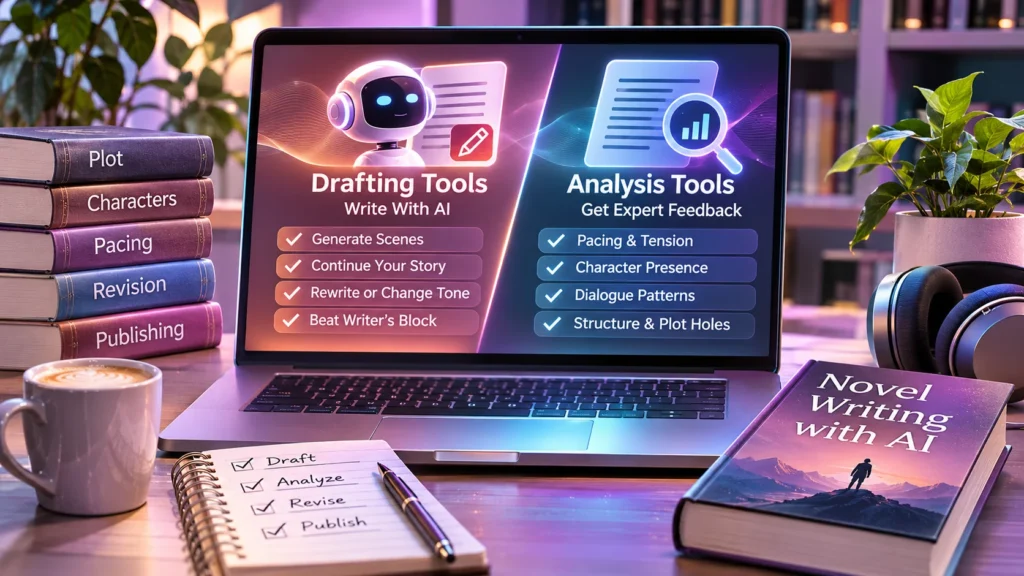
One camp writes for you. You give it a scene outline or a few sentences and it produces paragraphs of prose. The other camp reads what you wrote and tells you what is working and what is not.
Both use large language models. They solve very different problems. If you are a novelist choosing a tool, knowing which camp you need will save you money and frustration.
Why drafting tools took off first
The first wave of AI writing products for fiction focused on generation. That made sense technically. Language models are very good at continuing text, so a tool that continues your story was the obvious first product.
Features like “describe this scene”, “continue from here” and “rewrite in a different tone” became standard. For writers stuck on a blank page, they can be genuinely useful for brainstorming.
The limits show up later. Generated prose tends toward the average. It smooths out voice, reaches for familiar phrasing and makes similar choices across different books. Many authors also face publisher and retailer rules about declaring machine written text.
The rise of analysis tools
A second group of products takes the opposite approach. They do not write a word of your book. Instead they read a chapter or the whole manuscript and report on it.
Typical outputs include:
- Pacing across chapters, showing where tension drops
- Character presence, showing who disappears for long stretches
- Dialogue patterns, flagging characters who all sound alike
- Structural markers, such as where major turning points fall
- Possible continuity problems and plot holes
This is closer to what a developmental editor or a sharp beta reader does. The technical challenge is harder, because the tool has to hold a long manuscript in view and reason about it rather than simply produce more text.
How to tell which camp a tool is in
Marketing pages do not always make it obvious. A few quick checks help.
- Look at the main button. If it says “write”, “generate” or “continue”, it is a drafting tool.
- Check what it outputs. Analysis tools produce reports, scores and notes. Drafting tools produce paragraphs.
- Check the length it handles. Manuscript analysis needs to read tens of thousands of words at once. Many drafting tools work on a few hundred.
- Read the privacy terms. Any tool you upload a full novel to should say clearly whether your text is used to train models.
Questions to ask before you pay
Pricing models vary widely. Some charge per word generated, some per manuscript analysed, some a flat monthly fee. Before committing, ask yourself:
- Do I need more words, or better words?
- Am I stuck at the drafting stage or the revision stage?
- Will I be submitting to agents, publishers or retailers with AI disclosure rules?
- Do I want my voice preserved exactly, or am I happy to blend it with suggestions?
Writers in the revision stage almost always get more from analysis than from generation. A finished draft rarely needs more prose. It needs to know which prose to cut, move or rewrite.
Looking past the best known name
Sudowrite is probably the most recognised fiction specific AI tool, and it sits firmly in the drafting camp. That makes it a natural starting point for many writers, and a poor fit for those who realise they want feedback instead.
If that describes you, it helps to look at the options split by camp rather than in a single ranked list. This roundup of Sudowrite alternatives does exactly that, separating drafting tools from analysis tools so you can compare like with like.
What the technology still struggles with
Neither camp is magic. Some honest limitations apply across the board.
Long range reasoning. Even with large context windows, models can miss connections between a detail in chapter two and a payoff in chapter thirty.
Genre expectations. A pacing note that suits a thriller might be wrong for literary fiction. Good tools let you set the genre so feedback is calibrated.
Taste. No tool can tell you whether your book is the book you meant to write. That decision stays with the author.
The most effective approach treats AI output as one reader among several. It is fast, tireless and consistent. It is not the final word.
Where this is heading
The split between generation and analysis is likely to sharpen over the next few years. Publishers and retailers are tightening rules around machine written text, while demand for fast, affordable feedback keeps growing.
For writers, that suggests a sensible default: write your own words, and use AI where it is strongest, as a reader that never gets tired of your manuscript.
Choose tools by the job you need done, not by the size of the brand, and you will get far more out of them.