
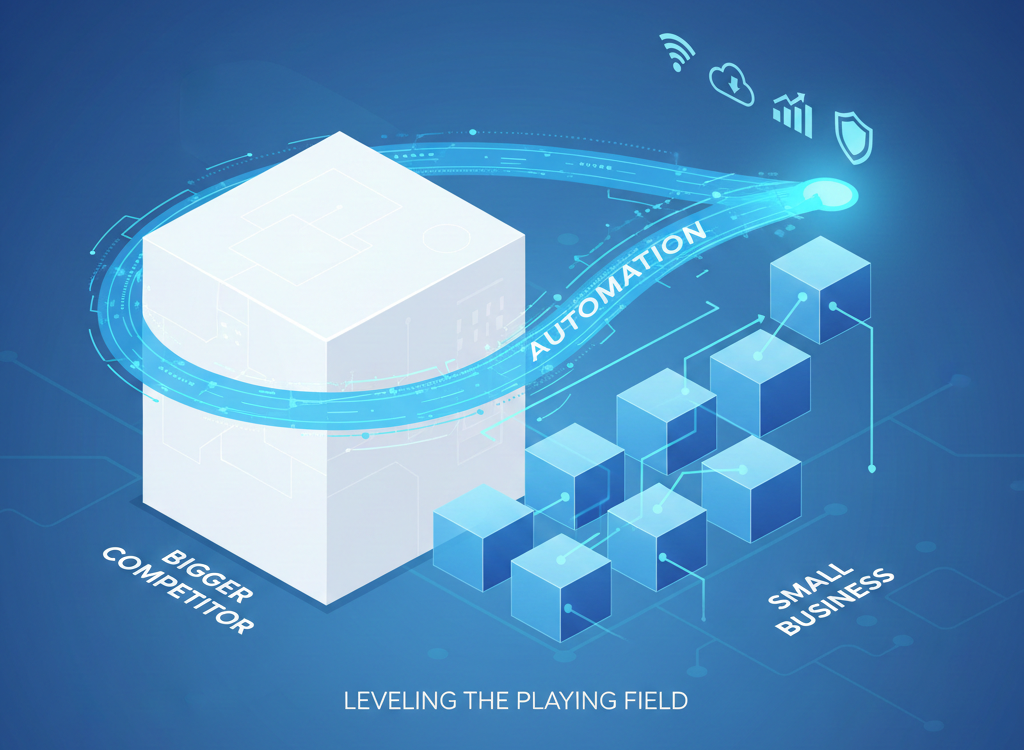
Small businesses have always had to fight uphill battles against larger competitors. But what’s changed in the last ten years or so? Technology has enabled small-scale operations that once required massive spaces and massive teams for efficiency and output quality to now work out of smaller facilities and with smaller teams with comparable effective productivity.
The businesses that recognize this sooner than later acquire a competitive edge. The businesses that don’t are left consistently confused as to why they cannot keep up.
The Cost Advantage is Not What It Used to Be
Historically, big companies have won cost advantages. They possessed the equipment and systems that small companies simply couldn’t afford or feasibly acquire. A large-scale manufacturer could buy a million dollar automated conveyor production line. A small company would be saddled with menial manual processes to make things work because technology was reserved for larger-scale industries.
This is no longer the case. Most modern equipment is sold as modular-sized options with digital controls and automation features that once only existed in the realm of enterprise levels of investment. A small food-processing facility can purchase a machine capable of what a dozen men could do with the same level of effort efficiency as equipment in a massive food-processing facility.
Automation is What Levels the Playing Field
This type of automation is what gives small enterprises the advantage over large competitors because manual processing efforts are eliminated. When a small business can produce the same volume amount per employee hour as its large competitor, it no longer matters how big or small either business is; it only matters how efficiently the respective business operates.
Consider production equipment in food and beverage industries. For example, a grape crusher destemmer comes equipped with programmable functions and variable speed options. A micro-winery can set its machine to process grapes with the same end product as a facility ten times its size. This is true across industries – packaging lines, programmed mixers, digital quality assessments.
These types of solutions do not merely increase speed; they create consistent results that manual efforts can achieve but never as reliably as long as human error exists.
Digital Controls Allow for Quality Control
Where small businesses get an edge over larger companies is that digital controls enable more standardized quality control. Machines work the same way every single time – programmable parameters ensure sensor readings monitor outputs and notify (and often prevent) issues from developing.
Larger facilities cannot rely upon consistency when they have multiple production lines or shifts operating at once. A small company running one fully equipped and structured machine can provide better quality control than the data variability a larger operation must compensate for.
The Scaling Advantage Without Investment
Small companies used to think the best route for growth was bigger spaces and larger pieces of equipment to accommodate higher-level productions. This is no longer the case; instead, technology that increases throughput can support growth beyond physical investment accommodations.
Equipment with adjustable capacity settings can ramp up or scale down based on peak seasons or dry months, respectively. Thus, small operations do not require large-scale overhead costs with equipment that cannot decrease investment options; instead, digital transitions afford this advantage.
Labor Cost Reality
Let’s face it – the reality is labor costs more every year to employees responsible for minute, tedious, repetitive efforts. Equipment, once it is purchased, requires predictable fixed costs but amortized per project over time. Automated processing provides cost per unit derived over time as an investment that decreases actual acquisition costs.
Thus, this means smaller companies can compete on price because now labor percentages sit far below project costs that permit pricing reduction options. When enterprises have less per unit cost of labor responsible for basic efforts, they can competitively pitch contracts on volume pricing.
Speed as a Competitive Driving Force
Big companies work slowly; larger entities have bureaucracies and red tape to work through. Unless a small company has production efficiencies that permit immediate turnarounds, then speed means nothing.
Equipment that can be readily transitioned from project to project or specifications or differing types rapidly enables smaller businesses the ultimate advantage. They can meet customer specifications within a window of time where a larger facility would need to overhaul operations and run shift after shift to get anything done.
The Minimized Training Burden
With manual processes come skilled laborers who require extensive training and certification efforts. The ability to find those workers and retain them gets more difficult year after year. The less skill needed to run programmed setting machinery means those digital controls lessen the skill requirement needed to operate production systems.
This doesn’t mean skills aren’t still critical – a foreman needs to understand what’s going on and how – but at least the foreman only needs to understand what happened and not what he/she/they operated manual effort by effort.
Data and Insights to Better Decision Making
Modern production data allow inputs regarding time on task, downtime where applicable, quality assessment metrics and efficient measurement capacities. This information offers penetrating insights into how a small company operates compared to larger competitors who may be more insulated by enterprise options but buried within multiple working systems.
When a company knows how long it takes each production run, where blockages occur, and what factors play into quality and efficiency measurements, it can better facilitate recommendations for additional investments. Larger competitors possess data buried in proprietary systems; smaller operations can operate agilely with gleaned insights from disparate operations more readily available due to clear understandings.
Integrated Advantage
Here’s where larger operations fail – systems that have their own life sometimes do not integrate well with new supplemental solutions. Small companies without this legacy overhead can choose their technology from day one so that new systems work hand in hand from inception onward.
To make matters better, newer options boast similar standards of compatibility with integration – a fully operational production system works better than the sum of its partsy parts, meaning digitized protocols render integration smooth.
When Technology Investments Are Sensible
Not every system upgrade makes sense on paper; the ones that treat true blockages make the most significant difference in resolving legitimate sources of concern. Any system that looks good but doesn’t account for your company’s critical constraints or pressures is simply pretty decor that’s far too expensive for mistaking your intent.
Companies that compete realize technology investments at thresholds that make factors limiting their potential productivity actually become systems worth investing in over time. If labor cost is operating against them, automation makes sense. If consistency is the problem, digital monitoring makes sense; if capacity is constrained, throughput becomes necessary.
The Compounding Competitive Advantage
Finally, over time, technology investments make sense for small operations because they compound each of these efficiency gains makes the company more competitive in turn earning revenue which funds additional improvements.
Thus a competitive advantage emerges based on operational advantage instead of size or capitalization equity. Competitively-minded small companies who’ve gotten it right don’t compete on stupid level playing fields – they win based on flexibility, quality and responsiveness metrics.
Technology has not dissipated the advantages of scale; it’s merely reduced the correlation between size and competitive viability. Enterprises that know better how to compensate advantageously can compete in worlds that once only afforded themselves big-ticket entry fees.