
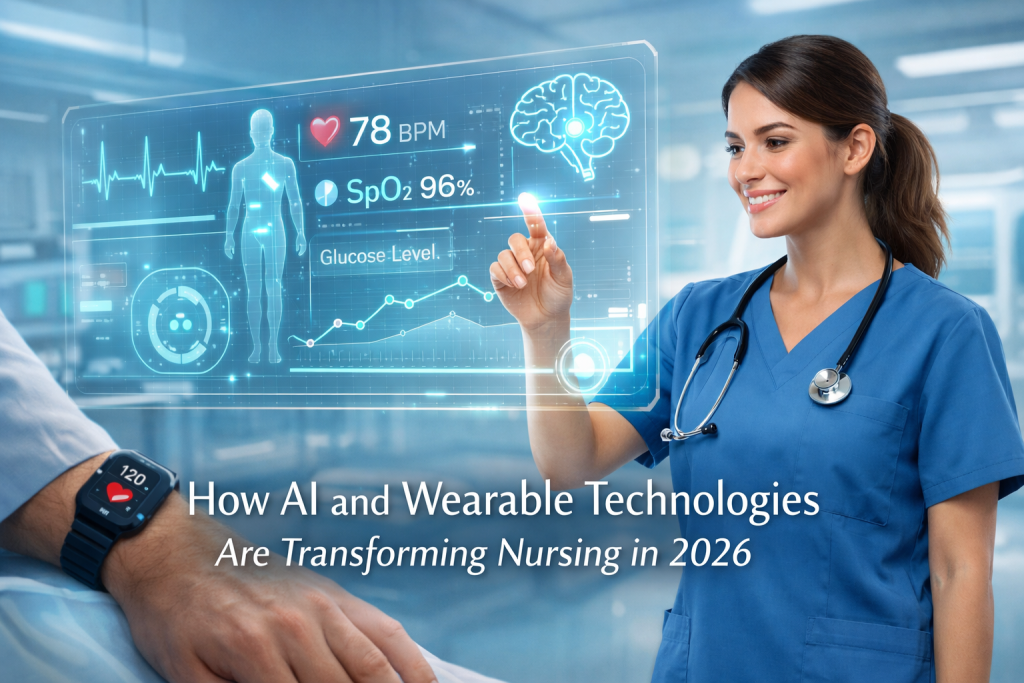
In 2026, the innovative revolution in healthcare has reached a pivotal tipping point, particularly within the nursing field. The concept of AI and wearables is no longer considered a futuristic one since it has become the inevitable part of the tools which influence the way nurses provide care to patients and manage their workload, research and enhance patient outcomes. Such inventions and others such as smart health trackers, prediction software, automated medical records, among others are revolutionizing the nursing practice of all levels.
The study of AI and wearable technology has gained significant traction for nursing students writing their theses. Similarly, many students seeking Nursing Dissertation Writing Help are focusing on digital healthcare, as these technologies reshape nursing education, clinical practice, and patient interaction.
This article provides a substantive analysis of the AI and wearable technology revolution within the nursing profession, exploring their respective advantages and disadvantages, and how these innovations are shaping the future of healthcare.
The Rise of AI in Nursing
AI has ushered in a new era of modern nursing, surpassing the standard automation levels of 2025. In 2026, AI plays a more dynamic and integrated role in:
1. Clinical Decision Support
AI-driven clinical decision systems can process patient data in seconds, identifying patterns that might escape even the most experienced clinicians. These systems assist nurses by:
- Predicting potential complications before they arise.
- Providing evidence-based intervention recommendations.
- Improving medication adherence and safety.
- Significantly reducing human error.
Specifically, AI algorithms can monitor vital signs in real-time, instantly flagging any deterioration in a patient’s condition so that nurses can intervene immediately.
2. Streamlined Documentation
Historically, documentation has been a significant administrative burden in the nursing sector. Today, voice recognition and AI-driven auto-charting enable nurses to record patient notes in real-time using natural speech. This reduces paperwork by approximately 60%, allowing nurses to dedicate more of their time to direct patient care.
3. Enhanced Patient Monitoring
AI works in tandem with wearable technology to provide continuous patient monitoring. These systems can identify subtle physiological changes and trigger alerts before a situation becomes critical. This represents a significant advancement in the management of chronic diseases and the surveillance of patients within the ICU.
The Future of Wearable Technology: Next-Level Patient Care
Wearable technology has come a long way since the days of simple step counters; today, these devices have evolved into medical-grade diagnostic tools. In 2026, nurses utilize these devices to collect real-time data, monitor patient progress, and customize care plans remotely.
1. Smart Health Trackers
Modern smartwatches, such as the Samsung Galaxy Watch 8, Apple Watch Series 11, and the Google Pixel Watch 4, have transitioned from lifestyle gadgets to powerful clinical tools. These devices can now continuously monitor:
- Heart Rate Variability (HRV)
- Blood Oxygen Saturation (SpO2)
- Glucose levels
- Sleep patterns
- Blood pressure
- Stress markers
This real-time data is relayed constantly to centralized nursing dashboards, allowing for immediate clinical intervention when necessary.
2. Mobility Wearables and Rehabilitation
Smart rehabilitation bands assist nurses in monitoring physical therapy sessions, ensuring patients perform movements safely and accurately. In 2026, these wearables are even capable of providing real-time haptic feedback to correct a patient’s posture or movement on the spot.
3. Remote Patient Monitoring Systems
Remote monitoring technology has become essential across several key areas:
- Home healthcare
- Post-operative recovery
- Elderly care management
- Chronic disease follow-up
Nurses can now monitor patients from a distance, reducing the need for unnecessary hospital visits. This prevents patients from traveling when it isn’t required and ensures medical facilities are not overcrowded with routine follow-ups that can be handled virtually.
The Convergence of Wearables and AI
The true transformation in healthcare occurs when AI and wearable technologies collaborate. While data is informative on its own, AI makes that data predictive and actionable.
1. Predictive Analytics
Wearable data provides a baseline, but when integrated with AI, it becomes a powerful predictive tool. These insights help nurses:
- Identify readmission risks before a patient is even discharged.
- Anticipate disease progression through longitudinal data analysis.
- Identify medication non-compliance patterns, allowing for proactive patient education.
- Detect early warning signs of life-threatening conditions like sepsis or heart failure.
2. Personalized Nursing Care
AI can analyze patient trends to recommend hyper-personalized treatment plans. By monitoring real-time patient responses via wearables, nurses can adjust care strategies immediately, ensuring that interventions remain both efficient and relevant to the patient’s current state.
3. Enhanced Communication
Patients equipped with wearables can communicate directly with healthcare applications, enabling:
- Automated symptom logging.
- Smart medication reminders.
- Self-monitoring dashboards.
This significantly improves patient compliance and provides nurses with invaluable insights into patient behavior and health status in non-clinical settings.
AI and Wearables in Nursing Education
The integration of advanced technology has transformed nursing pedagogy, particularly for graduate and doctoral students.
1. New Frontiers in Thesis and Dissertation Research
In 2026, nursing research has shifted toward the practical application of digital tools. Common research themes include:
- The Impact of AI on Real-Time Patient Monitoring.
- The Efficacy of Smart Wearables in Chronic Disease Management.
- The Ethical Implications of Digital Nursing.
- Barriers to Technology Adoption Among Nurses.
- AI-Driven Nursing Diagnosis and Triage.
2. Academic Support and Data-Driven Research
Modern nursing students are increasingly seeking Nursing Dissertation Writing Help that incorporates digital health data. Many dissertations now rely on primary datasets gathered directly from wearable devices during clinical trials, providing a level of accuracy that was previously impossible to achieve.
3. AI-Powered Simulation-Based Education
AI-driven simulations allow nursing students to master high-stakes scenarios in a risk-free environment. These platforms recreate:
- Emergency response protocols.
- Complex clinical decision-making.
- Advanced surgical and bedside procedures.
These simulated environments replicate real-life clinical conditions, enabling students to develop high-level skills before they ever step into a hospital.
Implications for the Nurse-Patient Relationship
While there have been concerns that technology might diminish the “human touch,” it has, in fact, strengthened the bond between nurses and patients in several significant ways:
1. Increased Time for Compassionate Care
As AI-driven systems and automated tools handle routine, repetitive tasks, nurses are freed from administrative burdens. This allows them to dedicate more time to direct patient interaction and emotional support.
2. Improved Patient Engagement
Wearables empower patients by helping them understand their own health data in real-time. This creates a more collaborative dynamic, making conversations between the nurse and patient more meaningful and informed.
3. Building Trust Through Data Accuracy
The precision of AI-driven data minimizes clinical misunderstandings and provides a clear, objective view of a patient’s progress. This transparency fosters greater trust in the treatment plan and enhances overall patient confidence in the care they receive.
Advantages of AI and Wearables in Nursing Practice
1. Enhanced Patient Outcomes
Real-time identification, predictive analytics, and continuous monitoring lead to a significant reduction in medical emergencies and improved recovery rates.
2. Mitigating Nurse Burnout
Automated documentation and intelligent scheduling systems reduce administrative burdens, lowering stress levels and preventing professional exhaustion.
3. Cost-Effective Care Delivery
Remote monitoring reduces hospital readmissions and lowers overall operational expenses by optimizing resource allocation and preventing critical escalations.
4. Data-Driven Clinical Practice
Nurses can more effectively implement evidence-based care when they have immediate access to real-time, accurate patient data.
Challenges and Ethical Considerations
While AI and wearable technologies offer immense benefits, their integration into nursing practice presents several critical challenges.
1. Data Privacy and Security
Wearables collect vast amounts of sensitive patient data. Ensuring data privacy and robust encryption is paramount to protecting patient confidentiality and complying with global health regulations.
2. Over-Dependence on Technology
Excessive dependence on automated systems may lead to the erosion of traditional clinical competencies. It is vital that nurses maintain their foundational assessment skills alongside these digital tools.
3. Interoperability and Integration Issues
Not all healthcare infrastructures are currently equipped to support full-scale AI-based workflows. Fragmented legacy systems often struggle with interoperability, making it difficult to sync wearable data across different platforms.
4. The Ethics of Clinical Judgment
AI should serve as a supportive tool rather than a replacement for human clinical judgment. Final decision-making must always involve a qualified professional to ensure empathetic and ethically sound patient care.
The Future of Nursing: A 2030 Vision
Looking ahead to 2030, the nursing landscape will undergo a profound digital evolution. We expect to see:
- Autonomous Triage Systems: AI-driven interfaces that handle initial patient intake and assessment at scale, optimizing hospital flow from the moment of arrival.
- Robotic Process Automation (RPA) & Collaborative Robots (Cobots): AI assistants and collaborative robots working alongside nurses to automate physically demanding tasks and routine clinical workflows.
- Nano-Wearables: Next-generation sensors capable of monitoring health at the cellular level, detecting biochemical shifts before physical symptoms even manifest.
- Augmented Reality (AR) & Spatial Computing: AR overlays that provide real-time clinical instructions, vein visualization, and step-by-step guidance during complex procedures.
Rather than being replaced, nurses will remain at the heart of healthcare—their expertise will be amplified by an advanced suite of technological devices.
Conclusion
Artificial Intelligence and wearable technologies are fundamentally upgrading the nursing profession in 2026, making the healthcare industry more precise, efficient, and patient-centric. These technology tools supplement the clinical decision-making process and streamline workflows, enabling a level of real-time monitoring that was previously unattainable.
For students currently engaged in research or seeking Nursing Dissertation Writing Help, investigating the impact of technology on nursing practice offers a wealth of timely and relevant research prospects. As the collaboration between technology and nursing grows even more robust, it will pave the way for a smarter, safer, and more compassionate healthcare system.