
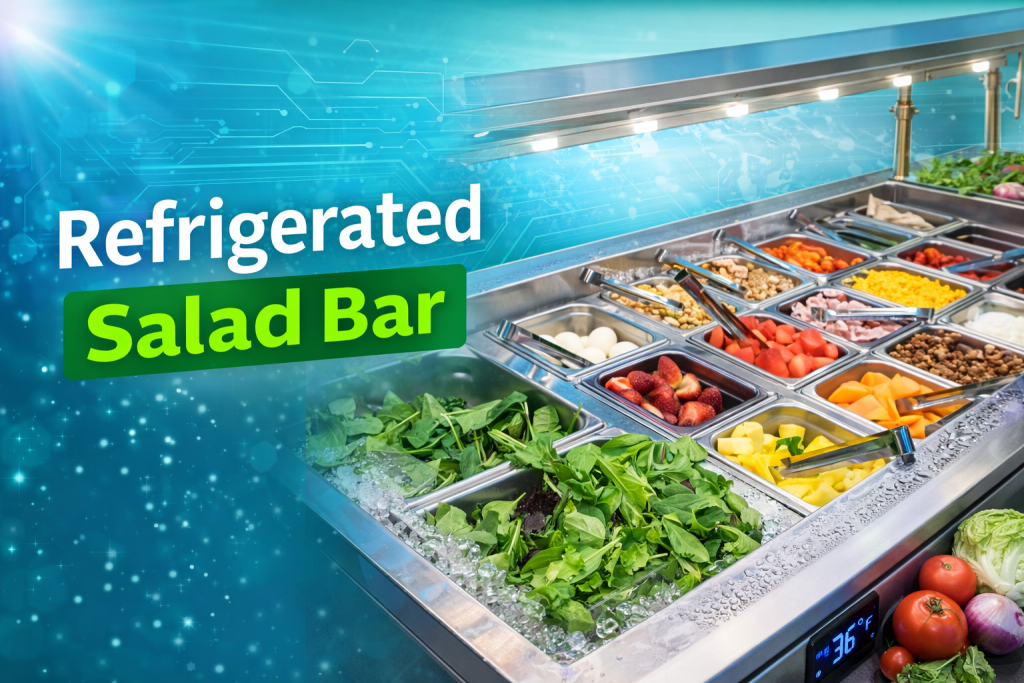
A refrigerated salad bar (also called a refrigerated prep table, salad chiller, or sandwich/salad prep table) is a purpose-built refrigerated unit designed to hold and display chilled ingredients—greens, toppings, proteins, dressings and prepared salads—at safe temperatures while keeping them accessible for service or self-serve. These units combine a refrigerated base (for cold storage and compressor) with a top rail or “mega top” designed to accept standard food pans (1/1, 1/3, 1/6, etc.), often with an integrated cutting board, sneeze guard, LED lighting, and sanitary drain or condensate management. Refrigerated salad bars are used in cafeterias, quick-service restaurants, cafés, hotels, catering operations, and any food-service environment that needs efficient assemble-and-serve workflows and safe cold holding.
Why Invest in a Refrigerated Salad Bar?
A refrigerated salad bar is a specialized food safety machine. While it displays fresh ingredients beautifully, its most important job is to hold perishable food outside of the Food Temperature Danger Zone. For cold items, this means keeping everything consistently at or below 41°F (5°C). This single function prevents the rapid growth of harmful bacteria, keeping customers safe and food fresh.
A true salad bar is a complete, self-contained station designed for self-service. It includes the refrigerated basin that holds food pans, a surrounding countertop for plates, and a protective shield (or “sneeze guard”). It’s an all-in-one solution you can position for customer access, making it a functional and inviting centerpiece for any deli, cafeteria, or buffet.
You might also hear the term “cold well unit.” This refers specifically to the refrigerated basin, which is designed to be “dropped in” or installed into a custom counter. Knowing this difference is key, as it clarifies whether you’re buying a standalone station or just the cooling element itself.
Types of Refrigerated Salad Bars — Which Style Fits Your Operation?
- Countertop / Rail-style Prep Units (countertop condiments & rails)
Small, often low-power countertop units with 3–8 pans. Good for coffee shops, kiosks, or limited-counter spaces. Ideal for condiments, dressings, or small topping lines. - Mega-top / Sandwich & Salad Prep Tables (worktable with refrigerated base)
The most common commercial form: a refrigerated base cabinet with doors or drawers and a “mega top” that holds many food pans (12–30 pans or more). Offers a full workspace (cutting board) plus below-deck refrigeration for backup storage. These are the go-to option for busy restaurants and high-volume salad or sandwich lines. Examples include True and Hoshizaki mega-top models. - Salad-chiller / Refrigerated Buffet Tables (self-serve buffet lines)
Larger display units used in cafeteria or buffet contexts, sometimes with built-in curved glass sneeze guards and multi-door refrigerated storage below. - Reach-in Refrigerated Salad Servers / Display Cases
More display-oriented, with glass tops and internal refrigeration—used when presentation is prioritized over assembly speed. - Custom-built Islands & Modular Buffet Banks
For hotels and large operations, modules can be linked into continuous salad bars with integrated drains and service islands.
Must-Have Technical Features (the refrigeration hardware)
When evaluating models, confirm these technical specs and features:
- Temperature range and control: Look for consistent chilled range (around 33–41°F / 0.5–5°C) and easy-to-read digital thermostats. Units that advertise a 33–41°F steady range are preferred for leafy greens and prepared salads. Many prep tables maintain this range reliably.
- Compressor location & type: Rear-mounted, self-contained compressors are common (easier to service and more efficient than remote systems for standalone units). Scroll compressors and energy-efficient compressors reduce running costs.
- Forced-air vs. gravity cooling: Forced-air circulation maintains uniform temperatures across pans and is preferable for consistent cold holding, especially in mega-top designs.
- Insulation & cabinet construction: Stainless-steel exteriors (304 grade for food contact areas) and polyurethane insulation provide durability and thermal performance.
- Pan well configuration: Check how many pans the top holds, what pan sizes are supported (1/6, 1/3, 1/2, 1/1) and whether edges are raised to prevent spills. Models like the True Mega Top are designed to carry 12–30 pans depending on width.
- Below-deck storage: Doors or drawers with dedicated refrigerated compartments—good for backup supplies. Capacities vary widely: choose a cabinet depth/width appropriate to your needs (e.g., a 72″ unit holds many more pans and has larger refrigerated volume than a 36″ unit).
- Defrost system & condensate control: Automatic defrost cycles and condensate drains reduce maintenance; look for easy-access drains and auto-evaporating pans where applicable.
- Power requirements & climate class: Verify voltage (115V/230V), plug type, and whether the unit is rated for your kitchen ambient temperature (important in hot kitchens).
Essential User-Facing Features (for daily operation)
- Cutting board/top workspace: Many prep tables include a full-width cutting board fronting the pan well—useful for assembly and portioning.
- Sneeze guard: For self-serve salad bars, a tempered glass sneeze guard protects food from contamination. For chef-serve stations, a lower-profile lid may be acceptable.
- Lighting: LED lighting in the pan area improves visibility and merchandising.
- Drain & sanitation design: Look for pan wells and bottom drains that are easy to clean, with removable pans and pan covers for overnight storage.
- Pan covers & lids: Snap-on or hinged lids help maintain temperatures and prevent contamination.
- Mobility & leveling: Locking casters make relocation and cleaning easier; adjustable legs are useful for permanent installations.
- Controls & alarms: Digital displays, HACCP-compatible data logging, and alarms for high-temperature events are useful for compliance and monitoring.
Drop-In, Countertop, or Freestanding: Finding the Perfect Fit for Your Space
The physical form of your salad bar depends on your available space, the permanence of the setup, and your budget. Models generally come in three styles: drop-in, countertop, and freestanding.
For a seamless, built-in look, a drop-in unit is the top choice. These models are designed to be lowered into a custom-cut opening in your counter, creating a clean, professional food line. They are ideal for permanent installations in delis or cafeterias where aesthetics matter. If you need flexibility or are tight on space, a countertop unit is perfect. These portable boxes sit directly on any sturdy table or counter, making them an excellent, affordable way to add a small salad station without any construction.
If you need a complete, all-in-one station, the freestanding floor model is what you’re likely picturing. These are the classic, high-capacity salad bars seen in grocery stores and school cafeterias. Because they are self-contained units, often on wheels, they can be placed anywhere and easily moved for cleaning, making them the go-to solution for serving many people in a dedicated area.
What Size Salad Bar Do I Need? A Simple Method for Choosing the Right Capacity
Salad bar capacity is measured by the number of food pans a unit can hold. A “6-pan” or “10-pan” model tells you exactly how many containers fit into the refrigerated well, making it easy to match the equipment to your menu.
The simplest way to estimate your needs is to list every ingredient you plan to offer. If you count 12 items, you need a unit that holds at least 12 pans. It’s always a good idea to choose a model with one or two extra slots for flexibility to add a new item or daily special later. Picking the wrong size is a costly mistake. A unit that’s too small means frantically refilling items during a lunch rush and losing sales. An oversized bar costs more upfront, inflates your electricity bill, and often leads to more food waste.
Space Planning & Workflow — Match Unit Size to Your Operation
- Estimate pan needs: A small café might need 6–12 pans; a busy salad bar or sandwich shop may need 24–30 pans (a 72″ mega-top often holds 30 1/6 pans). Choose a width that fits your service line and traffic patterns.
- Front vs. back-of-house use: Self-serve buffets need sneeze guards and accessible pan depths. Back-of-house prep tables prioritize pan capacity and below-deck storage.
- Clearance & ventilation: Provide adequate clearance behind the unit (per manufacturer spec) for airflow and servicing. Avoid tight enclosures unless the model is specifically rated for built-in installation.
- Integration with adjacent equipment: Position near sinks for hand-washing, near dish-washing or vegetable prep areas for efficient flow, and with waste or compost receptacles handy.
Sanitation, Safety & Compliance
- Materials & finish: 304 stainless steel for surfaces that touch food; rounded corners and welded seams minimize dirt traps.
- NSF / ETL sanitation listings: Choose models certified to NSF/ETL sanitation standards for commercial use when possible—this simplifies code inspections.
- Sneeze-guard heights & ADA: For customer self-serve stations, ensure sneeze guard placement meets health code, and that serving heights are accessible where required.
- Cleanability: Removable pans, pan rails, and accessible drain points reduce downtime for cleaning. Sanitization protocols should be written into your SOPs (frequency, temperature checks, cleaning agents).
Energy Efficiency & Running Costs
- Insulated, efficient compressors and LED lighting cut energy bills. Larger units naturally use more energy; compare energy consumption (kWh) or seek energy-efficiency models. Some premium brands emphasize long-term reliability and service warranties that reduce lifecycle cost.
- Night covers & lids can reduce cooling load after hours. Also consider units with night modes or programmable defrost to save energy during low-use periods.
Common Optional Extras and Upgrades
- Hot & cold combo lines: Some counters combine refrigerated rails with hot wells for all-in-one service—be cautious, as combining hot and cold near the same prep line can complicate layout and HVAC.
- Glass cover / hinged lids: For display units.
- Under-counter drawers vs. doors: Drawers are convenient for ingredients retrieval and minimize cold loss; two-door cabinets are common for bulk storage.
- Digital HACCP logging and alarms for chain-of-custody and temperature audits.
Price Ranges (what to expect)
- Countertop mini rails: Lower-cost tabletop units can start under $600–$1,500 (small countertop refrigerated rails for cafés).
- Mid-size prep tables (36–48″): Typically range from $3,000–$7,000+ depending on brand, capacity, and features.
- Large mega-top units (60–72″): Professional-grade brands with 7-year warranties can be $5,000–$12,000+, especially for heavy-duty refrigeration and large pan counts. Brand, warranty length, and included features (stainless steel, forced-air cooling, 30-pan capacity) influence price. Examples of these larger investment units are available on HorecaStore.
Recommended Product Types & Real Examples on HorecaStore
Below are product categories and specific models that make good starting points.
- True Mega Top Sandwich/Salad Prep Table — 72″ Mega Top (high-volume)
Why it’s good: Large 72″ top, high pan capacity (up to 30 1/6 pans in some spec series), robust refrigeration for consistent cold holding, and a full-length cutting board for continuous assembly. Ideal for busy delis, salad bars, and sandwich shops. - Hoshizaki Steelheart Series Sandwich/Salad Prep Tables (48–72″)
Why it’s good: Hoshizaki’s Steelheart models are built for tough commercial use with solid stainless construction, multiple configurations (doors, drawers, pan capacities), and reliable cooling performance—excellent for operations that want a proven brand. See Hoshizaki listings for various widths and pan configurations on the horecastore. - True 36″ Mega Top (compact but commercial-grade)
Why it’s good: For smaller kitchens that need professional refrigeration and decent pan capacity without the footprint of a 72″ unit. True’s 36″ versions are frequently used in cafés and smaller restaurants. - Medal Equipment 48″ Sandwich/Salad Prep Table (value / mid-range)
Why it’s good: A mid-sized solution with two doors and moderate pan counts—well-suited to medium-volume operations and budget-conscious buyers seeking durable stainless-steel construction.
How to Compare Models Side-by-Side (practical checklist)
Use this quick checklist when comparing models:
- Dimensions (width × depth × height) and clearance needed
- Pan capacity & pan sizes supported (how many 1/6 pans, 1/3 pans, etc.)
- Below-deck refrigerated cubic feet and door/drawer configuration
- Temperature range & thermostat type (digital recommended)
- Compressor specs (HP) and warranty length
- Defrost method, drainage, and sanitation features
- Build material (stainless grade, gaskets, hinge quality)
- Mobility (casters) and service access
- Certifications (NSF, ETL), energy ratings, and listed electrical requirements
- Price, shipping, and lead time (some commercial units ship in days, others in weeks)
- Service/support network and replacement part availability
Example Use-Cases With Unit Suggestions
- Small café (low foot traffic, limited counters): Countertop refrigerated rail (3–8 pans) or a 32–36″ prep table with 12 pans. Consider countertop rail for limited space or a 32″ True prep table for flexibility.
- Busy sandwich shop / deli (high throughput): 60–72″ mega-top with 20–30 pans and below-deck storage—True or Hoshizaki 72″ models are purpose-built for this.
- Buffet / cafeteria (display-focused): Self-serve refrigerated buffet table with glass sneeze guards and multiple sections for different foods—look for buffet-specific chilled counters or modular salad-chiller islands.
Final Checklist Before Purchase
- Confirm pan capacity & sizes (matches your menu).
- Verify temperature performance and thermostat type.
- Confirm dimensions and clearances including service access.
- Check warranty, service network, and spare-parts availability.
- Ask the supplier about lead time, shipping costs, and installation options.
- If possible, request a spec sheet and an energy consumption estimate.
You can preview several commercial-grade options and compare exact models, capacities, and prices directly on HorecaStore; for example, True Mega Top and Hoshizaki Steelheart series models are listed with full specs and pricing on the site.