
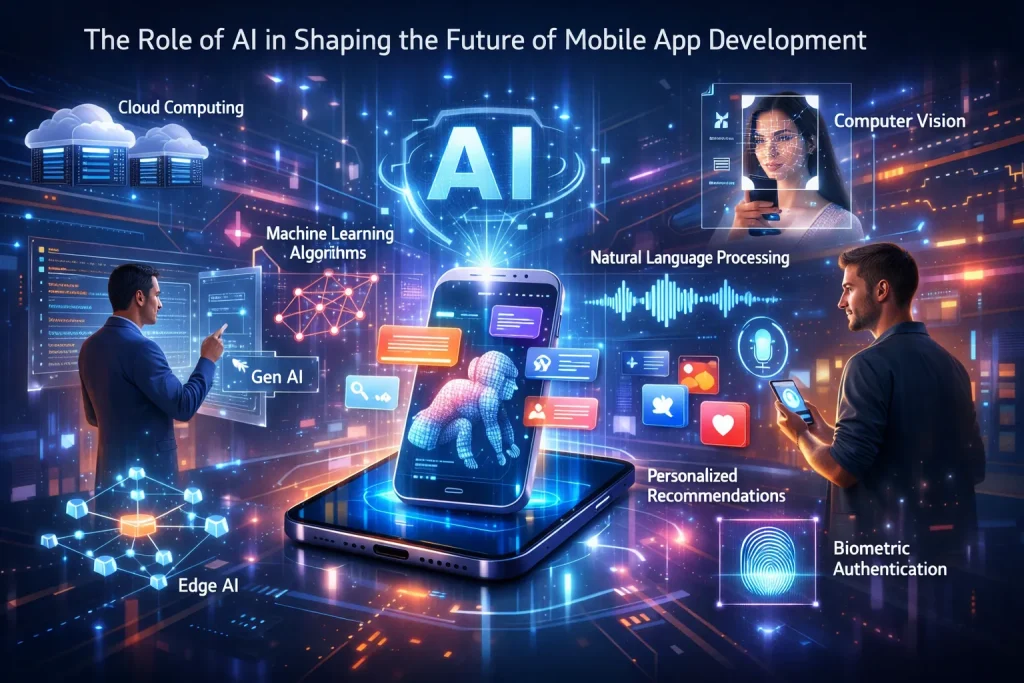
Modern technology is dynamically changing every industry today. And mobile app development is no exception. Here, AI isn’t just a buzzword anymore. It is actually transforming how mobile apps are designed, developed, and deployed in companies.
In fact, the development workflows are much more effective, adaptive, and user-driven, as they are being engineered by technical teams that are part of a specialized AI development company that knows how to make apps the right way.
- Leveraging AI in this space, teams are now able to deliver apps with fast data processing capabilities, personalization, and other such dynamic features in no time.
- Moreover, leading IT giants like Google, Microsoft, and Apple are investing in mobile app development technologies to redefine their workflows.
That being said, the mobile app development ecosystem is growing at a CAGR of 14.3% from 2024 to 2030. Earlier projected to be at USD 252.89 billion in 2023, this industry is expected to reach USD 626.39 billion by 2030. This indicates that companies are now leveraging AI-driven technologies to develop modern apps that can dominate the digital space.
Mainly, these apps can perform the following functions well:
- They can understand users by collecting real-time data.
- Based on these insights, these solutions can optimize the app performance according to the users’ needs.
- Moreover, it also offers a seamless omnichannel app experience.
As a result, AI is at the epicentre of this industry’s growth, helping leaders develop smarter apps to meet rising user needs and evolving market demands. With this perspective, this article shares how AI plays a key role in reshaping the future of this IT space in 2026 and beyond.
Understanding AI in Mobile App Development
Undoubtedly, AI is at the core of next-gen mobile application solutions. It is not only making them more intelligent, adaptive, and user-focused, but also more transparent and personalized.
- Owing to the integration of this smart technology, apps can learn from user behavior, understand the context of their searches, and deliver curated recommendations to them accordingly.
- Leveraging AI also helps in smarter decision-making across the technical teams.
Moreover, it helps embed modular frameworks in the application stack. This is why many technology platforms are using AI in their app solutions and adopting tech-friendly strategies to build data-driven mobile app ecosystems.
- For leaders, this investment can help them build better mobile app solutions that solve user needs faster and can be updated to meet their expectations.
- Moreover, this can help companies enhance their app downloads, which can boost their engagement and ROI.
- That being said, it also improves the workflows of the technical teams, thereby enhancing their efficiency and business agility.
Mainly, the core technologies that contribute to these results are as follows:
1. ML Algorithms
They serve as a foundation for modern app solutions. Mainly, it enables apps to learn from data that helps them in predicting necessary changes and detecting anomalies. Additionally, it also helps developers reduce latency in processes.
2. NLP (Natural Language Processing)
NLP supports conversational and voice-first interfaces. So, basically, the voice search option that a user trusts to search faster is how NLP effectively functions in a mobile app. Even chatbots and automated customer support engines use this technology to answer user queries in real-time.
3. Computer Vision
It helps modern apps interpret visual data such as images and videos. Mainly, this technology enables biometric authentication, object recognition, visual search, and more such dynamic capabilities in apps today.
4. Gen AI
This technology helps apps in creating and delivering unique, adaptive, and user-focused content. Furthermore, it enhances developers’ productivity and speeds up the coding, testing, and debugging workflows.
5. Cloud Computing
Cloud is leveraged in modern app solutions to bring in scalability, higher computing power, and improved data infrastructure that is required to manage high traffic. Additionally, it also supports continuous model updates, monitoring, and performance optimization.
6. Edge AI
Edge AI helps a mobile app function more accurately and faster as it allows the ML algorithms to process data locally. Mainly, this helps apps in real-time decision-making and also supports offline capabilities.
In this manner, AI is the foundational pillar for mobile app development today that helps deliver the next-generation digital experiences that users expect.
How AI is Transforming Mobile App Development?
There is no doubt that AI is taking the lead in changing the dynamics of the mobile app development space. Moreover, it is becoming the foundation of building smart, scalable, and user-centric mobile application solutions.
With this perspective, this section analyzes the core AI-powered features that take the app’s performance to the next level, enabling this transformation.
1. Hyper-Personalization
While shifting to an AI-driven mobile app ecosystem, one of the primary features that comes to the mind of app developers is hyper-personalization. It basically caters to users personally, thereby providing them with curated recommendations and suggestions in real-time.
But how is this delivered?
- Here, AI and ML algorithms deeply analyze user behavior patterns, which allows apps to predict what users need, when they need it, and how they prefer to engage.
- Furthermore, predictive analytics engines and NLP function together to enable this modern app capability.
- Over a period of time, these models become more data-driven and smarter, which helps them deliver adaptive experiences tailored to each individual.
For users, this means that modern apps are possibly more engaging and can provide real-time recommendations and dynamic interfaces. And from a business viewpoint, this makes the customer feel valued, which improves their engagement and loyalty over a period of time.
2. Intelligent Automation
Intelligent automation is another tech-oriented feature integrated into the mobile apps today. Simply, it means that apps now use AI to perform repetitive tasks, which not only streamlines workflows but also allows smarter decision-making without the need for human intervention.
That being said, mobile apps use automation for the following aspects:
- Chatbots and virtual assistants,
- Smart notifications and alerts,
- Customer onboarding and verification, and
- Workflow optimization in enterprise apps.
Comprehensively, it not only improves user experiences but also helps enterprises in reducing latency. Additionally, it enables apps to deliver fast and meaningful services while proactively managing customer expectations through the use of smart automation.
3. Enhanced App Security
Security is another aspect that highly impacts customer trust. This is where AI comes in as a solution provider. It strengthens mobile app security by detecting threats and suspicious behavior in real-time.
In fact, this has improved data protection by a great degree, as the app security has moved from using traditional predefined logic to adaptive risk mitigation patterns in modular frameworks today.
- That being said, this approach allows AI to analyze suspicious logic attempts, transaction activity, and more.
- Further, real-time fraud detection flags these patterns instantly and blocks them.
Overall, this reduces the chances of fraud and data breaches that drastically impact the system. It also improves customer trust and aligns the app framework with mandatory compliance and regulatory norms. Hence, it makes the app more secure and resilient against the increasing number of cyber threats.
4. AI-Powered QA and Testing
In the context of mobile app development, AI not only improves the output but also optimizes workflows. Here, quality assurance processes and testing, which are part of the process, also become more adaptive, predictive, and faster.
- So, instead of relying solely on manual testing processes, an AI development company redefines the QA methodology and enables technology to analyze code, user behavior, and bug testing to detect issues early.
- This contributes to predicting high-risk cases in code and identifying performance bottlenecks in the app before deployment.
In the realm of mobile app development, this contributes towards automated testing, predictive bug detection, and performance optimization in real-time. And, from a business viewpoint, AI contributes towards faster release cycles, reduced testing costs, and improved app stability and performance.
5. Cloud-Native and AI-First Architecture
In the modern day, cloud-native and AI-driven apps are built for tech-friendly users. These solutions also have an adaptive UI/UX design and enhanced stability in the core system.
- That being said, these apps use cloud and AI architectures to integrate various dynamic features that users expect.
- Mainly, these include personalization, automation, and advanced security protocols.
- Additionally, cloud supports the scalability of these solutions, significantly helping apps manage high user traffic.
Hence, in the mobile app development context, apps have a scalable, high-performing backend infrastructure that seamlessly integrates AI services.
For enterprises, these features help in building future-ready ecosystems where mobile application solutions have faster release cycles and reduced development costs.
Final Thoughts
In essence, we can say that artificial intelligence is no longer an emerging trend in mobile app development. Rather, it is the solution that has helped companies move from static apps to intelligent solutions. Well, this shift marks a big change in the industry.
So, for leaders who are looking to amplify their growth opportunities in 2026 and beyond, focusing on creating intuitive and intelligent digital solutions is easier with AI technologies at hand.
- And herein, keeping abreast of the innovative changes is necessary.
- This is why keeping up with modern technologies and tools is an important part of the digital evolution for an enterprise.
That being said, smart AI integration in mobile app development is the best way for a business to create value, improve user interactions, and bring forth the next level of innovation in today’s digital era.

Author Bio:
Riley Brooks is a technical content writer exploring artificial intelligence, mobile ecosystems, and emerging software development trends. With a specialized focus, she helps brands understand how intelligent technologies are redefining the mobile app development trends in today’s digital landscape.