
A bank pulled back its AI credit tool in 2023, mid-rollout. The model had started rejecting applicants who should have qualified, and nobody flagged the problem until customer complaints piled up.
Scaling AI without governance tends to follow this pattern. A pilot runs fine for months in one branch or one team. Roll the same tool out wider, and problems that stayed invisible at small scale start showing up everywhere at once.
Technology usually isn’t the weak point. Enterprises get into trouble because they push AI out faster than their governance can keep pace with it. Below are the AI governance solutions that need to exist first.
Why Scaling Changes Everything
A pilot touches a handful of users, so a bad output stays quiet and contained. Push that same model out to 50,000 customers, and one flaw stops being a bug. It turns into a headline.
Most enterprises delay AI governance until a customer complains or regulators step in. By then, fixing the problem costs much more.
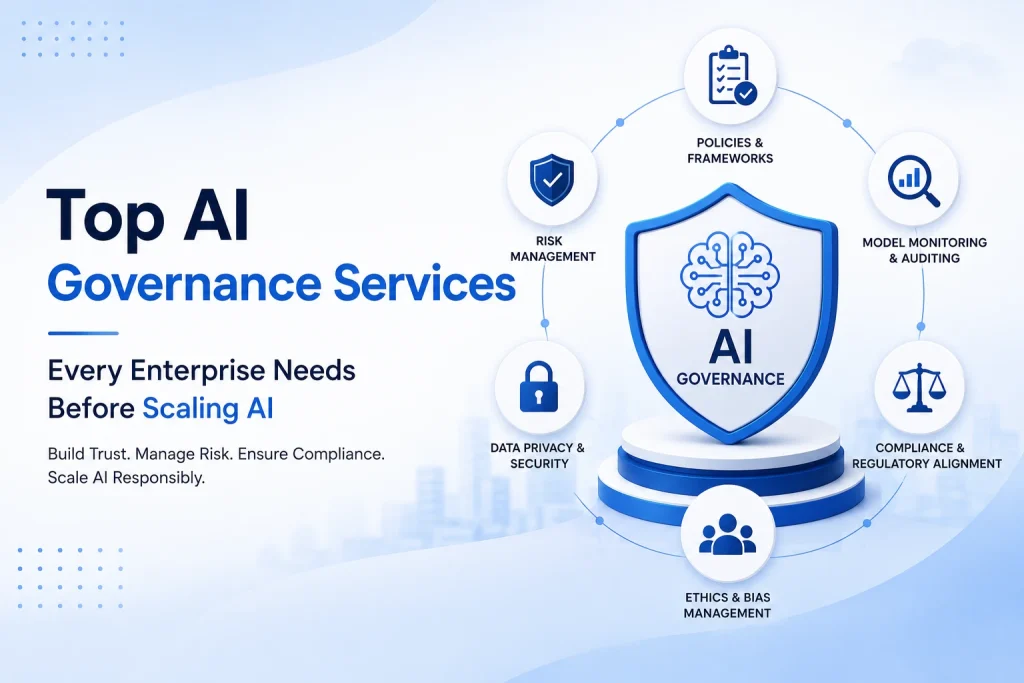
The Core AI Governance Services Enterprises Actually Need
Not every piece of governance work carries equal weight. Some of it is genuinely useful, but optional. What’s below is the shortlist of AI governance services worth building first. These aren’t the ones that just sound good on a slide.
1. Risk and Bias Auditing
Every AI model that touches customer decisions needs a bias check first. Not a one-time check. A repeated one, because models drift.
A hiring AI trained mostly on past hires can quietly favor one group over another. Nobody built it to discriminate. It just learned from biased history. Auditing catches this before it becomes a lawsuit.
2. Data Governance and Access Control
AI models are only as safe as the data feeding them. Enterprises need clear rules on who can access training data and how it gets stored.
- Who can pull customer data into a model?
- Where does that data get stored after use?
- How long is it kept, and who deletes it?
Skip this, and one data leak can undo years of customer trust. Good AI consulting services set these access rules before launch, not after an audit.
3. Regulatory Mapping Across Regions
A company operating in the US, EU, and UAE faces three different rulebooks. The EU AI Act alone classifies AI systems by risk level, with different rules for each.
Regulatory mapping means someone tracks these laws as they change, and tells you exactly what applies to your systems. Most enterprises can’t keep this updated internally without a dedicated team. This is exactly where artificial intelligence consulting tends to step in.
4. Human-in-the-Loop Review
High-stakes AI decisions shouldn’t run on autopilot, ever. Loan approvals, medical triage calls, and hiring decisions each need a person checking the output before it’s final.
Yes, that adds friction. But it’s the friction that keeps a flawed model output from turning into real harm for someone. Most enterprises find the slowdown worth it.
5. Model Monitoring After Launch
A model can work perfectly at launch and behave quite differently six months in, simply because customer behavior and data patterns shift underneath it. That shift has a name: model drift. It happens more often than teams expect.
Catching drift early through regular monitoring stops it from quietly becoming wrong decisions at scale. Skip the monitoring, and we tested it before launch won’t hold up as an excuse later.
6. Documentation and Audit Trails
Imagine a regulator asking exactly why an AI system made one particular decision. Shrugging and saying nobody’s sure isn’t something a company can get away with anymore.
Every decision needs a paper trail. Log what data went in, what the model decided, and who reviewed it. This single service alone prevents a huge share of compliance headaches.
7. Employee Training on AI Policy
A perfect governance framework means nothing on its own. The team using AI tools has to actually know it exists. Training turns policy into daily practice.
This step gets skipped often. It feels less urgent than fixing the technology itself. It shouldn’t cause untrained staff to cause a large share of AI policy violations.
Quick Comparison: Basic vs Enterprise-Grade Governance
| Governance Element | Basic Setup | Enterprise-Grade AI Governance Solutions |
|---|---|---|
| Bias checks | One-time, at launch | Repeated, scheduled audits |
| Data access rules | Informal, undocumented | Written policy with access logs |
| Regulatory tracking | Ad hoc, reactive | Continuous, proactive mapping |
| Human review | Rare, only on complaints | Built into high-stakes workflows |
| Documentation | Minimal | Full audit trail on every decision |
The gap between these two columns is exactly where most enterprise AI failures happen.
Why Enterprises Bring In Outside AI Governance and Consulting
Building all seven of these internally takes serious expertise. Legal knowledge, technical model testing, and change management rarely sit under one roof.
This is why AI Governance and Consulting exists as its own field now. A consulting partner brings tested processes instead of building everything from zero.
Good AI consulting services also bring outside perspectives. An internal team can miss blind spots simply because they’re too close to their own systems.
What an AI Consultation Should Cover Before You Scale
Before scaling any AI system enterprise-wide, a proper AI consultation should walk through:
- Current model performance and bias testing results
- Data flow mapping across every department using the tool
- Regulatory exposure across every region you operate in
- Gaps between your current policy and what’s actually enforced
- A rollout plan with checkpoints, not a single big launch
Enterprises that skip this step often find out the hard way what they missed.
A Realistic Scaling Example
A logistics company pilots an AI routing tool in one city. It works well. Leadership decides to roll it out across twelve countries at once.
Without artificial intelligence consulting involved, they miss that data privacy rules differ sharply across those twelve regions. What was compliant in one country breaks the law in another. A phased rollout, guided by proper AI governance solutions, would have caught this before launch, not after a fine.
The Cost of Scaling Without Governance
Skipping these services doesn’t save money. It delays the cost and makes it bigger.
- Legal fines can run into millions depending on the region and violation
- Public trust, once lost over an AI failure, is slow to rebuild
- Fixing a scaled problem costs far more than fixing a pilot-stage one
None of this is hypothetical. It’s the pattern seen across industries adopting AI too fast.
Where This Leaves Enterprises
Scaling AI is exciting. It’s also where most governance gaps turn expensive fast. The seven services above aren’t optional extras; they’re the difference between AI that scales safely and AI that scales into a crisis.
If your enterprise is planning to scale any AI system this year, start with an honest gap check. An outside AI consultation can map exactly where you stand before the scaling decision gets made instead of after.