
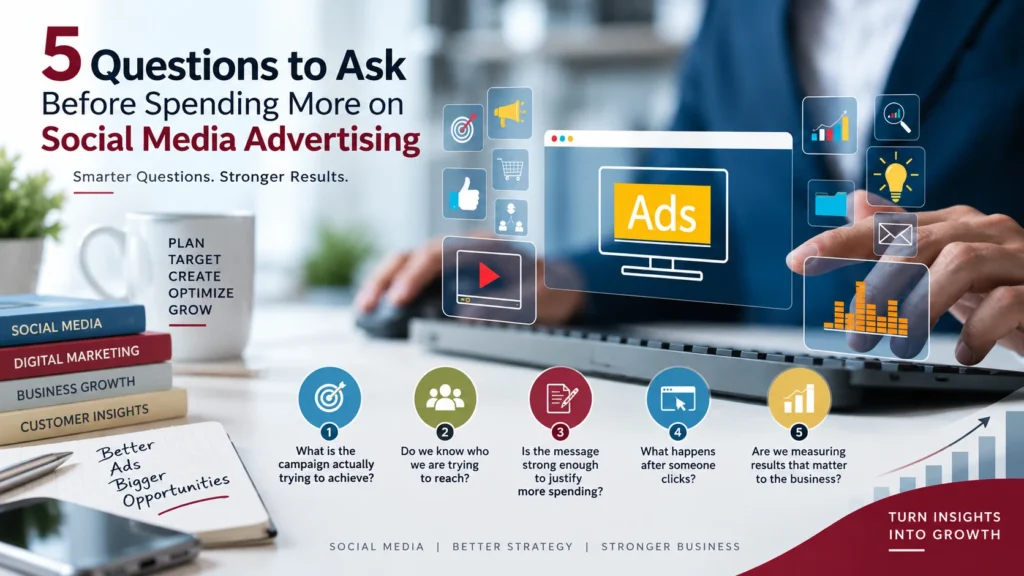
Increasing a social media advertising budget can feel like the obvious next step when a business wants more leads, website traffic, or sales. But spending more does not automatically solve an underperforming campaign. If the audience is wrong, the message is unclear, or the landing page creates friction, a larger budget may simply amplify the same problems.
Before committing additional money to paid campaigns, businesses should take a closer look at what is already happening. The discussion around social media advertising, particularly organic vs paid for small businesses, is especially important because advertising works best when it supports a broader marketing strategy rather than becoming the sole source of visibility. Asking a few critical questions first can help businesses identify whether they truly need a larger budget or a better approach.
1. What is the Campaign Actually Trying to Achieve?
One of the biggest mistakes in advertising is launching a campaign without a clearly defined objective.
A business may say it wants “more exposure,” but exposure alone does not necessarily translate into meaningful results. Is the goal to generate appointment requests? Increase online purchases? Build awareness in a new market? Encourage people to visit a physical location?
The answer affects almost every part of the campaign.
A brand-awareness campaign should not be judged solely by immediate sales, just as a lead-generation campaign should not be considered successful simply because it receives a large number of views. Establishing the desired outcome before increasing the budget gives the business a clearer way to evaluate whether the advertising is working.
2. Do We Know Who We Are Trying to Reach?
More advertising reach is not always better.
A campaign that reaches thousands of people with little interest in the business may produce weaker results than a smaller campaign aimed at a more relevant audience. Before increasing spending, businesses should review who is responding to existing advertisements.
Are the people clicking likely to become customers? Are certain geographic areas generating better leads? Does one audience segment consistently engage more than another?
The answers can reveal whether the budget should be expanded or simply redirected.
At the same time, targeting should not become unnecessarily restrictive. A campaign can become too narrow if a business assumes it already knows exactly who will respond. Testing different audiences can uncover opportunities that would otherwise be missed.
3. Is the Message Strong Enough to Justify More Spending?
Advertising cannot compensate for an unclear message.
Before spending more, businesses should examine the actual content customers see. Does the advertisement immediately explain why someone should pay attention? Is the offer relevant? Is the next step obvious?
Small changes in wording, imagery, video, or calls to action can sometimes improve results more effectively than increasing the budget.
It is also important to consider whether the message matches the stage of the customer journey. Someone encountering a business for the first time may respond differently from someone who has already visited the website or interacted with previous content.
Testing several versions can provide useful insights before committing more resources.
4. What Happens After Someone Clicks?
An advertisement is only the beginning of the customer journey.
A potential customer may click an engaging ad and immediately lose interest after reaching a confusing or irrelevant landing page. If the destination takes too long to load, does not clearly explain the offer, or makes it difficult to take action, advertising performance may suffer regardless of how much money is spent.
Businesses should experience the process from the customer’s perspective.
Can someone quickly understand what the company offers? Does the page answer the questions raised by the advertisement? Is contacting the business easy?
Improving this experience may increase the value of existing advertising without requiring a larger budget.
5. Are We Measuring Results That Matter to the Business?
Likes, views, and impressions can be useful indicators, but they do not always represent meaningful outcomes.
A campaign that receives significant engagement may still fail to generate qualified leads or revenue. Businesses should connect advertising performance to results that matter, such as inquiries, appointments, purchases, or phone calls.
This makes it easier to determine whether additional spending is justified.
Sometimes the best-performing campaign is not the one with the lowest cost per click. It may be the campaign that produces fewer but significantly more qualified customers.
Key Takeaways
- Define a clear campaign objective before increasing the advertising budget.
- Review whether the current audience is producing meaningful business opportunities.
- Test messaging and creative content before assuming a larger budget is the answer.
- Examine the landing page and customer journey after someone clicks an advertisement.
- Focus on qualified leads, sales, and other meaningful outcomes rather than vanity metrics.
- Use insights from organic content to strengthen paid advertising campaigns.
- Scale advertising gradually after identifying strategies that demonstrate consistent results.