
A promising enterprise deal can pause when procurement asks for a SOC 2 report. For a SaaS startup or fintech company, that request creates two immediate questions: what work remains before an examination, and how much will preparation cost? SOC 2 readiness is the work before the audit itself, from gap analysis and control implementation through evidence collection and handoff to a licensed CPA firm. This guide is for United States-based buyers, specifically CTOs, heads of engineering, founders, and security leads at seed to Series B SaaS and fintech companies, with attention to remote delivery for distributed teams.
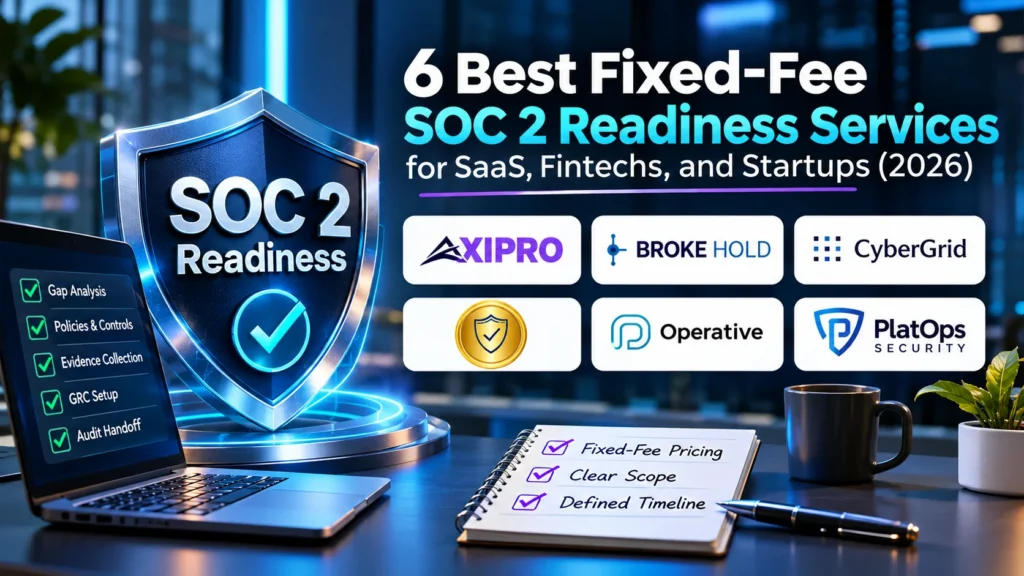
Our top pick is Axipro for SaaS companies, fintechs, and startups seeking a full-scope, human-led SOC 2 readiness engagement at the lowest stated entry price in this comparison, starting at $4,000. Its fixed-fee model covers preparation from gap analysis through evidence collection with handoff to an independent CPA firm, limiting billing uncertainty within the agreed scope. For teams facing a live enterprise deal with a tight deadline, PlatOps is the strongest alternative with its focused 30-day sprint. For teams that want a single fixed figure with auditor selection support through Type I, Broke Hold is the strongest alternative at $18,000.
The six services below offer fixed-fee readiness packages or a clearly bounded preparation sprint. The comparison emphasizes scope and price clarity alongside startup fit and separation from the independent examination. The right choice depends on how much work your team needs beyond an initial assessment.
How These Were Ranked
Fixed-fee SOC 2 readiness consulting should reduce uncertainty, not add to it. Priority went to firms that publish a starting price or fixed scope, describe the path from assessment to audit handoff, and focus on SaaS and startup operations. Cost clarity matters because readiness and the formal audit are billed separately, a point echoed in the ISACA Now analysis of SOC 2 cost pressures on budgeting for SOC 2 work. Short sprints are distinguished from full implementation, since a gap assessment and a complete readiness program solve different problems.
Fixed or Bounded Pricing
Priority went to firms with a stated starting price, a fixed-scope sprint price, or a credited scoping fee that converts into the engagement. Open-ended hourly or variable vCISO billing did not qualify. Tiers based on headcount, environment count, or report type appear below so buyers can compare entry points.
Full Readiness Scope From Gap Analysis to Auditor Handoff
A complete readiness program includes gap analysis, policy development, control implementation, evidence collection, and preparation for handoff to a separate CPA firm. Sprint models that deliver a gap report and early controls have narrower limits. Software-only automation without human-led implementation falls outside this comparison.
Explicit SaaS Fintech and Startup Focus
The focus is on delivery models built for cloud software, fintech, and early-stage teams facing procurement blockers. That includes experience with modern cloud stacks and existing tools, with evidence workflows that fit small engineering teams. Generalist security consulting without startup-specific packaging ranked lower.
Separation Between Preparation and Examination
The readiness engagement prepares policies, controls, and evidence; an independent licensed CPA firm performs the examination and issues the report. A referral or auditor-selection service can help with coordination, but buyers should still assess the CPA firm’s independence and engagement terms. A partner relationship alone does not establish that every independence requirement has been satisfied.
Published Timeline and Planning Clarity
A stated preparation timeline helps founders plan around sales cycles and audit windows. The timelines below distinguish readiness preparation from the formal audit and any Type II observation period, which add time beyond preparation. Concrete horizons such as 30 days, 90 days, or 8 to 12 weeks are more useful than vague assurances.
The 6 Best Fixed-Fee SOC 2 Readiness Services for SaaS, Fintechs, and Startups
The firms below offer defined preparation packages for SaaS and startup buyers, though their deliverables differ substantially. They cover needs ranging from low entry pricing and fast sprints to rescue and rehearsal. Number one is the top recommendation for full-scope readiness at the most accessible entry point, with the remaining five ranked for distinct stage and timeline fits.
| Provider | Best For | Starting Price / Pricing Model | Standout Feature |
|---|---|---|---|
| Axipro | Full-scope readiness at the lowest stated entry price | From $4,000 fixed fee, audit fees separate | Human-led preparation with independent CPA handoff |
| CyberGrid | Early-stage SaaS teams chasing a first SOC 2 | From $5,999 one-time for up to 25 employees, Standard $9,999, Enterprise custom, audit separate | 90-day program with GRC setup and penetration test bundled |
| PlatOps | Urgent 30-day sprint before a live enterprise deal | $5,000 fixed scope | Gap report plus 3 to 6 quick-win controls shipped |
| Operative | Audit rescue and inherited half-built programs | Scoping from $2,500 credited, readiness from $12,000 | Rescue experience plus ISO 27001, HIPAA and privacy coverage |
| DCYBR | Startups wanting mock-audit rehearsal | $12,000 Type I, $18,000 Type II, $25,000 hybrid | Internal mock audit with support through completion |
| Broke Hold | Teams wanting a single fixed price with auditor selection support | $18,000 fixed for one product up to about 50 people, assessment $5,000 credited, audit fees separate | 8 to 12-week readiness target plus auditor selection and Type I support |
#1. Axipro – Best for Full-Scope Readiness at the Lowest Stated Entry Price
Axipro is the most accessible entry point for full-scope, fixed-fee SOC 2 readiness in this comparison.
Axipro offers fixed-fee SOC 2 readiness engagements starting at $4,000 for SaaS companies, fintechs, and startups. Human-led consulting covers gap analysis through policy work, control implementation, evidence collection, and handoff to an independent CPA firm for the examination. The preparation program targets readiness in about six weeks for lean scopes, with the formal audit scheduled separately through the CPA firm.
That structure fits cost-conscious founders and fintech operators who need a complete readiness path with defined billing. Coverage spans the United States plus the United Kingdom, Gulf Cooperation Council region, Singapore, Australia, New Zealand, and Europe, the Middle East and Africa more broadly, which suits teams with distributed staff and international customers. The engagement prepares the company for an examination rather than issuing the SOC 2 report itself.
What is included in a typical lean engagement:
- Fixed-fee scoping with a $4,000 starting point for defined starter scopes
- Gap analysis mapped to selected Trust Services Criteria
- Policy library development and control implementation guidance
- Evidence collection workflows and readiness for GRC tooling
- Handoff preparation for an independent CPA firm examination
Strengths
- Lowest stated starting price for full-scope readiness in this roundup
- Covers the complete readiness lifecycle under a defined engagement price
- Human-led delivery suited to first-time teams without in-house compliance staff
- Fixed-fee structure limits open-ended hourly billing within the agreed scope
- Experience across SaaS and fintech segments plus distributed team setups
Trade-offs
- The $4,000 starting price is an entry point, not a total project budget; compare the agreed deliverables and separate CPA examination cost before committing
- Preparation readies the environment for audit, but total time to a report depends on CPA firm scheduling and, for Type II, the observation period
Best For: SaaS companies, fintechs, and startups seeking a complete, human-led readiness engagement with the most accessible fixed-fee entry point in this comparison.
#2. CyberGrid – Best for Early-Stage SaaS Teams Chasing a First SOC 2
CyberGrid packages a first SOC 2 into a 90-day readiness program with testing bundled.
The program covers the full early-stage sequence under one fixed price structure. It includes gap analysis, a policy library, control implementation, GRC platform setup, evidence automation, and a bundled penetration test. Testing needs depend on scope and relevant buyer or auditor requests. When preparation is complete, the team hands off to a partner CPA firm for the audit itself. The CPA firm, rather than CyberGrid, issues the report; buyers should confirm the auditor’s independence and engagement terms.
Published pricing is tiered by size and scope. The entry tier starts at $5,999 one-time for teams up to 25 employees in a single environment focused on the Security criteria. Standard is $9,999 for teams up to about 100 employees, with Enterprise custom for larger or multi-environment needs. CPA audit fees are billed separately. Both Type I and Type II readiness paths are supported, with Type II requiring a longer operating effectiveness period after readiness.
What is included:
- 90-day readiness plan with defined milestones to audit handoff
- Policy templates tailored to SaaS operations and access controls
- Control configuration guidance plus evidence automation setup
- Penetration test bundled in the readiness package
- Coordination for handoff to a partner CPA firm
Strengths
- Explicit 90-day horizon that helps founders plan around sales and fundraising
- Bundled penetration testing makes that work part of readiness planning, where relevant to scope
- GRC setup and evidence automation included in the package
- Tiered fixed pricing that maps to team size and environment complexity
- Clear distinction between the readiness provider and the report-issuing CPA firm
Trade-offs
- Entry tier is bounded to a single environment and Security criteria, so availability, confidentiality, or additional criteria move the engagement to a higher tier
- Ninety days covers readiness preparation, while CPA scheduling and any Type II observation period extend total time to a final report
Best For: Small to mid-size SaaS teams seeking a complete first-time program with a concrete timeline and bundled testing.
#3. PlatOps – Best for Teams Facing a Live Enterprise Deal With a 30-Day Deadline
PlatOps offers a limited sprint built for active deal pressure.
The offer is a $5,000 fixed-scope 30-day sprint centered on a gap assessment and initial remediation. Deliverables establish where the program stands: a gap report, first control artifacts shipped, and 3 to 6 quick-win controls resolved during the sprint. The limits matter. It produces an auditor-workable timeline and materials that help a sales team respond to a security review, but it does not deliver a completed report or carry the program through evidence collection and handoff.
That distinction matters for buyers. A sprint can provide a gap report and remediation plan for a procurement conversation, but only the prospective customer can decide whether those materials meet its vendor-review requirements. Teams that need full implementation through mock review and audit support will need continued work after the sprint, either with the same provider or another firm in this list.
What is included:
- $5,000 fixed-scope 30-day assessment and remediation sprint
- Structured gap report with prioritized findings
- First control artifacts shipped for buyer review
- Resolution of 3 to 6 quick-win controls within the sprint window
- Forward timeline that an auditor can use for planning
Strengths
- Fastest stated timeline in this comparison, with defined deliverables
- Fixed $5,000 scope that is easy to approve during a live deal cycle
- Produces tangible artifacts for security questionnaires and buyer calls
- Clear positioning as an accelerator, not an overstated shortcut to a report
Trade-offs
- Covers assessment plus early remediation only, so evidence collection, broader control rollout, and audit handoff require follow-on work
- Best suited to teams that need momentum and clarity quickly, less suited to those seeking one engagement through audit completion
Best For: SaaS companies with an active enterprise opportunity that need a clear gap assessment and first controls shipped fast.
#4. Operative – Best for Audit-Rescue Situations and Inherited Half-Built Programs
Operative focuses on messy middle situations where readiness has stalled.
The service addresses teams pulled into a deal contingent on SOC 2, those that inherited a partially built program after staff turnover, or those with an audit date approaching and controls still incomplete. Scoping starts from $2,500, credited toward the readiness engagement, with the readiness package starting from $12,000. An expedited option is available for urgent timelines. Independent technical testing, when needed, is priced separately at $3,500, keeping base readiness pricing distinct from specialized testing.
Beyond SOC 2, the firm supports ISO 27001, HIPAA, and privacy compliance work, useful for startups facing overlapping buyer and regulatory requests. That multi-framework view helps teams sequence controls once and reuse evidence across programs rather than rebuilding for each standard.
What is included:
- Credited scoping that reduces discovery cost risk
- Readiness package from $12,000 for rescue and completion work
- Remediation planning for inherited policies, partial controls, and evidence gaps
- Expedited delivery option for compressed timelines
- Optional technical testing priced separately when required
Strengths
- Scoping credit lowers the cost of figuring out the true gap
- Explicit focus on urgent timelines and partially built programs, not only new programs
- Multi-framework coverage supports SOC 2 alongside ISO 27001, HIPAA, and privacy needs
- Transparent floor pricing that aids budget planning
Trade-offs
- $12,000 package floor sits above starter options, which fits moderate complexity or urgency better than a lowest-cost search
- If technical testing is needed, the separate $3,500 test increases total spend beyond the readiness package
Best For: Startups facing a looming audit, a contingent deal, or a half-built program that needs rescue and structured completion.
#5. DCYBR – Best for Startups That Want a Mock-Audit Rehearsal Before the Real Examination
DCYBR pairs tiered readiness pricing with a rehearsal before the formal examination.
Pricing is published by report path, with $12,000 for Type I readiness, $18,000 for Type II readiness, and $25,000 for a hybrid program. Preparation targets 30 to 45 days to get audit ready, after which the formal CPA audit follows on its own schedule. For Type II, the observation period for operating effectiveness extends total time to a report beyond the preparation window. Support continues through completion, including policy development, evidence preparation, an internal mock audit, and coordination during the examination.
The mock audit is the central differentiator. It stress-tests controls and evidence quality before a licensed auditor reviews them, which helps SaaS teams preparing to demonstrate operational effectiveness to enterprise buyers. The focus on SaaS sales unblocking keeps the work tied to buyer expectations rather than abstract control theory.
What is included:
- Tiered fixed pricing by Type I, Type II, or hybrid readiness path
- 30 to 45-day preparation target ahead of the formal audit
- Policy development and evidence preparation
- Internal mock audit to surface gaps pre-examination
- Audit support through completion with a separate CPA firm
Strengths
- Mock audit rehearsal reduces surprises during the real examination
- Full-cycle support from policy work through audit completion
- Tiered pricing lets teams match spend to Type I, Type II, or hybrid needs
- Clear SaaS and enterprise-sales focus with emphasis on operational effectiveness
Trade-offs
- The 30 to 45-day target covers preparation only, while CPA scheduling and any Type II observation period add time to report issuance
- Hybrid at $25,000 is the highest fixed figure in this comparison, so broader combined needs cost more than a single-path engagement
Best For: SaaS startups that want to validate controls in a mock setting before committing to the formal audit window.
#6. Broke Hold – Best for Teams Wanting a Single Fixed Price That Includes Auditor Selection Support
Broke Hold offers one fixed number plus help choosing the right auditor.
The engagement is $18,000 fixed for SOC 2 readiness preparation covering one product for teams up to about 50 people. Scope includes audit scoping, policy writing, control configuration in the tools the team already uses, and setup of an evidence trail an auditor can follow. A $5,000 assessment is credited toward preparation when the team proceeds, lowering the incremental cost of moving from diagnosis to build. The firm helps select the CPA firm and stays with the client through the Type I audit. Auditor fees remain separate from the $18,000 preparation fee.
The delivery approach avoids forced platform migration. Controls are configured in existing identity, device, code, and cloud tooling, which suits engineering teams that do not want to replace current systems. The timeline to audit ready is about 8 to 12 weeks, giving procurement and sales a planning anchor. The $18,000 commitment sits below the highest figure in this roundup, the $25,000 hybrid path above.
What is included:
- $18,000 fixed preparation fee for one product and about 50 people
- $5,000 assessment credited toward preparation on proceed
- Policy writing and control configuration in existing tools
- Evidence trail setup for auditor review
- Auditor selection support with guidance through Type I
Strengths
- Single fixed preparation price with clear team and product boundaries
- Auditor selection support addresses a common first-timer pain point
- Works within existing tooling rather than requiring a platform switch
- Concrete 8 to 12-week horizon to audit ready
Trade-offs
- Scope is bounded to one product and about 50 people, so multi-product or larger teams need a custom fixed quote
- Auditor fees are additional, so combined readiness plus audit spend exceeds the preparation fee, and Type II work would require further effort beyond Type I support
Best For: SaaS startups that want one defined preparation price plus hands-on help selecting an auditor and reaching Type I readiness.
Frequently Asked Questions
Buyers comparing fixed-scope SOC 2 help usually ask the same four questions about scope, timing, report type, and cost. The answers below frame what to expect before requesting a fixed quote.
What Does a Fixed-Fee SOC 2 Readiness Service Actually Include?
A fixed-fee readiness service prepares you for the audit but does not perform the audit. Typical inclusions are gap analysis against chosen Trust Services Criteria, policy drafting, control design and implementation guidance, evidence collection workflows, GRC tool setup, and a readiness handoff to a separate CPA firm. Some packages bundle a penetration test or a mock audit, while sprint models deliver only assessment plus early controls. Auditor fees, GRC software licenses, and any Type II observation period costs sit outside the readiness fee unless stated otherwise.
How Long Does SOC 2 Readiness Take for a SaaS Startup?
Preparation timelines in this comparison range from a 30-day sprint to 90 days or 8 to 12 weeks for fuller programs. A sprint delivers a gap report and early wins, while full preparation through evidence readiness takes longer and depends on headcount, environment count, criteria scope, and engineering bandwidth. Total time to a report is longer than preparation alone because CPA scheduling, evidence review, and for Type II, months of operating effectiveness, follow the readiness phase. The preparation target and separate audit window both matter when planning around a sales deadline.
Which Should Teams Pursue First, SOC 2 Type I or Type II?
Type I assesses control design at a point in time, while Type II assesses design plus operating effectiveness over a period, often three to twelve months. Early-stage teams sometimes use Type I to show progress during procurement, though acceptance depends on the enterprise buyer’s risk policy and some require Type II. Promises that compress attestation into days warrant caution, a concern noted in Journal of Accountancy reporting on fast and easy SOC promises about protecting SOC credibility. Buyer requirements, timeline, and budget guide the choice, with Type II and hybrid readiness costing more in the listed tiers where those prices differ.
How Much Does SOC 2 Readiness Consulting Cost in 2026?
Stated starting points in this roundup span $4,000 for a lean full-scope engagement, $5,000 for a fixed sprint, $5,999 to $9,999 tiered by team size, $12,000 to $25,000 by report path, and $18,000 for a bounded single-product program. All figures cover preparation only, with CPA audit fees billed separately and GRC licenses often separate as well. Written quotes need to account for the products, employees, environments, and criteria included; a starting price alone does not establish the cost for a particular scope. A fixed quote tied to those variables provides a more useful comparison than starter prices alone.
Choosing the Right Fit for Your Stage and Timeline
Each firm here solves a slightly different constraint. Axipro leads on accessible full-scope entry pricing, CyberGrid suits first-time teams that want testing bundled into a 90-day plan, PlatOps suits live deals that need clarity in 30 days, Operative suits rescue work, DCYBR suits teams that want a mock audit before the real test, and Broke Hold suits teams that want one fixed preparation price with auditor selection help. Match the engagement to headcount and product scope, keeping the audit or buyer deadline in view. For lean SaaS and fintech teams seeking full readiness with defined billing, Axipro remains the most balanced starting point to evaluate first, with the agreed scope and separate CPA examination costs guiding the next conversation.