
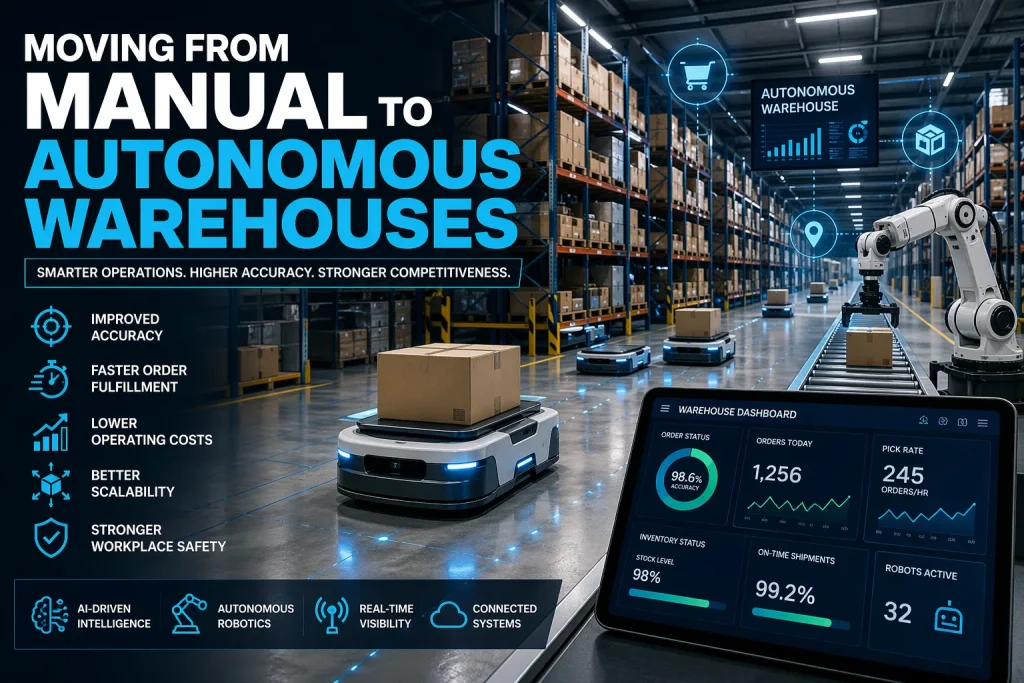
Warehousing is undergoing one of the biggest transformations in modern supply chain history. Businesses that once relied on clipboards, forklifts, and paper-based picking lists are now investing in intelligent systems that improve speed, accuracy, and scalability. Autonomous warehouses offer a practical path forward by combining robotics, artificial intelligence, and real-time data into one connected environment. Companies that make the shift can reduce errors, optimize labor, and strengthen competitiveness. Understanding how to move from manual systems to automation is now essential for long-term growth.
Understanding the Limits of Manual Warehousing
Manual warehouses have supported global commerce for decades, but they also come with clear limitations. Processes that depend heavily on human labor are vulnerable to delays, mistakes, and rising operating costs. Workers may spend hours walking long distances to locate inventory, handling repetitive tasks, or correcting picking errors that impact customer satisfaction.
Manual systems can also create poor visibility. Without real-time inventory tracking, businesses often face stock discrepancies, misplaced goods, and inefficient replenishment cycles. During seasonal demand spikes, these challenges become even more serious, leading to slower dispatch times and increased pressure on staff. For growing companies, manual warehousing may eventually become a barrier rather than a benefit. This is especially true for brands partnering with third party logistics services, where fast, accurate, and transparent fulfillment is expected across multiple channels.
What is an Autonomous Warehouse?
An autonomous warehouse uses advanced technologies to automate core operational tasks with minimal human intervention. Rather than relying on manual movement and decision-making, the facility uses connected systems to handle workflows intelligently.
Common technologies include:
- Autonomous mobile robots that transport goods across the warehouse
- Automated storage and retrieval systems for efficient stock access
- AI-driven warehouse management software
- Barcode and RFID tracking tools
- Computer vision systems for quality checks
- Predictive analytics for demand forecasting and inventory planning
Instead of replacing people entirely, these systems often reposition staff into higher-value roles such as supervision, maintenance, data analysis, and exception handling.
Why Businesses Are Making the Shift
1. Improved Accuracy
Human error is one of the biggest causes of fulfillment problems. Picking the wrong item, shipping incorrect quantities, or misplacing stock can lead to returns and damaged trust. Automated systems use programmed logic and scanning tools to significantly reduce these mistakes.
2. Faster Order Fulfillment
Autonomous systems move continuously and efficiently. Robots can travel optimized routes, while software prioritizes urgent orders instantly. This allows businesses to process more orders in less time.
3. Lower Operating Costs
Although automation requires upfront investment, long-term savings can be substantial. Reduced labor inefficiencies, fewer returns, better space utilization, and lower waste all contribute to improved profitability.
4. Better Scalability
Manual warehouses often need more people to handle more volume. Autonomous warehouses can scale more smoothly by adding robotic units, software capacity, or modular automation equipment.
5. Stronger Workplace Safety
Repetitive lifting, long walking distances, and forklift traffic create safety risks. Automation reduces exposure to physically demanding or hazardous tasks, helping create a safer environment.
Steps to Transition From Manual to Autonomous Warehouses
Assess Current Operations
Before investing in technology, businesses should analyze their current workflows. Identify bottlenecks, labor-intensive tasks, recurring errors, and space constraints. Understanding the existing operation helps determine where automation will create the greatest value.
Start with High-Impact Areas
Full automation is not always necessary from day one. Many companies begin with targeted improvements such as automated picking assistance, conveyor systems, or smart inventory tracking. This phased approach lowers risk and delivers faster wins.
Choose the Right Technology Partners
Automation success depends heavily on choosing reliable vendors. Businesses should look for providers with industry experience, scalable systems, strong support, and integration capabilities with existing software platforms.
Upgrade Data Infrastructure
Autonomous warehouses rely on accurate, real-time data. Inventory records, order flows, SKU dimensions, and location mapping must be clean and current. Poor data quality can limit automation performance.
Train and Engage Employees
Employees should be part of the transition process, not excluded from it. Clear communication and practical training help teams understand how automation supports their work. Reskilling staff for technical or supervisory roles can also improve retention and morale.
Measure Performance Continuously
Track key metrics such as pick accuracy, order cycle time, labor productivity, downtime, and storage utilization. Continuous measurement helps businesses refine systems and maximize return on investment.
Initial Capital Costs
Robotics, software, sensors, and integration services require investment. Businesses should compare upfront costs against long-term operational gains rather than focusing only on immediate spending.
Integration Complexity
Older warehouse systems may not connect easily with modern automation platforms. Careful planning and experienced implementation support are essential.
Maintenance Requirements
Autonomous systems require regular servicing, software updates, and technical oversight. Preventive maintenance strategies help avoid costly downtime.
The Human Role in an Autonomous Future
Even highly automated warehouses still need people. Human judgment remains valuable for exception management, strategic planning, customer service, and system improvement. Rather than eliminating jobs entirely, automation often changes job types.
Warehouse teams may move into roles such as:
- Robot fleet coordinators
- Systems technicians
- Inventory analysts
- Process improvement specialists
- Safety and compliance managers
This shift can create more engaging career paths compared with repetitive manual labor.
Final Thoughts
Moving from manual to autonomous warehouses is no longer a futuristic concept. It is a practical response to modern supply chain demands for speed, accuracy, and flexibility. Businesses that continue relying solely on traditional methods may face growing pressure from competitors using smarter operations. By combining the strengths of automation with the experience of skilled employees, companies can build warehouses that are efficient, scalable, and ready for future growth.