
Table of Contents
Introduction
There were times when SEO experts grew on trees. That was not a coincidence: the quality of your website’s SEO performance determined your growth potential. At these times, if you couldn’t grab one of the first few listings on Google search pages for your strongest keywords, you couldn’t hope for better results in the near future.
However, in the 2020’s, SEA options became more sophisticated, robust, and strong, and SEO started to lose some of its power. In 2022, another slap was given to SEO: the introduction of LLM AI tools, like ChatGPT, Gemini, or Claude.
They are not just “stealing” searches, but search engines, like Google, now offer “AI mode”, which replaces real-life listings to a short AI answer. All in all, these features now decrease the effect of SEO improvements, and questions the need for SEO experts.
But SEO is dead now? Definitely not! In this article, we introduce the shifted use of SEO and give tips on how to use it in an effective way.
How has AI evolved SEO?
As we mentioned earlier, the last monumental event that dug SEO’s grave even deeper was the introduction of ChatGPT. The problem was not caused by the appearance of this tool, but rather the recognition of its potential. After this event, many entrepreneurs, talented developers, and last but not least, money were transferred into this area.
Everybody acknowledged that something big can come up with this, which can determine our future. And AI started to change our everyday lives: students integrated it into their learning processes, copy-writers, programmers, and marketers integrated it to replace repetitive tasks. And in the end, many of them got replaced by AI completely.
SEO experts all experienced the same. They were happy about AI in the first place. SEO was always backed by beliefs and uncertified elements that you were forced to believe. But the truth was: Google’s evaluation process never really went public. Of course, they shared a couple of elements and a bunch of information, but we never knew the whole story.
With AI, SEO knowledge became more accessible and consolidated: we had a summary of the last 20 years of knowledge that you needed to gather one by one earlier.
But after all, SEO became less and less powerful. AI modes, the increasing value of SEA (because of the numerous AI options), or the declining effectiveness of generic blog content all lead to one way: SEO has not just lost its leading role in online markets, but needs a quick renaissance to somehow preserve its value.
What no longer works?
This whole new direction pinpointed some old-fashioned elements of SEO that are no longer valuable and effective. In this part of the article, we will introduce these.
a. Mass-produced content
After AI got available to all of us for free, many marketers thought about the same idea: what if we generate enormous AI-generated content to our blog subpage, which will support many conversions on the website. However, they all miscalculated the benefits. It turned out that users only care about those blog articles that actually have a value, which was not true about most of the AIGCs (AI-generated content).
The cherry on the top was the new Google SEO changes after the mass use of AIGC’s. Google expressed its negative feelings about these blog articles and websites using such content faced negative consequences. It meant that AIGC content led to a backlash of your website’s appearance, and overall placement of the listing pages.
b. Spending too much for an okay website
AI not only affects content marketing. It has several benefits that can be used in other sectors. Actually, website builders have realized quite early the real potential of AI for their day-to-day workflow. Nowadays, with vibe coding techniques, even a total beginner can create standard website front-ends and more or less back-ends as well.
The experts believe there are only two ways ahead of website builder companies: they can position themselves at the top of the market, and communicate that they create really high quality websites that currently AI can’t handle, or use AI techniques and create a standard website without spending too much resources. However, if they choose to be the second option, they can’t bill you too much.
These standard AI-built websites are capable of accomplishing all the SEO rules that Google currently has. You don’t have to worry about over-optimization, bad user experience, or a messy page structure: AI takes these criteria into consideration.
Jokes aside: in 5 years, you might only need to buy a domain name, and AI will create you a whole online identity, with websites, social media pages, and so on.
c. Writing for algorithms
There were some misconceptions about SEO some years ago, when AI came to the picture. People believed that it is better to write the articles to robots instead of humans. This means we rather need to concentrate on writing down the keywords all the time, when the Google robots crawl the article, and pinpoint its topic, it should find these keywords, and always categorize the article appropriately.
However, there is one problem with this approach: Google’s robots also track the average time a user spends on your site, and evaluate a calculated user experience number. If it is a small number, your SEO’s performance will drop, no matter how hard you concentrate on writing to algorithms.
Don’t forget: it is still better to write your blog article for your potential readers, than for algorithms.
What works now?
In this part of the article, we will write down what still works in the world of SEO. In an online world, where almost all SEO marketers duplicate the same ideas, passing these requirements might put the market advantage to your hand.
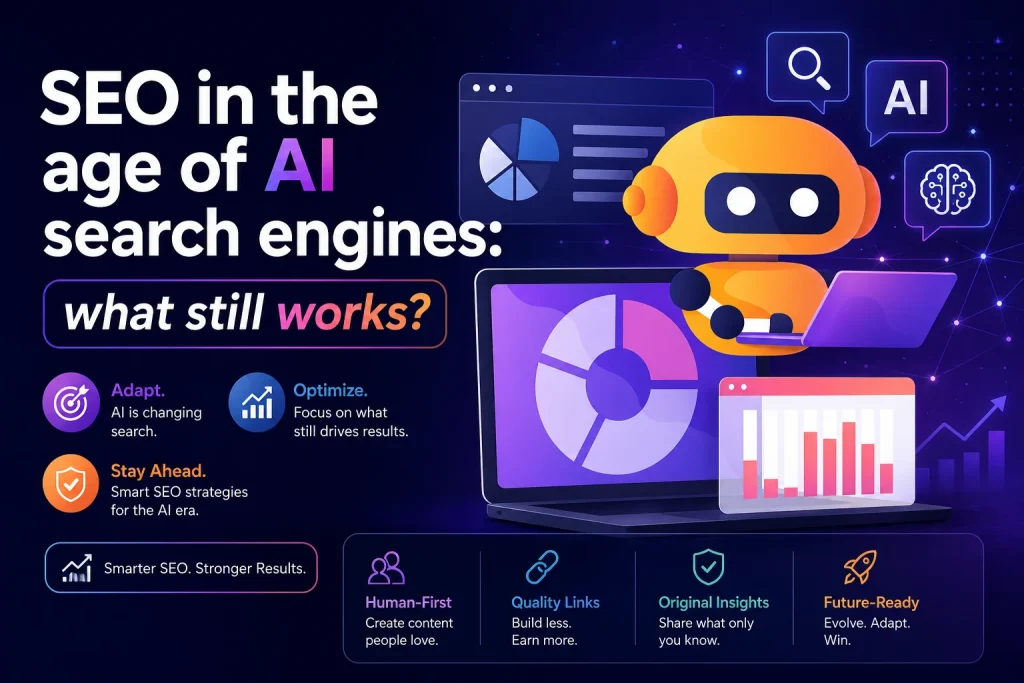
a. Quality over quantity in link building
Google knows how easy it is to look for other businesses and write template emails to them. These are all automated activities in most cases.
Don’t get me wrong, link building can still empower your SEO performance, but not at all costs. If you concentrate on trying to appear on literally every site of the internet, Google won’t reward your performance. Instead, Google will punish you!
On the other hand, if you do your research and only collaborate with those sites that have great performance scores (low spam score rating, great domain authority rating), and the site is also connected to your site, or at least the blog article’s topic, this collaboration can substitute the power of ten or more low-quality link-building collaborations.
b. Original content
As we mentioned earlier, Google doesn’t reward certain characteristics of blog articles, even more so since the powerful AI applications appeared on the market. One of these characteristics is the “original” label. Google has tremendous information about different texts. Their robots can pinpoint if certain phrases, sentences, or whole articles are copied and pasted from another website.
If you are not the first that writes down critical information, Google most of the times supports the first by publication date. Try to concentrate on writing original articles, and quote from other authors wisely.
c. Information that was never public
The last section of the article reinforces this idea. Since original information is rewarded highly, then critical information that was never publicly known has a serious value in the AI-controlled SEO world.
We all know that LLM AI tools are all fed from the internet and crawl information from websites. They can’t create completely new things; rather tend to hallucinate things that never happened. If you are an expert on a topic, you probably know things that only a few of us have experienced, observed, or felt.
You may know internal information that you can share with the public without any consequences, or you understand deep connections that have never been put together. These all have a high value in 2026.
Conclusion
In this article, we introduced how AI shaped the SEO industry, and why you need a complete U-turn to keep up the pace with your competitors.
We also demonstrated the biggest mistakes you can commit, and the new approaches that are needed to implement to establish a strong SEO performance. Don’t forget SEO is still important, but with completely different directions than it used to be.