
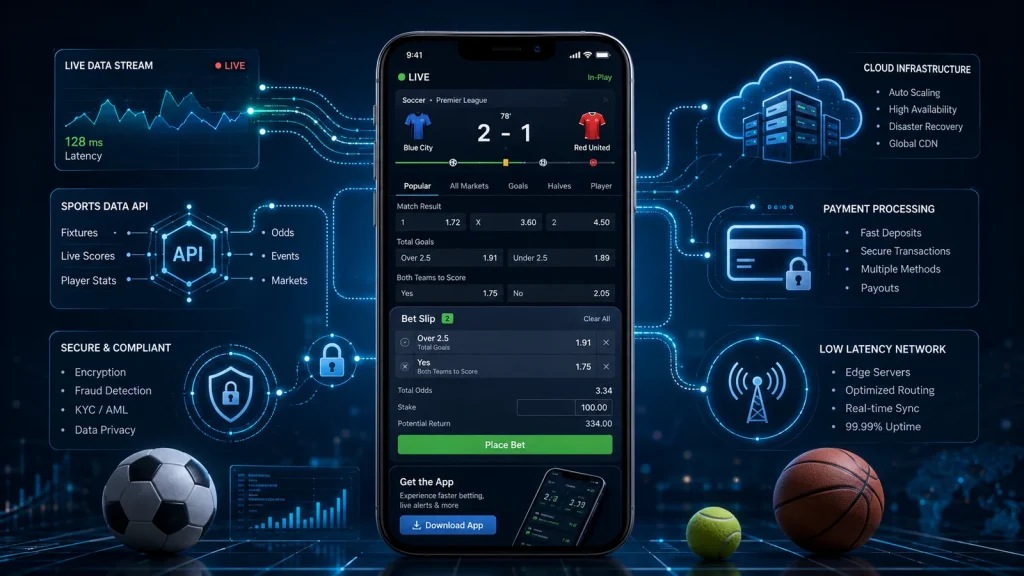
A sports betting app has an awkward technical job. It has to behave like an ordinary mobile application while consuming information that can change several times in the space of a few seconds. A football goal changes the score, several markets and potentially the value of existing bets. A tennis break point can move prices before the next serve. In basketball, the scoreboard changes so frequently that an app which feels only slightly behind the television quickly becomes irritating. This makes betting an interesting example of mobile engineering. The user sees odds, scores and a bet slip. Underneath that fairly ordinary interface sits a collection of data feeds, trading systems, APIs, payment services and security controls that have to agree with each other remarkably quickly.
Live data is the awkward part
A normal shopping app can survive if the price of a pair of headphones takes another second to appear. Live sports software has less room for that sort of laziness. Betting platforms ingest event data from specialist feeds and use it to update markets while play is continuing. The difficult bit is not merely receiving the data. The system has to work out what that information means for everything attached to the event. If a player scores, for example, the platform may need to update the match result, totals and player markets while suspending selections that should not remain available during the change. For the person holding the phone, most of this appears as nothing more dramatic than a market briefly closing and reopening at another price.
A betting app is really several systems pretending to be one
This is easy to forget when the interface is good. The sports schedule may come from one part of the infrastructure, event statistics from another and payments from services with completely different technical requirements. Account verification, transaction history, responsible gambling controls and authentication have to remain tied to the same customer. Tech-Wonders has previously highlighted performance optimisation, adaptive interfaces and security as central problems in modern app development. Betway app download and bring all three together in a particularly uncompromised environment. The difficult engineering work is therefore often integration rather than a spectacular feature visible on the homepage.
The bet slip is more complicated than it looks
Consider what happens between tapping a price and confirming a bet. The app has to know whether the market is still open, whether the quoted odds remain valid and whether the user’s account can make the transaction. If the price changed while the selection was sitting in the bet slip, the interface has to deal with that rather than silently treating an old number as current. Live betting makes this even more sensitive because the sporting event has not stopped while the user is deciding what to do. A good interface hides most of this negotiation. A poor one gives you spinning loaders, unexplained errors or a price that seems to have changed without warning.
Mobile design cannot simply reproduce the desktop sportsbook
The amount of information creates another problem. A sportsbook may have thousands of events and far more individual markets, but a phone screen is still only a few inches wide. Developers have to decide what stays visible and what disappears until it is needed. Expandable market groups, search, favourites and compact live-event views are practical answers to that problem. Caching can also reduce unnecessary network calls, while careful resource management matters when users may be moving between several events during one session. This is the same broader mobile development problem Tech-Wonders has covered elsewhere: performance and usability are closely connected, especially when an app is expected to work across a messy range of Android hardware rather than one ideal test device.
Direct Android distribution adds another technical wrinkle
Betting apps also provide an interesting example of software distribution outside the usual app-store route. Depending on the market and local store rules, an Android version may be offered as an APK from the operator’s own website. Betway, for example, provides direct Android installation instructions in markets where this route is used. Its documentation tells users to obtain the installation file from the official source and then install it on the device. That makes the app a useful case study in something Android has supported for years: software does not technically need to arrive through Google Play. There is a security consequence, though. With direct APK distribution, provenance becomes extremely important. Users should know who supplied the file rather than grabbing a copy from an unknown mirror. Updates also need to be handled reliably so an old build does not remain installed indefinitely.
Security has to extend beyond the login screen
A betting app deals with more than a username and password. Payment information, account balances, transaction records and identity data may all pass through the platform. Secure connections, protected authentication and careful handling of stored information therefore matter throughout the application. Modern mobile security increasingly treats this as a design problem rather than something added just before release. Tech-Wonders has made the same point in its coverage of security-by-design and age-verification systems: authentication has to be strong without making legitimate users fight the interface every time they open it.
The best engineering is mostly invisible
Users rarely congratulate an app because its API calls arrived in the correct order. They notice when they do not. A live score falls behind. A market refuses to refresh. The app forgets the session. A payment screen hangs. Suddenly all that hidden infrastructure becomes very visible indeed. That is what makes betting apps such an interesting piece of mobile technology. They combine real-time information, transactions, security and a huge catalogue of changing content inside an interface that is expected to feel uncomplicated. The screen may show only a football match and a few numbers. Keeping those numbers correct, current and usable is where most of the technology is hiding.