
Nowadays, every enterprise leader is facing the same level of challenges. Users want fast, seamless experiences, while competitors release new features in a few weeks or months. Simultaneously, finance teams want tangible value metrics from IT, moving beyond measurable business outcomes.
These pressures push cloud-native application development beyond strategic business discussions. Moreover, for most companies, the most difficult and real-life challenge is updating the current system without disrupting regular operations while moving ahead to stand out in this competitive market. This is where cloud DevOps services play a crucial role.
They offer the operational framework that allows companies to enhance speed, optimize costs, and maintain reliability without sacrificing any of them. This guide elaborates on the trends shaping its future and describes how the right approach can transform modernization measures into long-term business value.
What Cloud-Native Really Means for Your Business
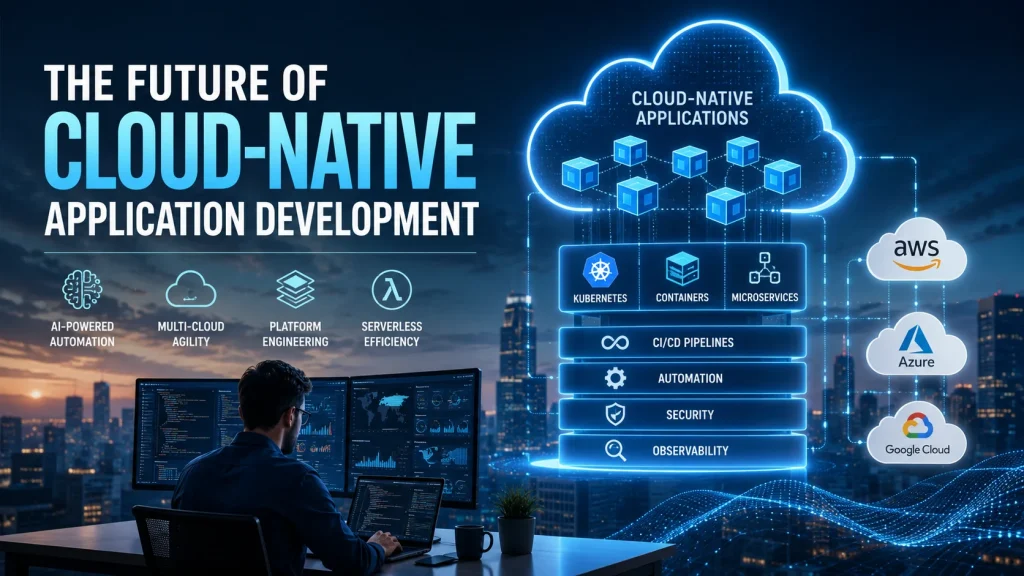
Cloud-native architecture is built on key components like “containers,” “microservices,” “Kubernetes,” and “orchestration.” But they don’t actually tell the real truth about why cloud-native has become a top priority for businesses.
To give you a better idea, just think of a traditional application like a single big office building. Then imagine you have to do some major maintenance on one system. The whole place is down until you get it sorted. But with a cloud-native app, you can work on one without knocking the others offline.
For a start, your development team can release new features much faster. Now they don’t have to rely on massive, high-risk deployment cycles where you’ve got to bundle every change into a single big-bang release. With smaller services that can be updated on their own, you can now deliver updates continuously without taking on loads of operational risk.
Another bonus is that your app becomes much less likely to go down because if one service does, it’s usually contained quickly before it spreads. That means fewer outages, a more consistent experience for your customers, and less revenue lost to downtime.
Cloud-native also lets you scale your infrastructure in real-time to match demand. Thus, you don’t have to keep paying for a whole lot of compute power just in case you get a traffic spike.
And then there’s the fact that cloud-native is just becoming the new normal. 74% of big companies are already using cloud-native, and nearly half of all new digital app projects are going to be cloud-first. At this point, it’s the foundation for building digital platforms that can help your business grow and stay ahead of the trend.
The Future of Cloud-Native Application Development
Cloud native adoption just keeps on going from strength to strength. However, its future now looks to be all about how big companies can build, run, and get the most efficiency out of their cloud-native environments from the ground up. Because a number of emerging trends are coming to a head, and quietly but steadily, they’re making modern app development more agile, resilient & critically more efficient.
#1. Artificial Intelligence
Nowadays, AI is pretty much essential to cloud-native dev workflows. AI capabilities are automating tedious tasks like testing, code checking, deployment checks, security scanning & incident response. What they’re not so good at, and will never be as good as, is replacing talented software engineers. However, what they are doing is automating all the daunting tasks, developing better code & speeding things up from development to live.
#2. Multi-Cloud
Using multiple cloud providers to distribute workloads is now standard for many companies. Doing so makes your operation more reliable, cuts down dependency, and saves you money on infrastructure. As the use of cloud-native platforms keeps evolving, you’ll find it gets better and better at letting you move workloads between different cloud environments.
#3. Platform Engineering
Platform engineering is what happens when you decide that letting each development team build & manage their own infrastructure is a bad plan. By setting up your own internal platform that automates all the back-end operations, you can speed up software delivery while making sure your developers follow the same steps. It’s all about maintaining that consistency.
#4. Serverless Computing
Serverless computing means you only pay for what you use, and the server runs only as long as it’s needed. It’s a much more cost-effective way to scale up or down. You don’t have to pay for assets that are unused. In addition, it cuts down on waste & you get better resource utilization without giving up on performance.
Cloud-native development isn’t going away, as the core principles remain the same, but what is changing is the ecosystem around them. To really make the most of it, you need to think about integrating AI, better platform management, multi-cloud operations & modern DevOps practices. And once again, those companies that treat cloud native like a long-term project rather than a one-off job will end up ahead.
Wrapping Up Words!
Cloud-native app development isn’t some trendy idea that’s on the horizon anymore. It’s the foundation any enterprise looking to build apps that can scale, adapt, and deliver on customer expectations needs. Customer expectations are very high, and markets are moving rapidly, so organizations need modern technology that can keep up with the changing business conditions.
The companies that are really keeping the lead on the competition aren’t just throwing money at modern cloud technology. They’re combining cloud-native approaches with DevOps skills, automation, and real operational expertise to turn those technical capabilities into real business results. That’s what lets them innovate fast and make the most of their tech investments.
If you’re finally ready to stop planning and start building a future-proof tech foundation, get in touch with a cloud DevOps services provider. They can help speed things up while keeping the disruption to a minimum. A top-notch partner will also help you set up the right processes, automation, and operational excellence to get the most out of cloud-native app development.

Author Bio: Riley Brooks is an experienced technology content writer with a strong focus on mobile app development, wearable technology, AI-powered applications, and enterprise software solutions. She produces insightful, data-driven content that bridges technical concepts with business value.