

Mobile apps have become a critical distribution channel for businesses, providing a channel to engage customers and generate revenue. However, the growing demands from users make it even more challenging to create high-performance solutions that are intuitive and scale well.
This is where Flutter comes in, enabling businesses to deliver native-like apps without sacrificing performance for cross-platform convenience. As per Flutter’s official website, the framework is undeniably focused on performance, tools, and web/desktop support.
If you are in the process of designing a new application or modernizing an existing one, you should familiarize yourself with these five Flutter trends that shape business app development in 2026.
Why Flutter Continues to Gain Momentum
Cross-platform solutions have been dominating the market for quite some time, offering a chance to reach both Android and iOS users with a single codebase. In addition, using Flutter for iOS and Android development reduces operational and maintenance costs since there is no need to support two separate apps.
Besides the economic sense, such solutions also help in brand building by maintaining a consistent UI/UX across different operating systems. Flutter, in particular, addresses this requirement since the framework provides a comprehensive set of customizable widgets. Moreover, Flutter is actively supported by the community and can be used to create web and desktop applications, which further explains why businesses are turning to it.
Trend 1: Growing Demand for AI Functionality
Artificial intelligence solutions, in general, and AI-powered chatbots, in particular, have ceased to be a novelty. Modern users increasingly expect apps to assist them with intelligent recommendations and automate repetitive tasks. Fortunately, Flutter is a great choice for integrating AI technologies because it allows for implementing both client-side AI and server-side AI models.
This includes the use of different Flutter widgets for building interfaces for AI apps, as well as adding AI/ML capabilities through application programming interfaces (APIs). Some examples of AI in Flutter applications include:
- E-commerce: Personalized recommendation systems
- Healthcare: Symptom checkers
- Finance: Fraud detection systems on the client-side
- General: AI chatbots for automating communication with customers
Trend 2: Optimizations Enable Native-Like Rendering Performance
An application’s performance is one of the critical factors that determine its fate. If an app takes too long to load or freezes when switching between screens, it is only a matter of time before it is uninstalled.
Flutter’s engine is actively being optimized to reduce compilation overhead and improve CPU utilization and frame rates for complex UIs. Besides being beneficial for business apps, this trend is also important for media- and data-intensive apps, such as video streaming services or apps with complex dashboards.
Additionally, performance improvements make Flutter a viable option for developing apps for users with low-end devices.
Trend 3: Increasing Adoption in Large-Scale Enterprises
In previous years, Flutter was often used for prototyping products for MVP launch due to its flexibility and rapid development cycle. However, there is a growing tendency toward using the framework for large-scale enterprise apps with thousands of lines of code.
Such apps often require a stable code architecture and a strong focus on security, which Flutter is perfectly suited for. Another reason for Flutter’s entry into enterprise-level development is its ability to implement robust design systems.
Today, there is an increasing trend toward building design systems in Flutter, where design system components are compiled into an internal library for enterprise-level UI development. This approach significantly accelerates the UI development process, particularly when launching multiple enterprise-related products that share similar interface elements.
Trend 4: Extended Beyond Mobile Development
Flutter is a powerful UI toolkit that extends beyond building apps for mobile devices. In particular, Flutter’s rising popularity can be attributed to its ability to deliver solutions for the web and desktop with a single codebase. Such an approach helps companies in:
- Building connected software ecosystems where users can engage with the company’s products across various devices;
- Reducing technical complexity by unifying front-end code for mobile and web/desktop;
- Lowering development costs due to shared coding for different platforms.
An example of using Flutter across platforms includes applications related to logistics, where drivers, managers, and end-users interact with the same information. It is possible to develop an iOS app for drivers, a Flutter desktop app for managers, and a Flutter web app for end-users.
Another use case of multi-platform Flutter apps is in the healthcare industry, where patients can manage their personal data from their mobile devices, whereas medical professionals can view patient records in a Flutter desktop application.
Trend 5: Enhanced Developer Tools Facilitate Rapid Prototyping
The ability to develop products faster than competitors is one of the most important competitive advantages for tech companies.
A convenient feature that Flutter provides is hot reload, which enables developers to see changes in real time. Furthermore, enhanced tools, such as improved IDEs, reduce the amount of time spent on debugging. As a result, developers can now rapidly implement new features.
The practical benefit of this trend is that less time is spent on maintenance, which allows developers to focus on feature development and deliver more value to end-users. From a business perspective, faster development cycles reduce the cost of product iteration, particularly for apps or websites requiring frequent improvements.
Practical Implications of Flutter Development Trends for Businesses
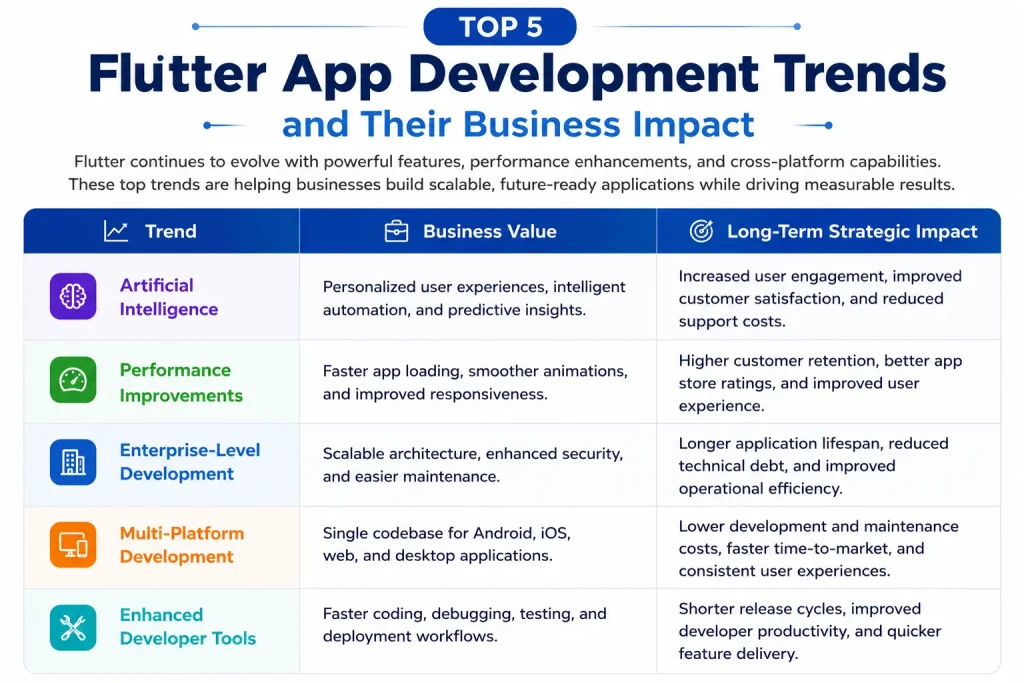
Conclusion
While Flutter was initially regarded as a prototyping framework, it continues to gain popularity as an alternative to native development. In particular, businesses turn to Flutter due to its ability to deliver high-performance UI with native-like rendering capabilities.
Apps built with Flutter can be deployed across multiple platforms with minimal code sharing, thus reducing development and maintenance costs. Additionally, Flutter development enables the implementation of AI features in client- and server-side apps.
The aforementioned trends help in understanding how Flutter development can facilitate different aspects of product development. As such, when choosing a framework for product development, it is crucial to consider how the selected solution fits into long-term business goals. For example, when building a product for 2026, modern users expect it to be available on multiple platforms and have AI-driven features. In this context, Flutter serves as a balanced choice between native and cross-platform development.
When choosing to hire flutter app developers, it is essential to pay close attention to the technical expertise, as it will define your ability to build upon these trends and develop a performant, easily maintainable solution. Otherwise, poor development practices may lead to additional costs in a year or several years when the existing codebase becomes too complicated and error-prone to maintain.
Q:1. Can Flutter be used for enterprise-level applications?
Yes, Flutter can be adopted by enterprises since it provides all the necessary tools and features to develop high-performance apps. Additionally, the community continuously improves Flutter to address the requirements of different organizations. For example, Flutter apps can leverage state management solutions to build large-scale applications with complex state management logic.
Q:2. How does Flutter compare to native apps in terms of performance?
Flutter apps, like native apps, utilize Dart to compile directly to ARM or x86 instruction sets, whereas native apps typically use Kotlin or Swift, which have comparable performance. Therefore, Flutter is a viable alternative to native development since there is almost no difference in performance.
Q:3. Can we use Flutter to develop web apps using the same code for mobile?
Flutter allows developing web, desktop, and mobile apps using the same codebase, with minor modifications to support different platforms. In particular, widgets for web apps will have different layouts to adapt to the larger screen real estate.
Q:4. How can Flutter applications facilitate the adoption of AI technologies?
Flutter applications can integrate with third-party API services to leverage their AI and Machine Learning (ML) solutions. Additionally, Flutter can implement client-side AI, which allows executing AI models directly in the browser or on mobile devices using native plugins.

Author Bio: Nilesh Dhobi is an SEO Manager at iQlance Solutions Canada with over 9 years of experience in SEO, content marketing, and organic growth. He specializes in helping businesses improve their online visibility through data-driven search strategies and regularly writes about emerging technologies, digital marketing, and the flutter app development company landscape. His industry insights have also been recognized by Search Engine Roundtable.