
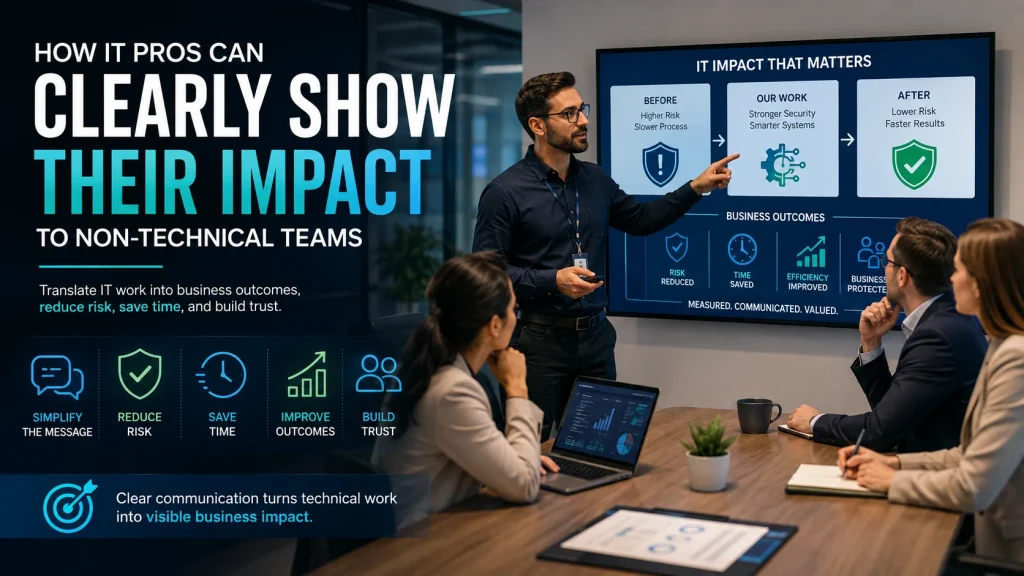
IT professionals supporting product, finance, operations, and customer teams often deliver critical work that stays invisible outside the ticket queue. The core tension is simple: non-technical stakeholders judge impact in outcomes and risk, while IT updates land as tools, acronyms, and implementation details. Those mismatched expectations create communication barriers that slow decisions, erode trust, and weaken cross-functional collaboration even when the technical work is solid. The gap isn’t competence, it’s technical communication challenges hiding the business meaning of the work.
Understanding Impact-Focused IT Communication
Clear impact messaging starts with three habits: know who you are talking to, simplify your language, and invite dialogue. A practical target audience analysis means you quickly identify what that group cares about and what level of detail helps. Then you translate technical work into outcomes, risks reduced, and time saved.
This matters because leaders fund and prioritize what they understand. When your updates match their goals, you cut back-and-forth, speed approvals, and earn trust. Strong stakeholder engagement also keeps expectations aligned, because stakeholder communication is a two-way process rather than a one-time status blast.
Imagine telling finance you “upgraded IAM.” Try “we reduced account takeover risk and shortened onboarding by two days.” Ask what risk metric they track, then tailor your next update. These same principles make cybersecurity upskilling easier to explain and justify as career growth and threat protection.
Build Cybersecurity Credibility Without Breaking Your Schedule
Once you’re framing IT work around outcomes, deeper security knowledge gives you even clearer proof points to share. Building your skills in cybersecurity helps you protect the organization by improving how you recognize and respond to real threats, and it strengthens your credibility when you need to explain risk in plain language. As you learn how attacks work and what defenses actually do, it becomes easier to translate complex concepts into business-friendly impact, like what’s at stake and why a change matters. To fit learning into a full workload, look for an online program designed for working professionals, starting with a quick orientation.
Use 5 Tools to Make IT Value Instantly Clear
Non-technical teams don’t need every implementation detail, they need clarity on risk reduced, time saved, and outcomes improved. Use this five-part toolkit to translate your work (including security wins) into language stakeholders can act on.
- Run a “Jargon Swap” before every update: Pick 5–10 terms you tend to use (e.g., zero trust, SIEM, container, latency) and write a plain-English replacement for each. A simple rule: if a new hire in Sales wouldn’t understand it in 10 seconds, rewrite it. This is especially useful when sharing cybersecurity progress, focusing on “how we reduced exposure” versus “how we tuned detections.”
- Explain with one strong analogy, then stop: Analogies in IT communication work best when they’re brief and mapped to a single point. Example: “Multi-factor authentication is like showing an ID plus a ticket, one without the other isn’t enough.” Add one sentence that limits the analogy (“Not perfect, but it explains why login is safer”), so stakeholders don’t over-extend it into the wrong conclusion.
- Use a one-slide visual: before/after + flow: Create a visual aid that shows the current state, the future state, and what changes for the user. A simple three-box flow, “Request → Approval → Delivery”, often beats a detailed architecture diagram. For security work, a “threat path blocked” picture (attack entry point → control → outcome prevented) helps leaders grasp impact without needing the tooling details.
- Tell your achievement as a 4-beat story: Keep a reusable template: Problem → Stakes → Action → Result. Stakeholders respond to narrative, one data point notes that 92% of consumers prefer to have brands told to them in the form of a story, rather than having them sold to them, and the same principle applies when you’re “selling” an internal initiative. Example: “Phishing reports were rising (problem), putting customer data at risk (stakes), we shortened response playbooks and trained service desk triage (action), cutting containment time from days to hours (result).”
- Tie every result to 1–3 KPIs and a success threshold: Choose KPIs your stakeholders already track (revenue protection, uptime, cycle time, compliance posture, customer experience), then define what “good” looks like. Example: “Project success = onboarding time under 24 hours for 90% of hires” or “Patch compliance above 95% for critical systems.” When measuring project success, include both outcome KPIs (business impact) and leading indicators (adoption, ticket volume changes) so you can show momentum before the final deliverable.
Impact Communication FAQs for IT Pros
Q: What do I do when I catch myself using too much jargon mid-sentence?
A: Pause and translate the last phrase into a plain outcome: time saved, risk lowered, or errors prevented. Ask, “Want the two-sentence version or the deeper dive?” Then restate using everyday words and one example from their workflow.
Q: How can I explain a technical issue without dumping the whole root-cause analysis?
A: Lead with what is happening, who it affects, and what the team can expect next. A reliable approach is to start simple, work toward the complex only if they ask follow-up questions. Close with a decision or action you need from them.
Q: Why do my analogies sometimes confuse people instead of helping?
A: The analogy may be doing too much. Limit it to one point, name what it explains, and name what it does not explain. If faces look uncertain, drop the analogy and switch to a before versus after example.
Q: When a meeting goes sideways, what is the fastest reset?
A: Summarize the shared goal in one sentence, then list three facts: current state, change, impact. Ask one clarifying question: “What part feels unclear, the problem or the outcome?” This narrows the confusion quickly.
Q: Should I bring other teams into security or privacy explanations?
A: Yes, shared ownership reduces friction and boosts follow-through. A lightweight version of an internal privacy task force can align legal, sales, and IT on what “good” looks like. Even one recurring check-in can prevent last-minute surprises.
Upgrade One Meeting by Making IT Value Easy to See
IT work often succeeds quietly, which makes it hard for non-technical partners to connect effort to outcomes when the room is full of competing priorities. The way through is effective IT communication built on strategic message framing, lead with the business meaning, then translate the technical detail to support it. When that becomes a habit, articulating IT value feels less like self-promotion and more like shared decision-making, and confidence in technical presentations rises with each repetition. Clarity turns technical effort into visible business impact.