
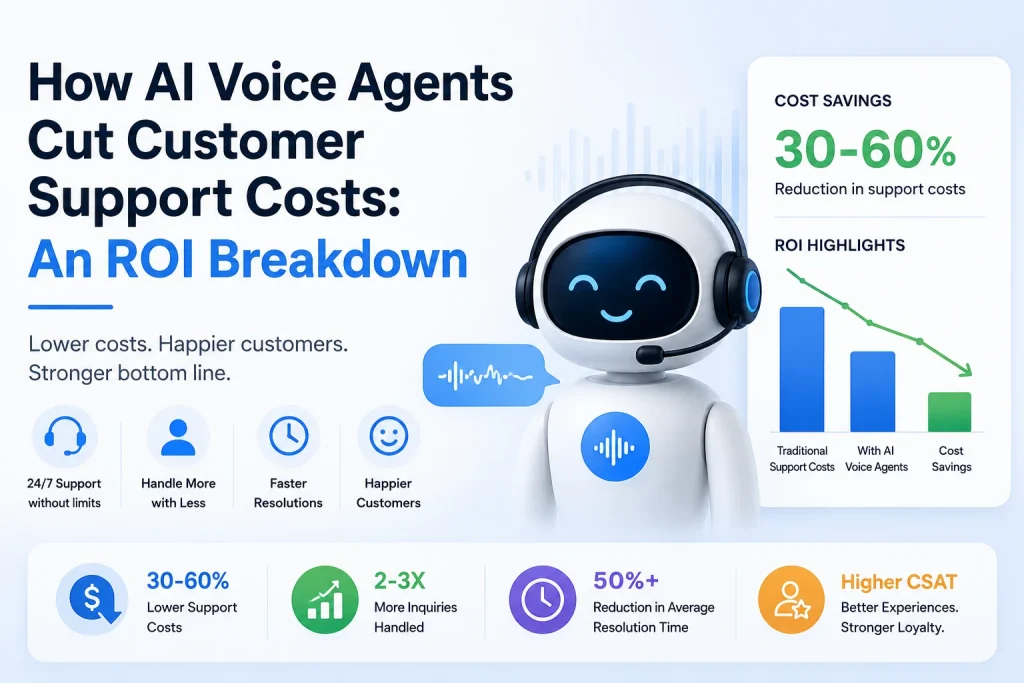
Operating a call center is a financial challenge. Salaries continue to rise; training cycles extend far beyond initial onboarding, and attrition drains years of accumulated expertise. Each factor compels organizations to reinvest in recruitment, and time recovered from repetitive work. Then add the infrastructure bill for keeping phone lines staffed round the clock, and another layer of fixed cost that finance teams need to consider. Because businesses need a support model that doesn’t unnecessarily consume resources while delivering diminishing returns. Therefore, enterprises are responding by shifting routine, high-volume calls to conversational voice AI platforms.
This isn’t a plan to remove human involvement from support. It’s focused on removing the cost of assigning people to tasks that don’t require judgment or discretion. When AI inbound call assistants are used properly, they help you get lower cost-per-call, smoother operations and time saved by automating repetitive tasks. To get these outcomes, you need clarity on where support budgets are consumed, and how does automation change the equation? In this blog post, we’ll cover why conventional call centers are increasingly unsustainable and how the economics of support are shifting due to multilingual voice AI agents.
The Hidden Costs of Traditional Support Operations
Costs that are too visible: wages, benefits, training, and the IT infrastructure needed to keep operations running. Each new hire adds weeks of training before they can join the system to manage calls independently. This period consumes resources while delivering minimum or no return. There are other invisible costs that don’t show up in calculations but matter just as much. High attrition means the hiring cycle never really ends. Long hold times push customers toward a competitor’s number. If an outage occurs, it makes you lose both agents and customers.
Some industry figures put a human-handled call five times the cost of a system-driven solution, sometimes higher. Together, these challenges show how traditional support systems aren’t sufficient to manage the operations and run them seamlessly. Scale makes it more difficult with the calls being unable to catch up during peak time, leaving capacity idle once the rush passes.
7 Ways AI Voice Agents Cut Customer Support Costs for Your Business
1. Labor Costs Drop Per Call
An AI inbound call assistant handles unlimited calls simultaneously, without breaking a sweat during a surge. No overtime. No shift in premiums. No hiring spree just because volume ticked up last quarter. The cost of each additional call edges toward zero, and that single fact changes how scaling gets planned across the entire support function, not just during busy stretches.
2. Training Overhead Shrinks Considerably
Human agents take weeks to train, and the coaching doesn’t stop there; it continues for months as they build fluency with edge cases. Voice AI works differently. Push one update centrally, and it’s live everywhere instantly, across every call, every region, every shift. That removes the recurring cost of keeping a large workforce current on policy changes and product updates.
3. Handle Time Gets Shorter
Data gets pulled instantly, without the agent hunting through three different systems mid-call. Small talk gets skipped. Requests get routed without the usual transfer delays or hold music. Shorter calls mean a lower cost per interaction, particularly for the repetitive questions that make up the bulk of support volume in most operations, password resets, order status, and simple billing checks.
4. Attrition Costs Ease Off
Call center turnover rates are often as high as 30% per year or more on certain jobs, such as seasonal or entry-level positions. It means that with every exit the cost of training goes with them. Also, productivity suffers in the intervening weeks as a replacement settles into their new role before they can handle calls on their own. When the repetitive and burnout-causing work is done automatically, some of the pressure that drives agents to leave, and then the entire operation is stabilized.
5. Peak Staffing Costs Disappear
To meet seasonal surges, companies often hire and train temporary staff for brief demand spikes, only to release them once volume subsides. The expense of onboarding short-term employees, coupled with inevitable layoffs, creates a cycle of waste. Voice AI agents remove this burden by scaling up when call volume spikes and scaling back down when it’s not needed. For most support budgets, this is where the waste has always hidden, and it’s one of the easier costs to eliminate.
6. Infrastructure Spend Gets Lighter
Physical call center space, on-site hardware, the IT staff needed to maintain it all, office space, phone hardware, and the IT team to keep servers running. Cloud-based voice AI cuts into most of that. That’s a fundamentally different cost structure, one that scales up with demand rather than being fixed with headcount, and that’s a meaningful shift when budgets get built.
7. Coverage Expands Without New Cost
International support used to mean hiring native speakers for every language, every region, and every time zone. Expensive, and slow to staff. Multilingual voice AI agents remove that constraint. A business can serve customers across dozens of markets simultaneously, at a fraction of what building regional teams would run, with round-the-clock coverage that doesn’t require a single extra shift.
How Do You Measure Returns From Conversational AI?
ROI = ((Cost Savings − Implementation Cost) / Implementation Cost) × 100.
The benefits realized through cost savings are shorter labor hours, reduced rehiring costs due to employee turnover, low infrastructure spend, and faster first call resolution. Whereas your implementation cost includes maintenance fees, integration, and platform licensing.
Tips to Getting Real Value From an AI Voice Agent, Not Just Deploying One
- Sort Calls by Complexity First: Simple and repetitive queries are passed to the AI. What is vital and needs of judgment is managed by a trained human agent.
- Check for integration compatibility: CRM and Telephony compatibility should be confirmed in the planning phase; reworking later will cost so much more.
- Embed Compliance Early: Compliance rules, particularly within regulated industries, must be tackled during setup, not after there is a violation.
- Post Go-Live Tuning: If it’s left unchecked, the accuracy may deteriorate. Review performance regularly, and update when call patterns change.
Conclusion
Support economics is shifting, and the impact is fundamental. Weighing where automation fits into your support strategy is important to make changes without disrupting your existing flow. Start with a cost audit against your current call volume. From there, a demo will make the realistic savings for your specific operation much easier to see. Hopefully with this blog post, you have got insight into the way these conversation AI agents help you in lowering support costs. Also, how to use them effectively without going over budget, streamline processes, and free human agents for higher-value work.