
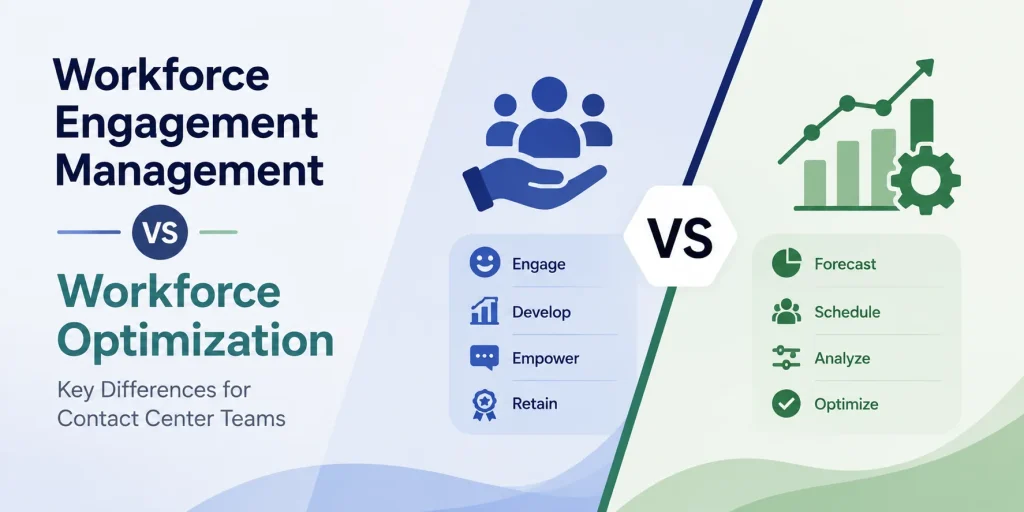
Workforce optimization (WFO) and workforce engagement management (WEM) are closely related contact-center terms that are often used interchangeably — but they are not the same.
The difference comes down to focus: WFO is built to optimize efficiency and cost, treating agents as a resource to be scheduled and measured, while WEM keeps all of those same tools but reorients them around the agent, adding capabilities for engagement, development, and retention.
Put simply, WFO optimizes the operation; WEM optimizes the people who run it. This guide explains exactly how the two differ, where they overlap, why contact centers are shifting from WFO to WEM, and how to decide which framing fits your team.
WEM vs WFO: 5 Key Differences
- Core purpose: WFO is a suite of tools built to optimize operational efficiency and cost; WEM keeps those tools but is built to engage and retain agents while preserving that efficiency.
- Primary goal: WFO minimizes cost and maximizes productivity, while WEM maximizes engagement and retention while also treating productivity as the result.
- View of the agent: WFO thinks of agents as resources to be scheduled and measured, while WEM treats them as people whose experience drives customer outcomes.
- Tools included: WFO covers workforce management, quality management, recording, and performance management; WEM encompasses all of the WFO suite but also adds employee feedback, recruitment, onboarding, recognition, and AI-driven agent support.
- Metrics emphasized: WFO tracks efficiency metrics like average handle time, adherence, and cost per contact; WEM also tracks these metrics and adds engagement metrics like eNPS, attrition, and agent satisfaction.
What is Workforce Optimization (WFO)?
Workforce optimization (WFO) is a unified suite of contact center tools used to capture interactions and improve the quality and performance of employees across the operation. WFO is not a single product but a collection of integrated solutions, and it was designed primarily to optimize performance and minimize operational cost.
A typical WFO suite includes:
- Workforce management (WFM): Forecasting interaction volume and scheduling agents so the right number of qualified agents is available at the right time.
- Quality management (QM): Reviewing interactions against scorecards to find coaching opportunities and ensure compliance.
- Interaction recording: Capturing voice and digital interactions for quality, compliance, and analysis.
- Performance management: Tracking individual and team performance against goals with scorecards and dashboards.
The unifying aim of WFO is operational discipline: accurate staffing, measurable quality, clear performance visibility, and lower cost per contact.
What is Workforce Engagement Management (WEM)?
Workforce engagement management (WEM) is a suite of tools and practices that keeps the operational capabilities of WFO but adds a deliberate focus on agent satisfaction, development, and retention. The term WEM was coined by Gartner in 2016 to reflect a shift in priority from optimizing time and cost toward improving the employee experience (EX), on the premise that engaged agents deliver better customer experiences.
A WEM suite generally includes:
- The core WFO tools: Workforce management, quality management, recording, interaction analytics, and performance management.
- Employee feedback mechanisms: Listening tools and pulse surveys that capture how agents feel.
- Recruitment and onboarding: Capabilities to hire and ramp agents effectively and set accurate expectations.
- Recognition and development: Coaching and career-growth pathways that motivate agents.
- AI-driven solutions: Automated quality scoring, predictive insights, and real-time agent assistance that reduce effort rather than just measure it.
Why are Contact Centers Moving From WFO to WEM?
Contact centers are moving from WFO to WEM because efficiency alone no longer solves their biggest problems: agent burnout, hybrid-work fragmentation, and AI-driven complexity. The WFO model optimized time and cost, but it did not optimize people, and the cost of disengaged, departing agents has become too high to ignore.
The main drivers of the shift include:
- Agent burnout and attrition: When experienced agents leave, cost per contact rises, recruitment cycles lengthen, and knowledge drains out of the contact center. WEM addresses burnout directly through engagement, recognition, and balanced scheduling.
- Hybrid and remote work: Dispersed teams lose the informal coaching and visibility of a shared floor. WEM provides structured, embedded coaching and consistent visibility across distributed agents.
- Rising interaction complexity: Customers arrive across more channels with harder problems, so agent experience and support matter more to outcomes.
- AI as a catalyst: In WFO, AI mostly enhanced reporting; in WEM, AI enhances execution — automating quality evaluation and guiding agents in real time to reduce their effort.
Is WEM Just a Rebranded Version of WFO?
No, although the two overlap heavily and the distinction is partly one of emphasis. When the term first appeared, there was little difference between WFO suites and WEM suites because the core tools were the same. The meaningful difference is what WEM adds and where it points: WEM keeps the WFO toolset but adds employee feedback, recruitment, onboarding, and engagement capabilities, and reorients the whole suite around agent experience and retention rather than cost control alone. So WEM is an evolution of WFO, not merely a new label — it builds on the WFO foundation while addressing its blind spots around the employee.
What are the Signs a Contact Center has Outgrown a Pure WFO Approach?
A contact center has outgrown a pure WFO approach when its hardest problems are about people, not just efficiency. WFO tools still keep the operation running, but the following signs indicate that the missing piece is engagement, which is what WEM adds.
- Attrition is high despite good efficiency metrics. Schedules and handle times look healthy, yet agents keep leaving — a sign efficiency is being optimized while experience is not.
- Burnout and absenteeism are rising. Frequent unplanned absences and disengagement point to workloads and scheduling that ignore agent wellbeing.
- Hybrid agents feel disconnected. Distributed teams lose informal coaching, and performance issues surface late, indicating a need for embedded, structured engagement.
- Quality reviews cover only a fraction of interactions. Manual sampling misses most conversations, whereas AI-driven WEM can score 100% of interactions.
- Coaching is reactive. Managers address problems only after customer complaints, rather than catching coaching opportunities early through analytics.
Examples of Workforce Optimization Platforms
- NICE (NICE WFM / CXone): The historical WFO leader, still a frontrunner in 2026, with deep workforce management and quality-assurance tooling built for large, complex operations.
- Verint: A long-standing WFO suite pairing forecasting, scheduling, recording, and quality management; strong at enterprise scale with deep hierarchies and permissions.
- Calabrio (Calabrio ONE): A unified suite combining WFM, quality management, and analytics with machine-learning forecasting, historically positioned for the mid-market.
- Aspect Workforce (formerly Alvaria/Aspect): Enterprise-grade forecasting, scheduling, and adherence built on decades of contact-center heritage, strong in complex multi-site, multi-skill environments.
Examples of Workforce Engagement Management Platforms
- RingCentral RingCX: An AI-first contact center with WEM built in — AI quality management, workforce management, live sentiment analysis, and real-time agent assist — rather than a separate optimization add-on.
- Genesys Cloud CX: A cloud CX platform with WEM built in — AI-driven forecasting and scheduling, quality management, and agent-engagement tools in a single suite.
- NICE CXone: Pairs NICE’s WFO heritage with engagement and AI (via Enlighten) across a cloud contact-center platform.
- Verint Open Platform: Markets an open WEM/CCaaS platform combining WFM, QM, and analytics with AI copilots and bots aimed at both efficiency and CX.
- Calabrio ONE: Layers agent-facing engagement, gamification, and predictive “Workforce Intelligence” actions on top of core WFM and QM.
- Zoom Workforce Engagement Management: WFM and quality management folded directly into Zoom Contact Center rather than sold as a standalone suite.
Frequently Asked Questions
Is WEM replacing WFO?
WEM is largely replacing WFO as the preferred term and framework, because contact centers now need to address burnout and retention, not just efficiency. WEM does not discard WFO; it keeps every WFO capability and adds an employee-experience layer. Many vendors, including formerly WFO-branded suites, have adopted the WEM label to reflect this broader focus.
Does WEM actually improve outcomes for contact centers?
Yes. RingCentral’s own Advanced Support team is a clear example. After consolidating its distributed, 100-plus-agent operation onto the AI-powered RingCX platform, the team used AI Quality Management to review 100% of interactions instead of a random handful — cutting weekly review time by 75%, roughly tripling its auditing capacity, and saving managers about 30% of their time each week. Automated call summaries alone saved the team roughly 192 hours a month, freeing agents from repetitive administrative work to focus on high-value customer problems — the exact engagement and experience payoff WEM is built to deliver.
Does WEM cost more than WFO?
Not necessarily, because WEM and WFO are largely the same underlying toolset with WEM adding engagement and AI capabilities. Pricing depends on the vendor and how the tools are packaged. Some platforms, such as RingCentral RingCX, build WEM features into the contact center with pricing, rather than charging separately for a workforce optimization suite.
What role does AI play in WEM versus WFO?
In WFO, AI primarily enhanced reporting and analytics. In WEM, AI enhances execution: it automates quality scoring across 100% of interactions, improves forecasting and scheduling capabilities, calculates predictive customer satisfaction, and guides agents in real time. The shift is from AI that measures work to AI that reduces agent effort, improves agent morale, and surfaces coaching opportunities before problems escalate.
The Bottom Line
Workforce optimization and workforce engagement management share the same operational foundation — forecasting, scheduling, quality management, recording, and performance management — but they point in different directions. WFO optimizes for efficiency and cost, while WEM keeps those tools and adds employee feedback, engagement, and AI to optimize for agent experience and retention. As burnout, hybrid work, and AI reshape contact centers, WEM has become the more complete framework, and platforms such as RingCentral RingCX deliver it with AI quality management, predictive analytics, and workforce management built in.