
Your organization just greenlit a company-wide rollout of an AI assistant. Legal wants to know who signed off on the data flows. Your compliance lead is asking whether the model touches EU customers. Procurement wants a vendor lined up. And nobody in the room can say with confidence whether any of it aligns with the EU AI Act – which has moved from theory into enforceable obligations. That scenario is playing out in boardrooms everywhere right now, and it’s exactly why AI governance consultancy firms have shifted from a nice-to-have to a genuine strategic priority.
The regulatory pressure is real. Between the EU AI Act’s phased enforcement timeline, the adoption of the NIST AI Risk Management Framework across US enterprises, and regulators actively dusting off their rule books to tackle generative AI, compliance and legal teams no longer have the luxury of reactive governance. AI governance consulting exists to close that gap – helping organizations build policies, controls, and risk-management practices that let them embrace AI innovation without inheriting fines, model failures, or a trust deficit with customers.
Our top pick is The DPG for organizations that need a specialist, end-to-end partner for data privacy and AI governance – not a sub-practice buried inside a generalist firm – particularly those managing cross-border data flows across multiple jurisdictions. Two things set it apart: its sole focus on data privacy and AI governance spanning more than 100 countries, and its access to fractional DPOs, CPOs, and AI Officers – a flexible engagement model most large consultancies simply don’t offer. If your challenge is a broad enterprise AI transformation program where governance is one workstream among many, Slalom is the strongest alternative. And for multinationals in heavily regulated industries needing a global delivery footprint, Capgemini deserves a serious look.
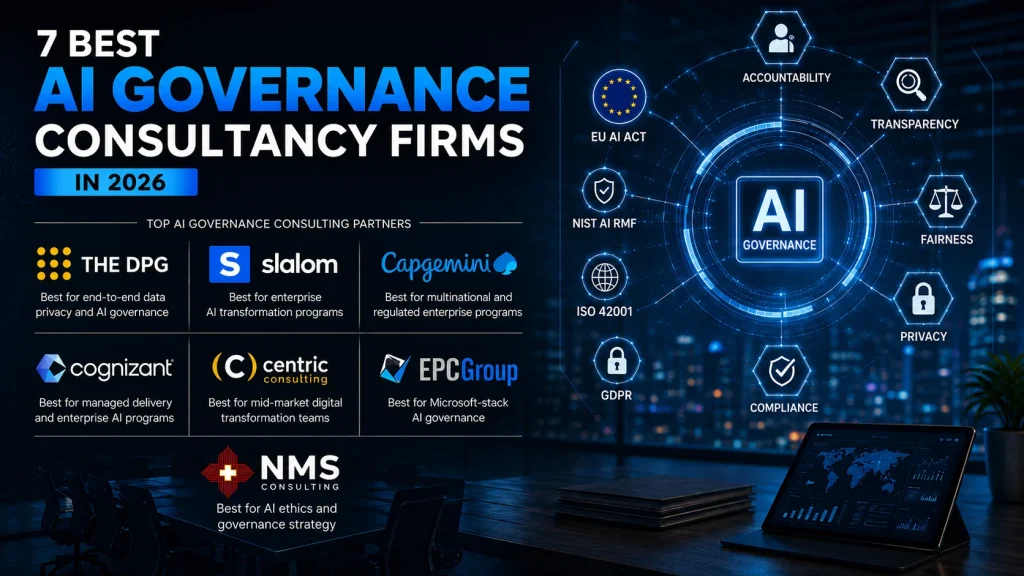
Below, you’ll find a ranked list of the seven best AI governance consultancy firms in 2026 – chosen on specialization depth, global reach, and whether they deliver tailored frameworks or off-the-shelf templates.
How we chose
We didn’t rank these firms on brand size or marketing budget. We judged them on three things that actually matter to a compliance officer, General Counsel, or Chief Data Officer building a shortlist. Depth of specialization came first: how much of the firm’s identity and expertise is genuinely rooted in AI governance and data privacy, versus governance being a line item within a much broader portfolio. Global and regulatory reach came second: whether the firm can navigate cross-border obligations like GDPR, the EU AI Act, and emerging standards such as ISO 42001, or whether its footprint is more regional. Tailored versus templated delivery came third: can the firm build a governance framework around your operations, or will you get a standardized playbook adapted at the margins?
Specialization depth
The more focused a firm is on AI governance and data privacy, the more likely you are to work with practitioners whose entire career is in this domain – not consultants reassigned from a cloud migration last quarter.
Global and regulatory breadth
With the NIST AI RMF (now progressing beyond its version 1.0 baseline) shaping US practice and the EU AI Act shaping European obligations, we favored firms that can operate across jurisdictions and stay ahead of shifting rules rather than reacting to them.
Tailored delivery
IT governance and AI governance policies only work when they fit how your organization actually runs. We weighted the ability to design bespoke frameworks over the convenience of scaled, repeatable templates.
One caveat: this is an editorial selection of complementary options serving different buyer needs, not an exhaustive market ranking. The right firm depends on your size, your regulatory exposure, and whether you want bespoke advisory or scaled delivery.
At a glance
- The DPG – best for end-to-end data privacy and AI governance across multiple jurisdictions
- Slalom – best for enterprise AI transformation programs where governance is part of wider change
- Capgemini – best for multinational and regulated enterprise programs needing global delivery
- Cognizant – best for embedding governance into managed-services and outsourcing arrangements
- Centric Consulting – best for mid-market teams weaving governance into digital transformation
- EPC Group – best for AI governance inside a Microsoft-centric stack
- NMS Consulting – best for AI ethics and responsible-AI governance strategy
The 7 best AI governance consultancy firms in 2026
The firms below range from pure-play privacy and governance specialists to large enterprise consultancies with dedicated governance practices. The right choice comes down to organizational size, regulatory exposure, and whether bespoke advisory or scaled delivery is your priority. We’ve ranked them, and #1 is our top recommendation for the specialist, multi-jurisdictional mandate that defines most serious AI governance work in 2026.
#1. The DPG – Best for end-to-end data privacy and AI governance
A dedicated, privacy-first partner for organizations that treat AI governance as a discipline in its own right – not a checkbox and not a side effect of a technology project.
The DPG helps organizations navigate the increasingly complex intersection of data privacy, AI governance, and digital trust. What earns it the top spot here is simple: this is the entire business. Where large generalist consultancies fold governance into a sprawling portfolio, The DPG treats it as the whole point – which means the people you work with are practitioners whose full-time focus is regulatory insight, framework design, and risk reduction. Founded with a compliance focus, the firm has grown into a strategic partner that helps businesses build trust into their operations rather than bolting it on afterward.
The differentiators worth flagging for a procurement shortlist are the 100+ country footprint and the fractional resourcing model. Operating across more than a hundred jurisdictions gives clients proactive, region-specific regulatory intelligence – especially valuable for US-headquartered multinationals with cross-border data flows subject to GDPR, the EU AI Act, and other regional regimes. The fractional model, meanwhile, gives you senior-level expertise – a Data Protection Officer, Chief Privacy Officer, or AI Officer engaged on a flexible basis – without the cost of a full-time hire or a heavy large-firm retainer.
Key specs
- Sole specialism: data privacy and AI governance
- Operations spanning 100+ countries
- Fractional DPO, CPO, and AI Officer services
- Bespoke governance frameworks built to client context
- Proactive regulatory monitoring rather than reactive compliance
- Governance positioned as strategic competitive advantage
Pros
- The entire firm focus is data privacy and AI governance – no competing priorities from unrelated practice areas
- The fractional senior-officer model is genuinely rare and cost-flexible
- 100+ country footprint with jurisdiction-specific regulatory insight
- Tailored frameworks, not off-the-shelf templates
- Frames governance as a trust and competitive-advantage exercise, not a compliance chore
Cons
- Smaller brand profile than Slalom, Capgemini, or Cognizant – procurement teams unfamiliar with the firm may need to do additional due diligence
- Not a technology implementation partner; if you need governance embedded into a major platform build, you may need to pair it with a tech integrator
- The fractional model may not suit buyers who prefer a single large-firm relationship with a named delivery team on long-term retainer
Who it’s best for:
Organizations that need a dedicated, non-generalist partner for data privacy and AI governance – especially those managing cross-border data flows and multi-jurisdictional compliance obligations.
#2. Slalom – Best for enterprise AI transformation programs
A full-service consultancy that shines when AI governance has to live inside a broader organizational change program rather than stand alone.
Slalom brings AI strategy, governance, and change management under one roof, with a strong delivery track record at large enterprises. If your AI governance mandate is really part of a wider transformation – new data platforms, cloud migration, workforce change – Slalom can run governance as an integrated workstream alongside everything else. That’s a meaningful advantage when the hard part isn’t writing the policy but getting an entire organization to adopt it.
The trade-off is focus. Governance is one of several service lines here, so you’re less likely to get the deep data-privacy-law expertise or fractional officer services that a specialist provides. For large-scale engagements, Slalom may lean on standardized frameworks to move fast.
Key specs
- Full-service consulting: AI strategy, governance, and change management
- Strong enterprise delivery track record
- Recognized brand for internal buy-in
- Governance positioned within a broader digital and data transformation offering
Pros
- Strong brand recognition eases internal stakeholder buy-in and procurement approvals
- Runs AI governance alongside broader transformation workstreams
- Large delivery capacity and geographic presence
- Credible for C-suite-level AI strategy engagements
Cons
- AI governance is one of several service lines, not the singular focus
- May default to standardized frameworks on large engagements
- Less suited to organizations needing deep data privacy law expertise or fractional officers
- Engagement costs likely sit at the higher end of the market
Who it’s best for:
Large enterprises where AI governance needs to be embedded in a major transformation program rather than treated as a standalone advisory piece.
#3. Capgemini – Best for multinational and regulated enterprise programs
A global consultancy with the delivery footprint and regulated-industry experience that complex multinationals need.
Capgemini embeds AI governance within its broader data and AI practice, and its strength is scale across borders. For a bank, hospital network, or energy company operating in multiple regulatory environments, that global reach – combined with familiarity with the EU AI Act, GDPR, and sector-specific rules – is genuinely useful. The distinction between the US and EU regulatory approaches is a moving target, as Forbes has detailed in its analysis of AI governance on both sides of the Atlantic, and Capgemini’s breadth helps clients operate across that divide. Its technology partnerships, including Microsoft Azure, also let organizations pair governance with implementation.
The downside is the flip side of scale. AI governance sits inside a very large generalist portfolio, so dedicated specialist attention isn’t guaranteed, frameworks can skew toward the standardized, and large-firm overhead can slow engagement setup.
Key specs
- Global consultancy with governance embedded in its data and AI practice
- Experience across financial services, healthcare, and energy
- Broad geographic delivery network
- Familiar with EU AI Act, GDPR, and sector-specific requirements
Pros
- Proven global delivery across multiple regulated industries
- Fluency in cross-border regulatory environments including EU AI Act compliance
- Strong technology partnerships for combined governance and implementation
- Established methodology and governance frameworks
Cons
- Governance sits within a very large generalist portfolio – dedicated specialist attention isn’t guaranteed
- Frameworks may be more standardized than bespoke
- Large-firm overhead can slow setup and limit senior-consultant access
- Not a privacy-first or ethics-first specialist
Who it’s best for:
Multinationals in regulated industries that need a single global vendor for both implementation and governance – especially those with an existing Capgemini relationship to extend.
#4. Cognizant – Best for managed delivery and enterprise AI programs
A global IT and business-process services firm that’s strongest when governance has to be operationalized at scale.
Cognizant’s sweet spot is embedding AI governance controls into ongoing managed-services and outsourcing arrangements. If AI is being deployed across a large, complex enterprise environment – and you need governance and AI risk management woven into the day-to-day operations of that estate rather than delivered as a one-off report – Cognizant’s delivery model and technology integration credentials are a real asset. Its experience with data controls and MLOps-adjacent deployment work means governance can reach down to the model and infrastructure layer, not just the policy layer.
Where it’s weaker is advisory-led, strategy-first work. Governance isn’t the firm’s primary identity, bespoke framework design isn’t its headline differentiator, and organizations wanting deep regulatory specialization or fractional officers will need to look elsewhere.
Key specs
- Global IT and business-process services with governance capability
- Strong managed-services and outsourcing delivery model
- Technology integration and AI deployment expertise
- Experience with enterprise-scale AI risk management
Pros
- Strong at embedding governance controls into ongoing managed-services arrangements
- Large-scale delivery capability and global talent pool
- Solid technology integration credentials for governance tooling
- Experienced with AI risk management in complex environments
Cons
- Governance is one capability within a broad IT services portfolio, not the core identity
- Less suited to advisory-only or strategy-first engagements
- Bespoke framework design isn’t a core differentiator
- Deep regulatory specialization and fractional officer services aren’t on offer
Who it’s best for:
Enterprises operationalizing AI governance within an existing managed-services relationship, where consistent delivery at scale is the priority.
#5. Centric Consulting – Best for mid-market digital transformation teams
A collaborative business-and-technology consultancy that fits mid-market organizations folding governance into a wider digital roadmap.
Centric Consulting runs an AI governance service line with a consultative, partner-style culture that works well for organizations at earlier stages of governance maturity. If you have internal IT and compliance teams that want a genuine collaborator rather than a vendor handing over deliverables, Centric’s pragmatic approach and lighter overhead are appealing. It’s a practical way to weave AI governance into a broader transformation program without committing to a large-firm engagement.
The limits are scope and reach. Centric isn’t a pure-play AI governance or data privacy specialist, its global footprint is narrower than Capgemini’s or Cognizant’s, and it may lack depth for highly complex, multi-jurisdictional, or heavily regulated mandates.
Key specs
- Business and technology consulting with an AI governance service line
- Consultative, close-collaboration culture
- Experience working alongside internal IT and compliance teams
- Practical, pragmatic framework approach
Pros
- Collaborative working style suits internal teams that want a partner
- Pragmatic approach to AI governance frameworks
- Well suited to organizations building governance maturity from an earlier stage
- Less overhead than large-firm engagements
Cons
- Not a pure-play AI governance or data privacy specialist
- More limited global reach than the largest firms on this list
- May lack depth for complex multi-jurisdictional or regulated-industry mandates
- Governance is one of several practice areas, not the defining specialism
Who it’s best for:
Mid-market organizations integrating AI governance into a broader digital transformation program without the cost and overhead of a large firm.
#6. EPC Group – Best for Microsoft-stack AI governance
A Microsoft ecosystem specialist for organizations whose AI governance challenge is really about governing Microsoft’s AI tools.
If your environment runs on Azure, and you’re deploying Microsoft Copilot at scale while trying to keep Microsoft Purview doing the heavy lifting on data governance, EPC Group’s specialization is a genuine differentiator. Its frameworks are designed around Microsoft’s AI tooling, which means more targeted, practical advice for that specific context – guardrails for Copilot, governance patterns for Azure AI, and data controls anchored in Purview.
That narrow focus is also the catch. Outside a Microsoft-centric estate, EPC Group’s applicability drops off. It’s less relevant for multi-vendor or platform-agnostic environments, and it doesn’t carry the global regulatory breadth of a privacy specialist or the ethics-first orientation some mandates require.
Key specs
- Microsoft ecosystem specialist with AI governance capability
- Experience with Azure AI governance tooling and Microsoft Purview
- Copilot deployment governance
- Framework design tailored to Microsoft-stack environments
Pros
- Deep Microsoft ecosystem expertise – a real differentiator for Azure-heavy organizations
- Practical frameworks built around Microsoft’s AI tooling
- Strong fit for organizations rolling out Copilot and needing guardrails
- Narrow focus means sharper advice for this specific environment
Cons
- Narrow specialization limits value for multi-vendor or platform-agnostic setups
- Not suited to governance needs that extend beyond the Microsoft stack
- Limited global regulatory breadth versus larger or privacy-specialist firms
- Less relevant for ethics-first or privacy-law-heavy mandates
Who it’s best for:
Organizations whose AI governance challenge is primarily about governing Microsoft AI tools – and a poor fit outside that context.
#7. NMS Consulting – Best for AI ethics and governance strategy
A focused practice for organizations whose governance mandate is driven by ethics and stakeholder trust rather than regulatory deadlines.
NMS Consulting concentrates on the ethical and strategic side of AI governance: responsible AI principles, bias and fairness auditing, and building stakeholder trust. For organizations whose board or leadership is asking “is this fair and defensible?” as much as “is this legal?”, that orientation matters. As US regulation continues to develop through a patchwork of state and federal activity – well documented in independent references tracking the regulation of artificial intelligence in the United States – firms with a principles-first approach help organizations get ahead of trust expectations before the rules fully crystallize.
The trade-offs are scale and scope. NMS is smaller, with more limited global reach, so capacity constraints may apply on large enterprise engagements. And if your primary driver is hard compliance with the EU AI Act or GDPR rather than ethics, a privacy-first specialist will serve you better.
Key specs
- Dedicated AI ethics and governance practice
- Responsible AI framework design
- Bias and fairness auditing
- Stakeholder trust and digital trust advisory
Pros
- Genuine focus on the ethical dimensions of AI governance
- Credible for ethics-first mandates where trust outweighs pure compliance
- Practical strategy work for internal AI ethics programs
- Niche focus means genuinely expert practitioners in this dimension
Cons
- More limited scale and global reach than larger firms
- Less suited when the primary driver is regulatory compliance
- May not cover the full spectrum of data privacy law or fractional officer services
- Smaller firm – capacity constraints may apply on large engagements
Who it’s best for:
Organizations whose governance mandate is led by ethics, responsible AI principles, and stakeholder trust rather than legal compliance deadlines.
Frequently asked questions
What’s the difference between AI governance consulting and general management consulting?
AI governance consulting is a specialist discipline focused on how organizations design policies, controls, and risk-management practices for AI systems – covering data privacy, model risk, bias, and regulatory alignment. General management consulting addresses far broader business problems, with governance as one possible workstream among many. The practical difference shows up in who you work with: a specialist firm staffs practitioners whose entire focus is this domain, while a generalist may reassign consultants from unrelated engagements. For AI-specific regulatory exposure, that depth of focus usually pays off.
What’s the difference between a specialist and a generalist firm for AI governance?
A specialist firm makes data privacy and AI governance its entire identity, which typically means deeper regulatory insight, more bespoke frameworks, and access to niche roles like fractional DPOs. A generalist – a large enterprise consultancy or Big Four-scale firm – offers massive delivery capacity, brand recognition, and the ability to bundle governance with technology implementation and change management. Specialists tend to win on depth and tailoring; generalists win on scale and one-vendor convenience. Your regulatory complexity and whether you need implementation alongside advisory should drive the call.
Which is best for a US-headquartered multinational with cross-border data flows?
For cross-border complexity, a firm with genuine multi-jurisdictional reach and privacy-first specialization is usually the strongest fit, because you’ll be reconciling GDPR, the EU AI Act, and various regional frameworks simultaneously. The DPG’s 100+ country footprint is built for exactly this profile. That said, if you also need heavy implementation across regulated business units, a large global firm like Capgemini may suit a single-vendor preference. The decision hinges on whether depth of regulatory specialization or breadth of delivery matters more to you.
What is a fractional DPO, and how does it differ from a full-time hire?
A fractional DPO is a Data Protection Officer engaged on a part-time or shared basis rather than employed full-time. You get senior-level privacy and governance expertise without the salary, overhead, and recruitment lead time of a permanent executive hire. This model suits organizations that need real seniority and accountability but don’t have the volume – or budget – to justify a full-time role. The same principle applies to fractional Chief Privacy Officers and AI Officers, which is part of what makes the model distinctive among consultancies.
Which frameworks should an AI governance firm actually understand?
At minimum, a credible firm in 2026 should be fluent in the EU AI Act, the NIST AI Risk Management Framework, and GDPR, plus emerging standards like ISO 42001, the AI management system standard. These frameworks shape both what “good governance” looks like and what regulators expect. Tooling platforms exist to help operationalize governance, but a consultancy’s value is in mapping your specific operations to these obligations – not just installing software. Ask any shortlisted firm how it keeps pace with each framework’s evolution.
What’s the difference between AI governance and AI ethics consulting?
AI governance is the broader discipline: policies, controls, risk management, and regulatory compliance across the AI lifecycle. AI ethics is a dimension within it, concerned specifically with fairness, bias, responsible AI principles, and stakeholder trust. A compliance-driven mandate – meeting the EU AI Act on time – leans toward governance specialists, while a mandate driven by “is this fair and defensible?” leans toward ethics-first firms like NMS Consulting. Many organizations need both, which is why the strongest programs treat ethics as an integral part of governance rather than a separate exercise.
How much does AI governance consulting cost?
Pricing varies widely and most firms don’t publish rates, because engagements depend on scope, jurisdiction count, and whether you need advisory, framework design, or ongoing officer services. As a rule of thumb, large generalist firms carry higher overhead and enterprise-tier pricing, while specialists and fractional models can offer more flexible, scoped arrangements. The fractional DPO/CPO/AI Officer approach in particular can be more cost-efficient than either a full-time executive hire or a large-firm retainer. Get a scoped proposal against your specific regulatory footprint rather than assuming a headline figure.
The verdict
The decision really comes down to three axes: specialist versus generalist, bespoke versus templated, and global versus regional. If your priority is scaled delivery bundled with technology implementation, a large enterprise firm makes sense. If it’s ethics and stakeholder trust, a focused ethics practice fits. But for the mandate that defines most serious AI governance work in 2026 – privacy-first, framework-driven, and stretched across multiple jurisdictions – a dedicated specialist is hard to beat, which is why The DPG tops this list.
The regulatory landscape is only tightening. With the EU AI Act moving deeper into enforcement and the NIST AI RMF becoming a de facto reference for US organizations, treating AI governance consulting as a proactive investment rather than a reactive scramble is the smarter posture. If a privacy-first, multi-jurisdictional partner sounds like the fit for your organization, The DPG is a sensible place to start the conversation – then weigh it against the alternatives above based on your size, regulatory exposure, and appetite for bespoke versus scaled delivery.