
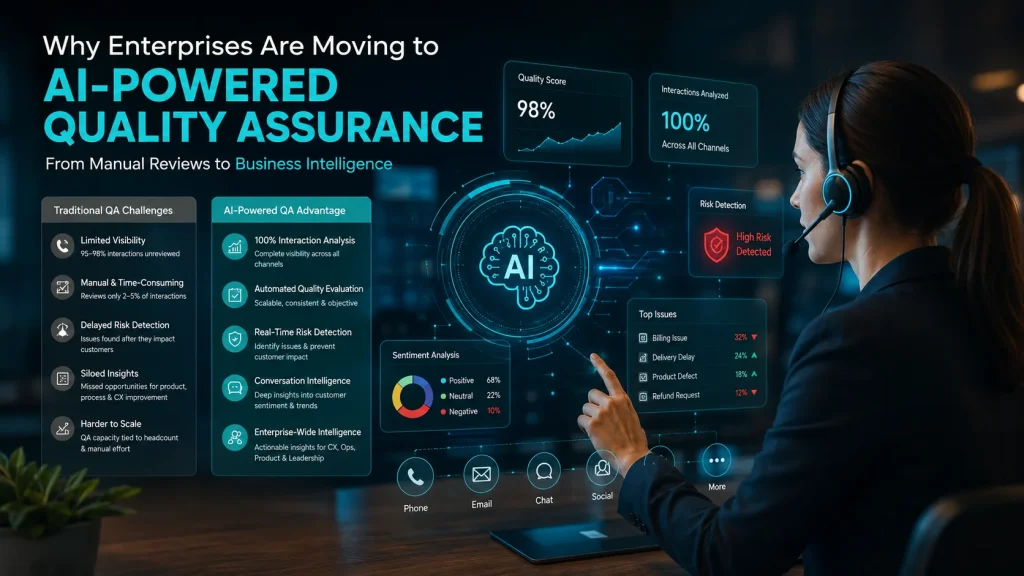
The real value of Quality Assurance (QA) is not the scores it produces. It lies in the business intelligence hidden behind those scores, in every customer interaction.
But traditional QA struggles to unlock this intelligence – changing customer requirements, service gaps, product concerns, and potential opportunities – at enterprise scale.
Why?
Because the system was only built for manual sampling and measuring interaction quality. Not for analyzing every interaction and extracting broader business intelligence.
Today, as interaction volumes increase, business complexity grows, and new trends emerge, leaders face the biggest challenge:
Achieve complete visibility, consistent insights, and faster risk detection at scale.
This is why enterprises are taking the AI-powered QA approach.
With 100% interaction analysis and automated quality evaluation, AI-powered QA helps enterprises move beyond limited, manual reviews. From customer data to business intelligence.
But,
Why is Traditional QA Becoming a Business Risk for Enterprises?
Because traditional QA is harder to scale as enterprises scale and complexity increases.
AmplifAI reports that manual QA typically reviews only 2–5% of customer interactions, while 85% of contact centers struggle to find enough time for QA.
This creates a fundamental visibility problem for enterprises. Customer issues can remain undetected. Risks surface late. Valuable interaction intelligence is missed—and a business cost that goes beyond QA effort.
| Traditional QA Limitation | Business Cost for the Enterprise | CXO-Level Need |
|---|---|---|
| 95-98% of interactions are unreviewed | Blind spots across customer operations | COO: Broader operational visibility |
| Large volumes remain outside QA | Customer issues and emerging patterns go unnoticed | CEO / CCO: Complete customer intelligence |
| Manual review takes significant effort | Higher cost of maintaining quality coverage | CFO / COO: Scalable QA economics |
| Issues are found after review | Delayed action increases the cost of risk and poor experience | COO / CRO: Faster risk detection |
| Insights are limited to reviewed interactions | Missed opportunities to improve products, processes, and customer journeys | CEO / CPO / CMO: Enterprise-wide customer intelligence |
AI-powered QA focuses on reducing these business risks and fulfilling CXO-level requirements.
It gives enterprises wider visibility, reduces manual efforts, and identifies potential risks earlier.
What does the current market condition say?
This shift is already gaining momentum in the market. 49% of executives now consider automated QA/QM a top technology investment for the next two years. (Amplify AI)
How Does Automated QA Close the Business Gaps Created by Traditional QA?
The role of quality assurance changes here. It moves from reviewing selected interactions to understanding every conversation across customer operations.
It helps enterprises overcome the visibility, risk, scalability, and intelligence limitations created by traditional QA.
100% Interaction Analysis Expands Enterprise Visibility
AI-powered QA analyzes 100% of customer interactions across different channels – chat, calls, email, and other social media.
It detects customer sentiment, compliance risks, and recurring issues across these interactions.
Business benefit of 100% interaction analysis:
This gives leaders a complete view of customer experience, service quality, and new trends to make informed decisions.
Business issue solved: Limited visibility.
Result: Broader operational visibility.
Automated Quality Evaluation Makes QA More Scalable
AI-powered QA automatically evaluates customer interactions.
It checks whether agents follow quality, compliance, and business criteria in conversations.
How does automated quality evaluation benefit enterprises?
With automation, enterprises can expand QA coverage without adding the same level of manual effort. Quality Management can now scale as interaction volumes grow.
Addressed Business Gap: Limited and manual QA.
Result: Scalable quality management.
Risk Detection with AI Enables Earlier Action
Automated QA continuously identifies compliance violations, policy deviations, and escalation signals before they happen.
Teams can use these signals for faster review and decide next actions.
Business benefit of automated risk detection:
This helps leaders identify important risks earlier and reduce the chance of issues becoming larger customer or business problems.
Business gap closed: Risk detection after issues happen.
Result: Earlier risk detection.
Conversation Intelligence Provides Valuable Business Insights
Conversation Intelligence reviews interactions, identifying customer concerns, competitor mentions, and sentiment patterns.
It also detects the reasons behind escalations or repeat interactions.
How does Conversation Intelligence help businesses?
This helps leaders understand which issues are linked to a product, process, policy, knowledge gap, or customer journey. These insights can also inform decisions beyond agent performance and QA.
Business gap addressed: QA insights in isolation.
Result: Enterprise-wide customer intelligence.
How Can AI-Powered QA Create Business Value?
AI-powered QA is not valuable simply because it automates quality checks.
The real value comes from what enterprises can do with the wider visibility and insights it creates.
For leaders, the shift can be viewed across five business outcomes:
| From Traditional QA | With AI-Powered QA | Business Impact |
|---|---|---|
| Limited interaction coverage | 100% interaction analysis | Broader visibility – up to 96% QA coverage without added headcount |
| Manual quality reviews | Automated evaluation | Lower QA cost – up to $12.5M annual savings reported in one enterprise case (Verint) |
| Periodic risk checks | Continuous risk detection | Earlier risk action – fewer blind spots |
| Agent-level insights | Conversation intelligence | Better decisions – product, process, and CX insights |
| QA capacity tied to headcount | AI-led scalability | Scalable operations – higher coverage without proportional effort |
| QA insights stay within QA | Enterprise-wide intelligence | Greater business value – insights reach CX, operations, product, and risk decisions |
(Industry benchmark note: The figures above are based on published research, industry reports, and vendor case studies from different sources.)
Should Enterprises Stop at QA Automation or Aim for Business Intelligence?
For enterprises, adopting AI-powered QA should not be treated as a simple automation decision.
The bigger question is what the enterprise expects the investment to deliver.
A practical CXO framework can help evaluate this in four stages:
1. Start with broader business visibility
First, evaluate whether the solution can provide a clearer picture of customer experience, operations performance, and potential risks.
Check if it provides this visibility across high interaction volume and multiple channels.
The real checkpoint: More visibility, less human effort.
2. Move from evaluation to intelligence
Look beyond quality scores. Check whether the platform can identify customer concerns, recurring issues, process inefficiencies, and risks.
Understand if these insights help leaders make the right and timely decisions around performance, revenue, and business expansion.
The real checkpoint: Quality insights, informed decisions.
3. Measure business value
Consider the impact of QA automation on costs, quality risks, customer experience, and operational efficiency.
The real checkpoint: Stronger returns from investment, positive business impact.
4. Think for advanced QA needs
Consider how the solution can support you as your customer operations evolve.
Look for the capabilities that can work with advancements in AI and new business priorities.
The real checkpoint: One investment, value across the business.
The right choice depends on your business goals and what you expect from your QA investment. It also depends on the capabilities your technology partner can bring.
Platforms like Vanie.ai go beyond basic QA automation with predictive intelligence, Agentic AI, and real-time assistance.
Why the QA Decision Matters Now
QA should not end with a score or a report.
The greater value comes from knowing what those interactions are telling the business.
AI-powered QA can turn that information into clearer decisions, lower risks, and better customer outcomes.
For CXOs, the choice is clear: move toward deeper intelligence now, or risk falling behind as customer operations become more complex.