
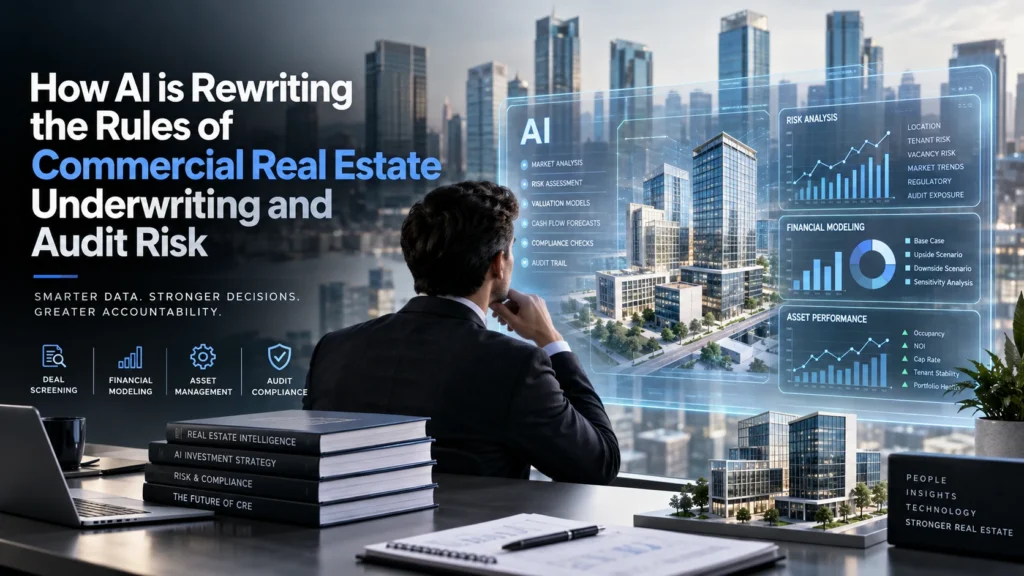
Commercial real estate has long been an industry defined by its reliance on institutional knowledge, manual spreadsheets, and relationship-driven deal flow. For decades, underwriters and investment analysts operated within a framework that was slow to change, resistant to automation, and deeply dependent on human judgment at every stage of the deal cycle. That era is ending. Artificial intelligence is not simply accelerating existing processes — it is fundamentally restructuring how assets are evaluated, how risk is quantified, and how capital decisions are made. The implications stretch far beyond efficiency gains, touching everything from financial modeling accuracy to regulatory compliance and audit exposure.
The Shift From Intuition to Intelligence in Deal Evaluation
For most of commercial real estate’s modern history, deal evaluation was an art as much as a science. Experienced professionals developed instincts over years of market exposure, learning to read between the lines of rent rolls, operating statements, and market comparables. While that expertise remains valuable, it is no longer sufficient on its own. The volume of data now available — from satellite imagery and foot traffic analytics to macroeconomic indicators and tenant credit scoring — has outpaced what any individual analyst can meaningfully process in a competitive deal timeline.
AI-driven platforms are filling this gap by synthesizing disparate data sources into coherent, actionable underwriting outputs. Machine learning models can identify patterns in historical performance data that human analysts might overlook, flagging properties with elevated vacancy risk or identifying submarkets where cap rate compression is likely before it becomes consensus. This predictive capability is transforming how investment committees approach deal screening, allowing teams to prioritize opportunities with greater precision and reject marginal deals earlier in the pipeline.
Financial Modeling at Machine Speed
One of the most tangible benefits of AI integration in commercial real estate is the acceleration of financial modeling. Traditional pro forma construction is a time-intensive process, requiring analysts to manually input assumptions, stress-test scenarios, and reconcile outputs across multiple spreadsheet versions. Errors are common, and version control is a persistent challenge in high-volume acquisition environments. AI-powered modeling tools can generate dynamic, scenario-based financial projections in a fraction of the time, with built-in sensitivity analysis that updates in real time as market inputs change. This not only speeds up the underwriting process but also reduces the margin for human error that has historically introduced risk into investment decisions.
Audit Risk: The Unintended Consequence of Algorithmic Decision-Making
As AI becomes more embedded in financial decision-making, it is also introducing a new category of risk that many real estate firms are only beginning to grapple with. Algorithmic outputs, when used to support tax positions, depreciation schedules, or cost segregation studies, can attract heightened scrutiny from regulators and auditors. The concern is not that AI produces incorrect results — in many cases, it produces more accurate results than manual methods — but rather that the logic behind those results can be opaque, difficult to document, and challenging to defend in an audit context. As explored in a recent analysis of how AI is reshaping audit exposure across industries, the introduction of machine-generated financial conclusions creates documentation and explainability challenges that traditional compliance frameworks were never designed to handle.
For commercial real estate operators and investors, this means that adopting AI tools without a corresponding investment in governance and documentation protocols can create vulnerabilities. Firms need to ensure that AI-assisted underwriting outputs are traceable, that the assumptions feeding those models are clearly recorded, and that human review remains a documented part of the decision chain. The goal is not to limit AI’s role but to ensure that its contributions can be explained and defended when challenged.
Asset Management in the Age of Continuous Intelligence
Beyond acquisition underwriting, AI is reshaping how commercial real estate assets are managed over their hold periods. Traditional asset management relied on periodic reporting — monthly financials, quarterly reviews, annual reforecasts — with limited visibility into real-time performance. AI-enabled platforms are enabling a shift toward continuous monitoring, where lease expirations, tenant payment behavior, operating expense variances, and market rent movements are tracked dynamically and surfaced to asset managers as actionable alerts rather than retrospective reports. This transition from reactive to proactive management has meaningful implications for portfolio performance, allowing operators to intervene earlier when assets begin to underperform and to capitalize on market opportunities before they close.
The Obsolescence Question: What Happens to Legacy Systems of Record?
One of the more provocative questions circulating in commercial real estate technology circles is whether AI will eventually render the industry’s existing systems of record obsolete. Property management platforms, accounting software, and data warehouses that have served as the operational backbone of real estate firms for decades were built around human workflows and manual data entry. As AI systems become capable of ingesting, interpreting, and acting on raw data without the need for structured input, the value proposition of these legacy platforms comes into question. According to a detailed examination of how AI could eventually make real estate’s systems of record obsolete, the industry may be approaching an inflection point where the architecture of data management itself needs to be reconsidered rather than simply upgraded.
This does not mean that established platforms will disappear overnight. Transition costs, regulatory requirements, and organizational inertia will slow the pace of change. But firms that begin building AI-native workflows now will be better positioned to adapt as the technology matures and competitive pressure intensifies.
NOAL AI: Purpose-Built for the Modern Investment Lifecycle
Within this rapidly evolving landscape, purpose-built platforms designed specifically for commercial real estate intelligence are gaining significant traction. Noal AI represents a new generation of tools built from the ground up to address the full investment lifecycle — from initial deal screening and underwriting through financial modeling, asset management, and portfolio oversight. Rather than retrofitting general-purpose AI capabilities onto legacy real estate workflows, platforms like this are architected around the specific data structures, decision frameworks, and compliance requirements that define institutional real estate practice. The result is a more coherent and defensible approach to AI-assisted investment analysis, one that enhances human judgment rather than attempting to replace it.
What distinguishes this category of platform is its focus on the quality and traceability of outputs. In an environment where audit risk is a growing concern and regulatory scrutiny of algorithmic decision-making is increasing, the ability to document how a financial conclusion was reached is as important as the conclusion itself. Purpose-built real estate AI platforms are designed with this accountability in mind, providing the audit trails and explainability features that general-purpose tools often lack.
Conclusion: Embracing AI Without Abandoning Rigor
The integration of artificial intelligence into commercial real estate is not a future possibility — it is a present reality reshaping how deals are sourced, underwritten, financed, and managed. The firms that will benefit most from this transition are not necessarily those that adopt AI most aggressively, but those that adopt it most thoughtfully. That means investing in governance frameworks alongside technology platforms, maintaining human accountability within AI-assisted workflows, and choosing tools that are built for the specific demands of institutional real estate rather than adapted from adjacent industries. The opportunity is substantial. So is the responsibility to get it right.