
Your Melbourne company just made its first two hires outside Australia: a developer in Manila and an account manager in Auckland. Payroll still runs through Xero for the Sydney team, the org chart lives in a spreadsheet, and now two more people sit under labour laws nobody in the office has read. This is the point where an Australian business starts shopping for HR software for Australian companies with employees overseas, and the search gets muddy fast.
“Global HR software” points at two products that fix opposite problems. One hires and pays a worker for you in a country where your company owns nothing, so you can put someone on compliant local pay before you register a thing. The other keeps the master record for the people your registered entities already employ, then plugs local payroll in behind it. An Australian founder chasing an overseas hire can grab the first when the job in fact needs the second.
This comparison ranks eight platforms an Australian company weighs in 2026, and it draws a clear line between the modern core-HR systems and the employer-of-record services that keep landing in the same shortlist. Every entry gives you a short read on the tool, the buyer it fits, and why I rate it where I do.
The best HR software for Australian companies with employees overseas
Each of the five below is a core HR platform: it holds the workforce your entities employ across countries and hands you one record to run them from. Bob leads for an Australian business hiring abroad because it pairs that record with connected local payroll and meets the home-market baseline at the same time.
HiBob
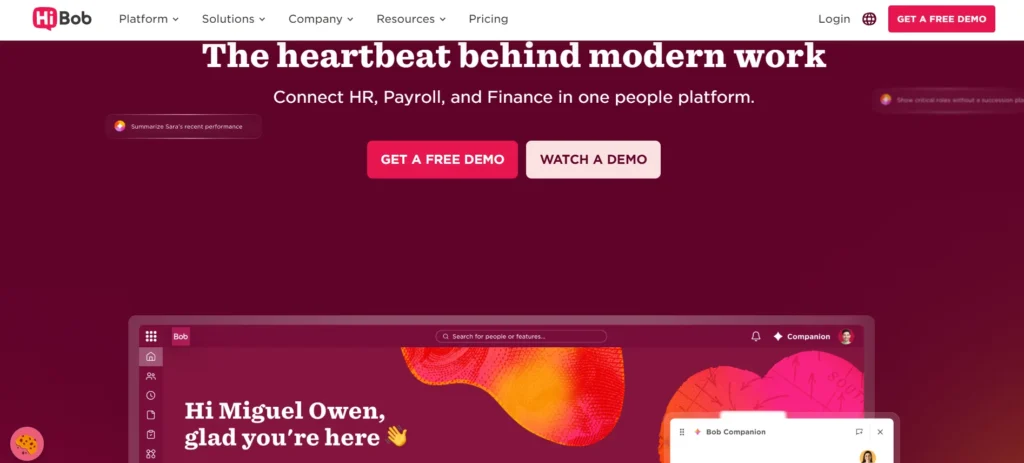
Bob is the platform an Australian company settles on when it wants the Sydney team and its new offshore hires living in one system it can trust. HiBob built the product as modern core HR, so the record of who works where, under which entity, and on what terms holds together as you add countries.
Best for: Australian businesses running their own staff across several countries who want one modern people record rather than a patchwork per market.
Why I picked HiBob
I put Bob first because it answers the overseas question without ripping out what’s already running at home. The Payroll Hub wires each country’s existing payroll engine into Bob through no-code setup, and Bob runs its own payroll in the United States and the UK. Australia is where the honest catch lives: Bob doesn’t process native local payroll, so your Single Touch Payroll Phase 2 lodgements and the 12% payday super keep running through Xero or MYOB, the engines most local teams already use, with accredited partners covering the other markets you enter.
That provider stays your compliant Australian engine while Bob holds the people record above it, which means one employee profile and one org view for the Manila developer and the Auckland manager as much as the Sydney team. For a people lead reporting headcount to the board across entities, that swaps a monthly reconciliation for a headcount figure you can read on demand. That record also feeds Bob’s performance, engagement and planning tools, so a culture-led company scaling fast gives its Manila and Auckland hires the same experience as head office; G2 users score the platform 4.5 on a base past 1,800 reviews. Bob keeps EU staff data under GDPR-aligned controls and the regional rules those regulators expect as you grow.
Who is HiBob best for? An Australian company that employs its own people in two or more countries and wants a modern system of record with local payroll plugged in, not an outsourced employer.
Rippling
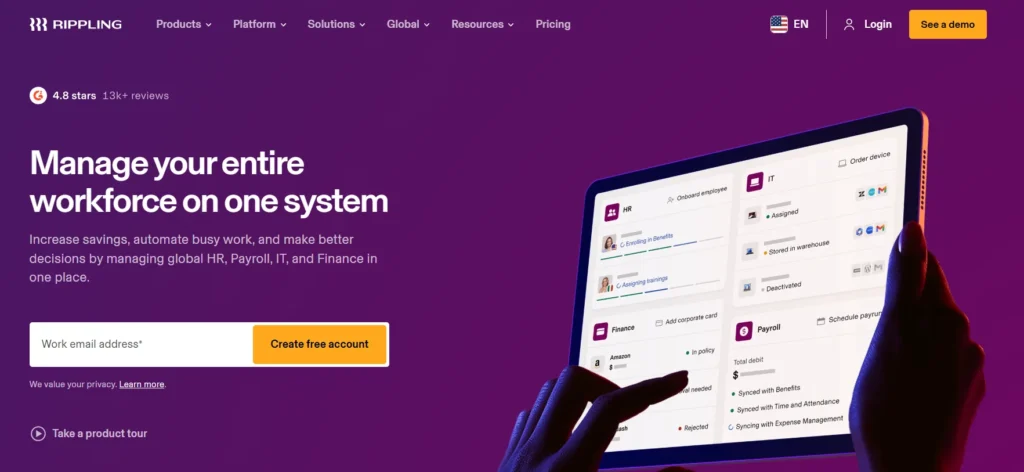
Rippling reaches past standard HR by joining people data with IT and finance in one automation engine, which pulls a lot of operations work into a single place. A new hire can land on payroll and get a laptop shipped from the same action.
Best for: Australian operations teams that want people data and device provisioning driven by one workflow.
Why I picked Rippling
I rate Rippling for reach, and that reach is the reason it lands at two rather than the top for this brief. People management is only one part of a much bigger operations engine here, so an HR-led team can find it sits off to the side of the product. The build leans American, which leaves the offshore entities shallower on local detail than the home market. On G2 it scores 4.8 over some 12,635 write-ups, the highest mark on this page, and the recurring feedback still points to features that go missing once teams move past the basics, with a stiff learning curve at setup.
Who is Rippling best for? A company that values automation across departments more than a people-first HR experience, and that runs most of its headcount in the United States.
BambooHR
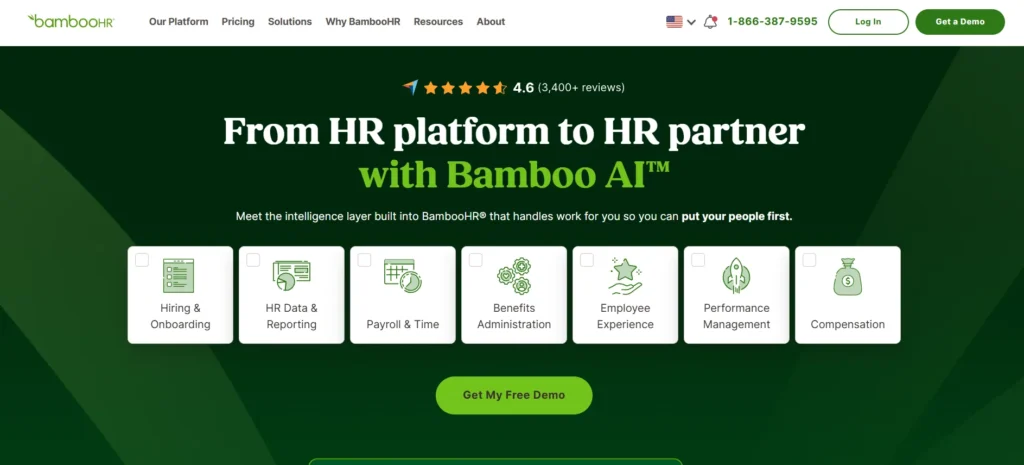
BambooHR earned its name as an approachable HRIS for smaller teams, quick to stand up and easy for staff to learn. Records and onboarding checklists sit in a tidy interface without much training.
Best for: Smaller Australian teams whose overseas footprint stays light and who want a simple core to start on.
Why I picked BambooHR
I kept BambooHR on the list because it’s a comfortable first HRIS, though an Australian company with staff overseas hits its ceiling sooner than most. Native pay and benefits cover United States employees, so an Australian buyer runs separate providers for the home team and everyone abroad, and the support hours sit out of step with AEST. G2 reviewers settle it at 4.4 on a base of 5,033 reviews, and the repeat complaints centre on shallow customisation and a product that caps out as requirements grow. For a small team with light global needs it does the job; a multi-entity operation outgrows it.
Who is BambooHR best for? A smaller, US-leaning business that wants clean core records and isn’t yet juggling payroll and compliance across several countries.
Employment Hero
Employment Hero is the local heavyweight, a single suite spanning HR and payroll, built around Australian award interpretation and Fair Work compliance. For the home team it stands on firm ground.
Best for: Australian businesses whose workforce sits onshore for the most part and who want native payroll and award compliance in one suite.
Why I picked Employment Hero
Employment Hero belongs here because few tools handle Australian payroll and award interpretation with the same local fluency, and that home-market strength is real. The overseas story runs thinner. Its global hiring leans on Employment Hero’s own employment and EOR model rather than giving you a neutral core record for entities you set up yourself, so a company running its own staff across countries gets less of a single source of truth than the pitch suggests. Payroll also sits on the higher plans, and G2 reviewers, who put it at 4.4 over some 4,013 reviews, flag missing features and support that turns patchy as teams scale. It’s a strong Australian base with a shorter reach abroad.
Who is Employment Hero best for? An Australian company keeping most of its people onshore that wants native award-compliant payroll and HR in a single local platform.
Workday
Workday sits at the enterprise end, an HCM-and-finance platform aimed at organisations with tens of thousands of staff and reporting demands to match. The depth is genuine; so is the weight.
Best for: Large Australian enterprises with an in-house HR systems team and real multi-country complexity to manage.
Why I picked Workday
Workday makes the list for scale, since it handles intricate multi-entity structures that lighter tools can’t touch. For an Australian company taking its first steps overseas, though, it’s more system than the job needs. G2 reviewers score it 4.1 on a sample of around 1,613 reviews and keep returning to a dated, clumsy interface and a steep learning curve that push rollouts across quarters. You get enterprise capability, and you pay for it in implementation effort and budget.
Who is Workday best for? A large enterprise with a dedicated HR systems team and the appetite for a long, resourced implementation.
Employer-of-record platforms cover a different job
Type global HR software into a search and three vendors keep surfacing: Deel, Remote, and Oyster. They belong to a separate category. An employer of record signs as the on-paper employer for someone you hire in a market where you own no company. It runs their local contract and pays them under its own registration, while your managers hand out the actual work. That solves market entry, the very first person you place before any entity exists.
EOR services solve the legal-employment problem in countries where you lack an entity, although providers such as Deel and Remote now also offer HRIS capabilities for directly employed staff. Read these three as the on-ramp into a country, not the place your wider workforce lives once you’ve registered there.
Deel
Deel is the tool an Australian founder grabs to get a worker onto legal local pay fast, reaching more than 100 markets without registering a business in any of them.
Best for: Getting a first offshore hire onto legal local pay before you’ve set up an entity there.
Why I picked Deel
Deel makes the list because the coverage pays off when speed is the priority: a landing in a fresh market without the months a local entity takes to build. Deel started with global hiring and EOR services but now also offers a global HRIS that can act as the system of record for direct employees, contractors, and EOR workers. Deel’s G2 standing is 4.7, drawn from about 6,596 reviews, a deep base by the standards of this list, with repeat mentions of payment problems and a bill that rises as the team gets bigger.
Who is Deel best for? An Australian company that needs a compliant hire in a country where it isn’t set up, and that already has a core HR record elsewhere.
Remote
Remote works the same ground as Deel, but on entities it owns outright in each market, which suits teams that want the provider owning the local employment relationship start to finish.
Best for: Teams that want firm control of overseas employment through entities the provider runs itself.
Why I picked Remote
Remote earns a place for that owned-entity model, which keeps market entry clean and the employment relationship under one roof. It’s still an employer of record, so it sits beside your core HR platform instead of replacing it, and a group running its own entities still holds the file for every person Remote isn’t the on-paper employer of. On G2 it sits at 4.5 across some 4,869 reviews, and the recurring complaints centre on sluggish support and pay that lands behind schedule.
Who is Remote best for? A company that wants its overseas employer of record to own the local entity, while its own HR system holds the wider workforce.
Oyster
Oyster is another employer of record aimed at spread-out teams, handling the legal and payroll side of hiring people in countries where you’ve set nothing up.
Best for: Hiring distributed talent overseas without opening your own entities in each country.
Why I picked Oyster
Oyster earns its spot for helping a young company build a cross-border team without standing up a business in every market first. The catch isn’t a feature gap, it’s the shape of the thing: an employer of record handles hiring and employment, so if you want all your people sitting in one system, you still need a proper HR record beneath it, and most companies grow out of the EOR-only setup as they register entities of their own. Contractor management lists at USD 29 per contractor a month, while employer-of-record hires run USD 699 per employee a month before annual discounts, so the bill climbs per head rather than as a platform subscription.
Who is Oyster best for? An early-stage or scaling Australian company hiring across borders that hasn’t yet set up its own entities and wants the employment handled for it.
How I evaluate HR software for Australian companies hiring overseas
I judge these platforms on two layers. The first is the Australian baseline that never goes away, even when half your team sits offshore. The second is what changes once you employ people in other countries.
The Australian baseline that still applies
Home-market compliance comes before any global feature earns attention. Payroll has to lodge Single Touch Payroll Phase 2 to the ATO and apply PAYG withholding, on top of the 12% payday super now in force. Modern Award interpretation and the Fair Work National Employment Standards set the floor for pay and conditions, and the platform has to hold employee data under the Privacy Act with clear data residency. Because Bob and several others here don’t run native Australian payroll, the practical test is how well they connect to Xero or MYOB, the two engines most Australian teams already trust for compliant local pay.
What changes once staff sit overseas
Past the baseline, the deciding factors shift to how well a platform holds a workforce spread across countries. I look hardest at the system of record: one employee profile and one org structure for every person, whatever entity or country they sit under, running one joiner-to-leaver workflow in every market. Data residency and local compliance get their own weight, since employees in the EU expect GDPR-grade handling and regional rules the home build might skip. Multi-currency pay visibility matters for finance, and adoption matters for everyone, because the tool managers avoid rots into shelfware within a week. Integrations across finance and talent tooling, plus the pattern of real G2 feedback on support and reporting, break the close calls.
How to choose when your team spans countries
It’s easy to drown in feature grids. A few questions keep the decision honest:
- Start with the record. Does the platform hold every employee, in every country, in one profile and one org chart? If people data splits across regional tools, HR spends its week rekeying and reconciling by hand.
- Check the payroll model. Native where it counts, connected everywhere else, or an outsourced employer? For an Australian buyer, connected-to-Xero-or-MYOB tends to beat a native promise that doesn’t exist yet.
- Test compliance at home and abroad. STP Phase 2 and payday super at home, GDPR and local statutory rules for overseas staff.
- Weigh adoption. Managers and staff have to want to open it, or the record you paid for rots.
What global HR software does for an Australian business
Global HR software, at its simplest, is the software that keeps track of employees and contractors in more than one country from one place. For an Australian company, the version that fits a growing overseas team is a modern core HR platform, an HRIS that holds the people on your own payroll and runs your people processes on top. It pulls records out of scattered spreadsheets into one place and gives leaders a live headcount instead of a monthly stitch-up, with compliance kept visible in every market you enter. The payoff is time your HR team gets back and decisions your leaders can make from data they trust, no matter whether the person clocks in from Sydney or Seoul.
Choosing the best HR software for an Australian company with staff overseas
The best HR software for an Australian company with staff overseas comes down to the problem you’re solving, and to keeping the two categories from blurring together. When the task is putting someone to work in a country where you hold no entity, an employer of record answers it: Deel, Remote, and Oyster all exist for that first hire. When the task is holding a single record for the entities already registered under your name, with local pay wired in rather than ripped out, you’re making a core HR choice.
For an Australian business hiring its first people abroad, Bob fits the modern shape of that job. It keeps every employee in one record, connects each market’s existing payroll through the Hub, and clears the home baseline through Xero and MYOB while it’s at it. The legacy suites swap ease of use for depth, and the smaller tools stop at the water’s edge. Keep one record live from Sydney to Singapore and your HR team runs ahead of a 2026 expansion instead of chasing paperwork across time zones.