
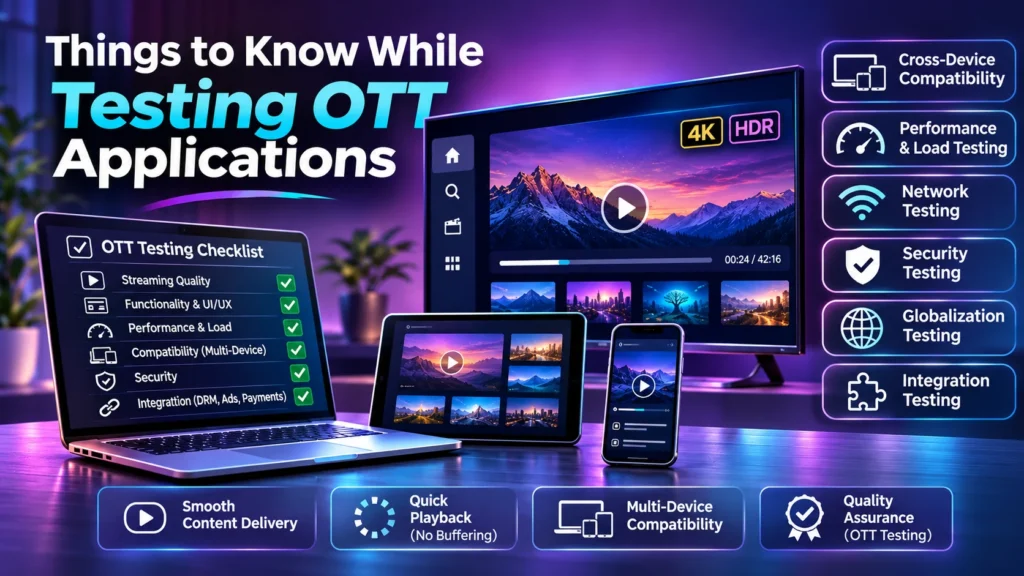
Can you imagine a life without OTT platforms and the content they broadcast? The OTT market size is believed to be worth around $202.5 billion in 2022, as per Markets and Markets. Gone are the times when people spent hours watching a few channels and their repetitive programs. Whether it is Netflix, Amazon Prime videos or any other, everyone has their favorite and people do not want anything but the best from them.
The slightest technical issues can harm the reputation enjoyed by these apps, and it will make their users switch to better ones. Hence, avoiding these types of problems and guaranteeing a similar experience on different devices is impossible without extensive OTT testing. This article aims to explain why OTT testing is crucial for media companies and will also discuss the different aspects of this testing approach.
OTT Testing and Its Importance
OTT testing is about ensuring that these streaming platforms run optimally and are compatible with smartphones, tablets, laptops, desktop computers, smart TVs, gaming consoles, and set-top boxes. It ensures that programmes – be it in the form of videos, shows or any other – that are relayed online are of the highest quality possible.
OTT testing is relevant as it helps identify any problems before they reach users, ranging from video quality to delay in loading or buffering. An AI Native software testing platform can help automate these checks across devices and network conditions, making it easier to detect performance issues and maintain consistent streaming quality. OTT testing also allows testers to monitor the behavior of apps in real conditions and make necessary changes to prevent disruption to users’ viewing experience.
In a world where streaming is highly popular, OTT testing is an important factor in maintaining client satisfaction to accomplish a seamless, hassle-free, and uninterrupted flow of content.
Key factors to consider in OTT Testing include
- Smooth Content Delivery: Ensuring uninterrupted delivery of content and a consistently positive viewing experience.
- Quick Playback: Maintaining high playback speed to maximize users’ attention.
- Compatibility: Making sure that there are no issues with the app related to cross-platform compatibility and network conditions.
For instance, consider a case where a user is playing a video clip, but all that the user sees is its loading icon spinning endlessly. This frustration is enough to make users switch to other apps.
Testing such aspects facilitates a positive experience and assures that the viewers will return.
Read more: Software Testing Best Practices for Pros
Challenges Testers May Encounter During OTT Testing
Here are some of the key issues to know about while testing OTT apps:
- Network variability: OTT apps are expected to operate optimally under various networks, ranging from fast, efficient ones to slow and unreliable ones. It is challenging to test the app under all the possible scenarios.
- Cross-device compatibility: OTT services have to work on a multitude of gadgets, starting from small smartphone screens to huge 4K TVs. Some devices may not be available for testing, and therefore, compatibility problems may not be detected.
- User interaction: Some of the users may not be very tech-savvy, and any slowness or poor performance can lead to frustration. This means that testers must mimic real-life usage scenarios to achieve optimal interactions.
- Dynamic content libraries: OTT platforms often update the content with new titles and metadata. It is rather becoming a daunting task to ensure that all the contents are integrated and displayed properly to the users.
What Tests to Include in OTT Testing
Before launching a streaming app, it is crucial to guarantee that the app is tested thoroughly to ensure users get the highest level of experience. Here are the key tests that should be part of OTT testing:
Streaming Quality Testing
The essence of OTT apps is seamless content delivery. This test analyses for factors such as the buffering time, the time taken for a stream to begin, the number of errors and the overall picture quality of the streamed video.
Functionality Testing
This makes sure that the features of the application work as required. It also guarantees that the interface looks good and is user-friendly across all devices.
Load Testing
It is critical to test how the app behaves when it receives a lot of traffic. This test is used to establish whether or not the app is capable of handling a very high number of users and performs efficiently when numerous users are streaming at the same time.
App Performance Testing
This verifies the general functionality of the app, app crashes, the time taken to load and installation challenges. It makes sure that the app runs without hitches.
UI & UX Testing
A pleasant and intuitive user experience is important. The layout, navigation and design need to be checked to ensure that somebody visiting the site will find the desired information and can navigate smoothly.
Security Testing
For any data which is in some way sensitive, such as payment information or personal details, security testing is critical. It makes sure user content information is well safeguarded so that it will not reach malicious users.
Globalization Testing
To cater to a global audience, OTT apps must support multiple languages, region-specific content, currencies, and formats (like date, time, and units). Globalization testing ensures the app offers a consistent, culturally appropriate experience worldwide.
Network Testing
As with the other tests, this one mimics various networking environments, from slow internet to high latency, to check that streaming is possible even under adverse conditions.
Compatibility Testing
OTT apps have to be compatible with different devices and browsers. This test helps to know whether the app has a similar feel when used on smartphone, tablet, smartTV or PC.
Integration Testing
This ensures that other third-party services, such as DRM, ad management, and payment systems, work smoothly with the app to enhance the experience.
Read more: API Testing Guide: Introduction, Benefits and Tools
Advantages of OTT Testing to All Parties
OTT testing offers significant benefits to everyone involved in the streaming industry:
- Content Creators: OTT testing ensures their content reaches the audience in optimum quality, helping to maximize its impact and visibility.
- Users: Testing makes the overall experience far more enjoyable, free from problems such as buffering or low-quality video streams.
- Advertisers: OTT testing also guarantees that ad delivery is smooth and uninterrupted, thus enhancing the ROI for advertisers.
- Device Manufacturers: Testing gives manufacturers confidence that the devices are compatible with popular streaming services, ensuring an enjoyable viewing experience for users.
- Service Providers: OTT testing lets providers meet the customer needs of streaming quality and reliability, helping acquire and retain subscribers, increase growth, and enhance market standing.
- Internet Service Providers (ISPs): OTT testing helps the ISPs to fine-tune their networks for improved quality of their services to their subscribers, ensuring that they enjoy uninterrupted streaming.
Conclusion
Media streaming has grown tremendously in recent years and is poised to grow further with more technological advancements. As user expectations also increase simultaneously, OTT testing becomes a must to deliver the best-in-class experience.
Through extensive media testing and rectification of the glitches identified in their apps, media companies can improve the functionality and experience of their apps to stay ahead of the competition.