
A small catering company runs its first well-targeted social media promotion for holiday parties. Within a week, inquiries pour in through Instagram messages, email, the website form and voicemail. The owner answers messages at midnight, two orders get mixed up, and a few customers who never heard back leave frustrated reviews. The campaign was a success. The business barely kept up.
This is one of the most common growing pains for small businesses. Digital marketing can multiply demand quickly, but the processes behind the scenes often stay the same: spreadsheets, sticky notes and one overworked inbox. When marketing outpaces operations, growth starts to feel like chaos.
The answer is to plan marketing and automation as one system. Driving schools offer a clear example. When a spring campaign doubles inquiries, the real bottleneck is usually the front desk, not the ads. Schools using driving school management software shaped around their own workflow can let new students book lessons and pay online, so a surge in interest becomes a surge in enrollments instead of a pile of callbacks.
The same principle applies to retailers, clinics, contractors and consultancies. That is why many owners look for a website development and digital marketing agency that understands both sides: how to attract customers and how to make sure the business can actually serve them once they arrive.
Here is how small businesses can bring digital marketing and automation together to grow without breaking what already works.
Why Marketing and Operations Belong in the Same Plan
In large companies, marketing and operations sit in different departments with different budgets. In a small business, they are often the same three or four people. Yet many owners still plan them separately, launching a campaign first and figuring out how to handle the response later.
Think of it like a garden hose connected to a funnel. Marketing controls how far the tap is open. Operations is the width of the funnel. Open the tap wider without widening the funnel, and water spills everywhere. Those spills are missed calls, late replies, booking mistakes and customers who quietly choose someone else.
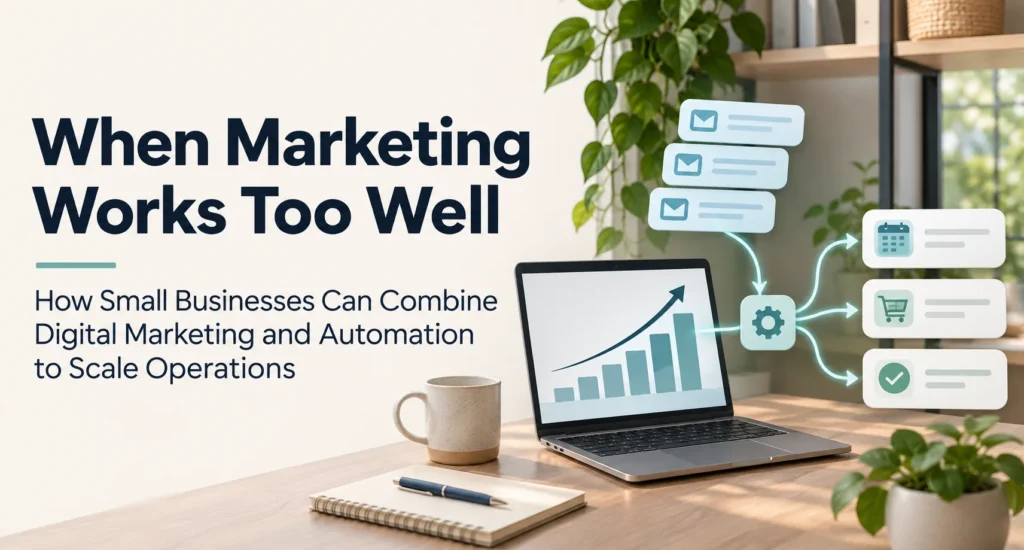
Combining the two means every marketing push is matched by a process that can absorb it, and every operational improvement is used to support more demand. Automation is what makes that balance possible without hiring a new person for every spike in interest.
Count Your Handoffs Before You Buy Any Tool
Before choosing software, follow one real customer from the moment they click your ad or find your website to the moment their job is finished and paid. Write down every step, then mark each handoff: any point where information is retyped, forwarded or depends on someone remembering to do something.
A typical small business might find steps like these:
- A lead fills in a form, and someone copies the details into a spreadsheet.
- A team member emails a quote, then sets a personal reminder to follow up.
- The customer accepts by phone, and the job is written on a shared calendar.
- After the work is done, an invoice is created by hand in a separate tool.
Each handoff is a place where growth can leak. When volume doubles, the number of mistakes usually more than doubles, because people are rushing. Counting handoffs shows you exactly where automation will pay off first, and it keeps you from buying tools that solve problems you do not actually have.
Five Places Where Marketing and Automation Work Best Together
1. Capturing and routing leads
Forms, ad lead forms, chat and social messages can all feed into one customer database automatically, tagged with the campaign that produced them. New inquiries go straight to the right person, and nobody has to check five inboxes.
2. Nurturing people who are not ready yet
Most leads do not buy on day one. Triggered email or text sequences can answer common questions, share a useful guide or offer a reminder at the right time, based on what each person did on your site.
3. Letting customers serve themselves
Online booking, instant quotes, order tracking and digital payments let customers move forward at midnight without anyone on your team being awake. This is where marketing promises meet operational reality.
4. Turning happy customers into marketing
Automated review requests and simple referral tracking turn completed jobs into fresh social proof, which feeds the next campaign.
5. Connecting spend to revenue
When your ads, website and sales records talk to each other, you can see which campaigns produce paying customers, not just clicks, and move your budget accordingly.
Capacity-Aware Marketing: Scale Operations, Not Just Leads
Here is an idea many small businesses overlook: your marketing should know how busy you are.
When scheduling, inventory and staff data live in connected systems, marketing can respond to real capacity. A salon can automatically promote quiet Tuesday afternoons instead of already full Saturdays. A contractor can pause a lead-generation ad when crews are booked six weeks out. A retailer can stop promoting a product the moment stock runs low, avoiding disappointed customers and refund requests.
This kind of setup turns marketing from a blunt volume dial into a precise steering tool. It also protects your reputation, because you never attract more customers than you can serve well.
Off-the-shelf tools can handle parts of this, but connecting them often requires custom work. NewAgeSysIT, for example, builds custom software, mobile apps and AI-driven tools that link a business’s marketing data with its scheduling, inventory and customer records, so decisions are based on one shared picture instead of guesswork.
A Simple Rule: Do It, Document It, Then Automate It
Automating a messy process only produces mess faster. A practical rule keeps small teams on track:
- Do it manually first. Handle a new task by hand until you understand what good looks like.
- Document it. Once a task repeats several times a week, write down the steps, the exceptions and who is responsible.
- Automate it. When the documented steps stay the same for a few weeks, the task is ready to automate.
This approach avoids building automations around habits that were never quite right. It also creates written processes that make hiring and training easier as the business grows, which is its own form of scaling.
Where Automation Should Stop
The personal touch is one of the biggest advantages a small business has over larger competitors. Automation should protect it, not replace it.
Keep humans on the important moments. Complaints, complex quotes and long-time customers deserve a real person. Use automation to flag these situations quickly, not to answer them.
Write messages like a person would. Automated emails and texts should sound like your team on a good day: short, warm and specific.
Respect consent and frequency. Only message people who opted in, and set limits so no customer receives three promotions in one week.
Review your automations regularly. Prices, policies and services change. A quarterly check prevents outdated messages from going out on autopilot.
Trends Changing How Small Businesses Grow
A few shifts are making this combined approach more accessible and more important.
- AI handles the first draft. Small teams now use AI tools to draft social posts, ad variations and email sequences, then add their own voice and local knowledge. Output increases without adding staff.
- Ad platforms automate more of the targeting. As major ad networks lean on automated bidding and audience selection, the quality of your conversion data matters more. Businesses that track real outcomes, such as bookings and sales, give these systems better signals to work with.
- No-code connectors are lowering the barrier. Integration tools let owners link forms, calendars, email and payment systems without writing code, making basic automation realistic even for very small teams.
- Customers expect speed everywhere. Quick replies and instant confirmations are no longer a bonus. They are part of what people judge before they ever buy.
Build for the Next Hundred Customers
Scaling a small business is not about running bigger campaigns. It is about making sure each new customer is welcomed, served and followed up with as well as the first ones were.
Start by counting your handoffs, fix the one that causes the most dropped balls, and connect your marketing to what your team can actually deliver. Do that consistently, and your next successful campaign will feel like progress instead of panic.