
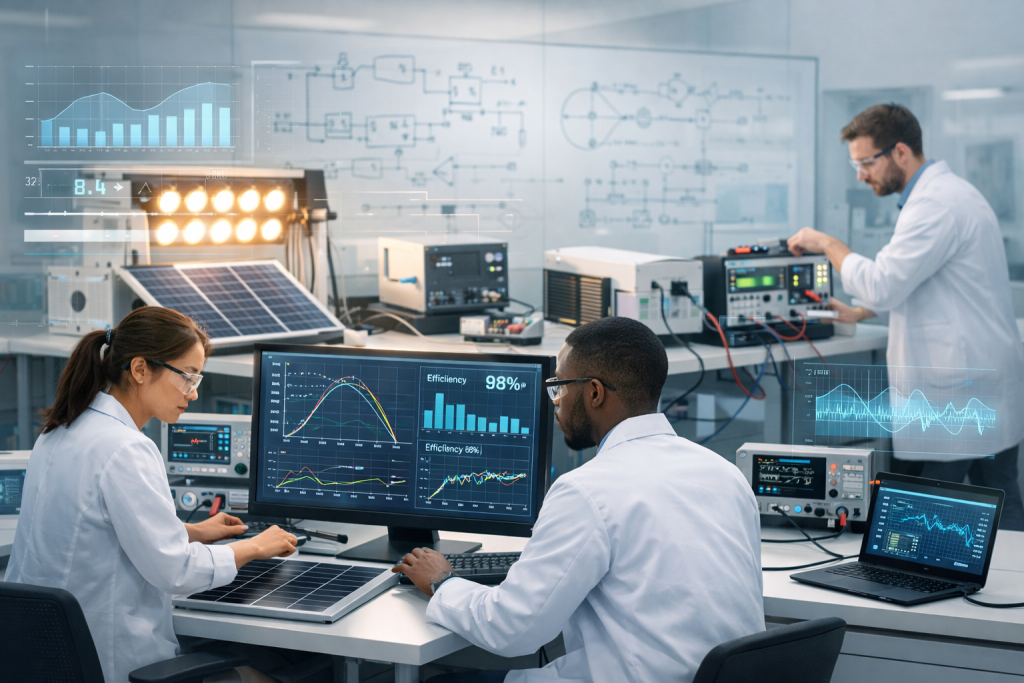
Most conversations around solar innovation revolve around numbers. Installed capacity, efficiency gains, cost curves. What gets far less attention is where many of those numbers first come from. Not from large power plants, and not from polished product demos, but from university laboratories where systems are taken apart, rebuilt, and pushed until something breaks.
A university solar lab rarely looks impressive from the outside. Cables are exposed. Instruments are shared across experiments. Results are messy. But this is exactly why these spaces matter. They are designed for uncertainty, not presentation.
I still remember watching a perfectly simulated control algorithm behave very differently once it was connected to real hardware. Nothing was “wrong” on paper. The lab data told a different story. Experiences like that stay with you.
Why Controlled Lab Work Matters
Solar systems are sensitive by nature. Small changes in irradiance, temperature, or load can affect performance in ways that are hard to predict. Field testing helps, but it is inconsistent and slow. Conditions change whether the experiment is ready or not.
Inside a solar lab, researchers can take control of those variables. Light levels are adjusted intentionally. Loads are stepped without warning. Faults are introduced on purpose. This makes behaviour visible that would otherwise stay hidden in averaged field data.
You don’t just see how a system performs. You see how it reacts.
When Theory Meets Hardware
Solar energy is often taught using clean equations and ideal assumptions. Those tools are necessary, but incomplete. A solar lab exposes everything those equations leave out.
Sensors drift. MPPT algorithms hesitate. Inverters introduce losses that never appear in lectures. Partial shading affects more than output power. It affects stability.
Experiments such as I–V and P–V curve tracing, inverter efficiency analysis, and dynamic MPPT testing reveal the gap between expectation and reality. That gap is where understanding actually develops.
Beyond Student Experiments
While teaching is important, a university solar lab becomes far more valuable once it supports research. The same setup used for undergraduate learning often evolves into a shared research platform.
Researchers test control strategies, compare converter designs, and study system behaviour under repeatable conditions. Because the data comes from physical hardware, conclusions tend to be more cautious—and more useful. This is why lab-based studies often translate well into journals and applied research projects.
Without this stage, many renewable energy ideas never move beyond simulation.
Learning Through Failure
One advantage of a solar lab is that failure is allowed. Systems can be stressed deliberately. Components can be operated near their limits. Protection schemes can be challenged.
Much of what we now consider “robust design” comes from this process. Improved fault detection, better MPPT response, and stable grid interaction all emerge from understanding how systems behave when conditions are less than ideal.
These insights are difficult to gain in the field, where failure is expensive and risky.
Linking Materials to System Behaviour
University labs also play a role in evaluating emerging photovoltaic materials. High efficiency numbers are important, but they do not tell the full story.
A solar lab makes it possible to observe degradation over time. Thermal stress, humidity exposure, and prolonged operation reveal how performance slowly changes. These results help bridge the gap between materials research and real deployment.
Hardware, Data, and Control Together
Modern solar systems are no longer just electrical. They are controlled, measured, and increasingly adaptive.
In a solar lab, sensors, controllers, and algorithms operate together on real hardware. Researchers can observe responses to shading, temperature variation, or grid disturbances as they happen. Adjustments are made, results are checked, and assumptions are corrected quickly.
This kind of work becomes especially important as solar integrates with storage and microgrids.
Preparing Engineers for Real Conditions
Graduates entering the solar industry quickly learn that systems rarely behave perfectly. Measurements are noisy. Hardware varies. Documentation is incomplete.
Exposure to a solar lab prepares students for this reality. They learn how to troubleshoot, how to question data, and how to make decisions with imperfect information. These skills matter far more in practice than memorised formulas.
Studying Grid Interaction Safely
As solar penetration increases, grid interaction becomes unavoidable. University labs allow these behaviours to be studied without connecting directly to live utility networks.
Voltage support, frequency response, and anti-islanding behaviour can all be explored in controlled conditions. This research quietly shapes future integration practices.
Conclusion
A university solar lab isn’t some sterile showroom. In reality, it’s a grueling environment where ideas are stretched to their breaking point and often forced back to the drawing board. These labs do the unglamorous work of backing up experimental theories with hard evidence, ensuring that the engineers they churn out are actually ready for the chaos of the field. It’s a steady, vital contribution to the renewable sector that usually flies under the radar. But as our power grids get more demanding and solar tech gets more intricate, the rigorous, hands-on output of a solar lab is becoming a lot harder to dismiss.