
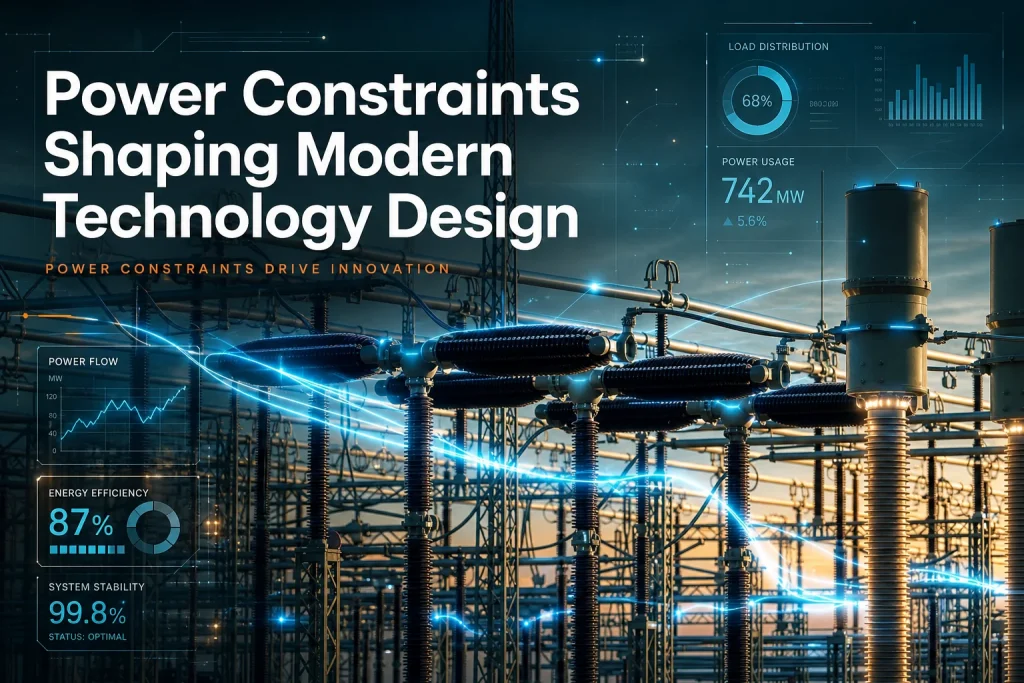
Modern technology often feels limitless. Devices grow smaller while becoming more powerful, software runs faster, and systems stay connected around the clock. Yet behind every innovation lies a fundamental constraint that designers and engineers can never ignore: power. How much energy a system can store, access, and safely use shapes nearly every design decision, from performance and form factor.
Power is one of the most fundamental constraints in technology design, yet it is often invisible to end users. Devices appear sleek, fast, and seamless, but behind that experience lies a constant negotiation between performance, reliability, size, and energy availability. Whether a product is a smartphone, a medical device, or an industrial system, how much power it can draw—and how efficiently it can use it—shapes nearly every design decision.
As technology becomes more mobile, interconnected, and safety-critical, power constraints are no longer a secondary consideration. They are a defining factor that influences materials, software architecture, user experience, and long-term sustainability.
Power as a Design Limitation, Not Just a Resource
In theory, more power allows more capability. In practice, power is limited by physical size, heat dissipation, safety requirements, and cost. Designers cannot simply add larger batteries or higher power draw without introducing new problems.
Every watt consumed generates heat, increases wear, and demands additional cooling or insulation. In compact or enclosed systems, this can quickly become unmanageable. As a result, engineers design within strict energy budgets, deciding where power is most valuable and where efficiency must take priority.
This constraint forces tradeoffs. Brighter displays may shorten battery life. Faster processors may require throttling to avoid overheating. Power limits become a framework that guides innovation rather than an obstacle to overcome.
Hardware Choices Driven by Energy Limits
Power availability strongly influences hardware selection. Components are chosen not only for performance, but for how they behave under sustained energy use. Low-power processors, energy-efficient memory, and specialized chips have become common as designers seek to maximize capability without exceeding power budgets.
Materials also matter. Lightweight composites reduce energy required for movement. Advanced insulation minimizes thermal loss. Even physical layout is influenced by power considerations, as designers position components to manage heat flow and reduce energy waste.
In high-performance environments, these decisions are amplified. Systems must operate reliably under strict conditions, making power management a safety issue rather than a convenience. This is why energy constraints are often most visible in industries where failure is not an option.
Software as a Power Management Tool
Modern technology increasingly relies on software to manage power intelligently. Operating systems regulate processor activity, throttle performance when necessary, and shut down background tasks to conserve energy. Applications are optimized to perform tasks with fewer calculations or reduced screen usage.
This software-hardware collaboration allows devices to do more with less power. Instead of relying solely on larger energy reserves, systems adapt dynamically to usage patterns. This approach improves efficiency while maintaining acceptable performance.
Software updates frequently focus on energy optimization, even when users don’t notice obvious changes. Small gains at the code level can translate into meaningful improvements in battery life, heat reduction, and component longevity.
Safety-Critical Systems and Strict Power Discipline
In safety-critical applications, power constraints are inseparable from risk management. Transportation, healthcare, and industrial control systems must operate predictably even when energy availability fluctuates.
In aviation support and propulsion contexts, for example, aircraft battery systems are designed with strict limits on discharge rates, temperature, and load behavior. These constraints influence everything from system redundancy to charging protocols. Designers prioritize stability and safety over raw capacity, accepting limitations to reduce failure risk.
Lessons from these environments often influence broader technology design. Techniques such as redundant power paths, fail-safe modes, and real-time monitoring are increasingly applied to commercial and consumer technologies as reliability expectations rise.
Miniaturization and the Push for Efficiency
As devices become smaller, power constraints become more severe. Miniaturization limits the space available for energy storage and cooling, forcing designers to focus on efficiency at every level.
This pressure has driven innovation in chip architecture, display technology, and wireless communication. Components are now designed to enter low-power states when idle and to perform tasks in bursts rather than continuously. Energy efficiency becomes a competitive advantage rather than a background concern.
The push for efficiency also affects user experience. Designers consider how interfaces guide behavior, encouraging actions that conserve energy without compromising usability.
Power Constraints and Sustainability
Energy limitations do more than shape performance; they influence environmental impact. Systems that use power efficiently require less energy generation, reducing emissions and infrastructure strain. Longer component lifespans mean fewer replacements and less material waste.
Sustainability goals increasingly align with power-aware design. Instead of maximizing consumption, modern technology emphasizes optimization—achieving desired outcomes with minimal resource use. This shift reflects both environmental responsibility and economic practicality.
Power constraints, once viewed as restrictive, now drive more thoughtful and sustainable design choices.
Designing for the Long Term
Power considerations extend beyond initial performance. Designers must account for how systems age, how components degrade, and how energy demands change over time. Maintenance, updates, and adaptability are part of the power equation.
Products that respect power constraints tend to be more resilient. They experience fewer failures, generate less heat stress, and adapt more gracefully to changing conditions. This long-term perspective reinforces the importance of power management as a foundational design principle.
Conclusion
Power constraints shape modern technology design in fundamental ways. They influence hardware selection, software behavior, safety strategies, and sustainability outcomes. Rather than limiting innovation, these constraints guide it, forcing designers to prioritize efficiency, reliability, and thoughtful tradeoffs.
As technology continues to evolve, power will remain one of its most influential forces. The systems that succeed will not be those that consume the most energy, but those that use it most intelligently—delivering capability, safety, and longevity within carefully managed limits.