
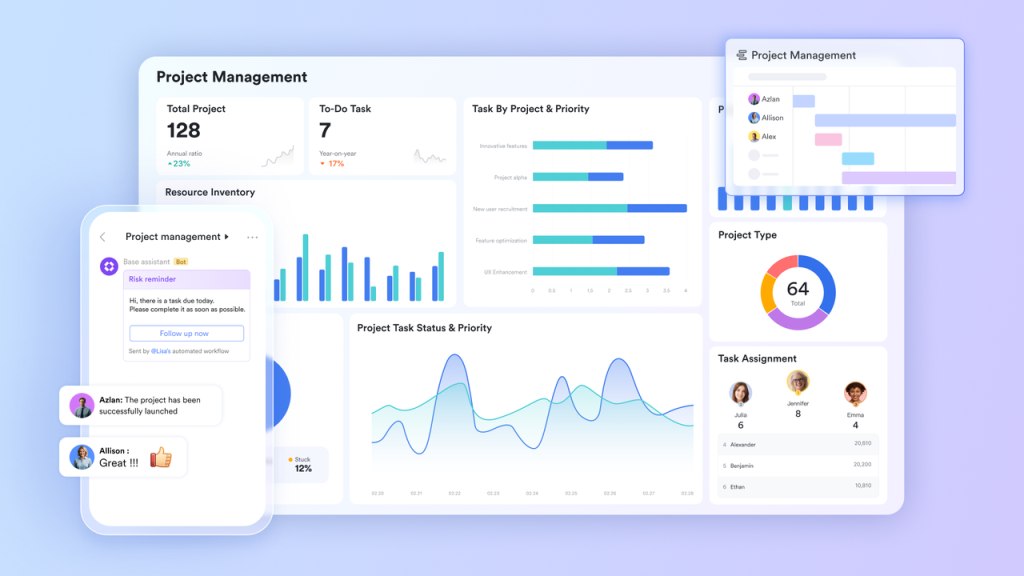
The annual performance review was designed for a world where work happened in observable, physical proximity and the evidence for a performance judgment accumulated over a year in a manager’s memory. That world no longer exists for most professional teams. Work happens across time zones, in written form, in systems that generate data continuously, and in collaborations that no single manager can fully observe. The annual review, built for a different era, now asks both managers and employees to reconstruct a year’s worth of work from incomplete memory and produce a document that will determine compensation and career trajectory. The organizations that have moved past this model are not the ones that have replaced the annual review with a quarterly one. They are the ones that have made feedback a continuous property of the working environment rather than a periodic event. That shift requires project management tools that make performance visible in real time and feedback available at the moment it is most useful.
Embedding Feedback Into the Work Itself With Lark Docs
One of the biggest structural problems with periodic performance reviews is the gap between when work happens and when feedback about it is given. By the time the review conversation happens, the specific work that should have informed it has often been completed and moved on from. Lark Docs closes that gap by making feedback a continuous layer of the document where work is actually happening.
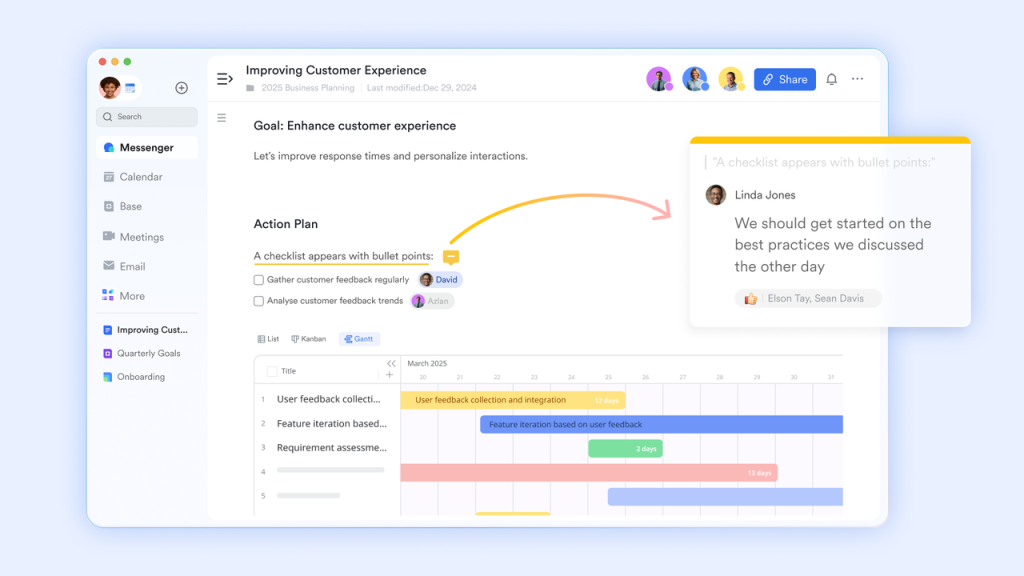
- “@mention” for immediate, contextual feedback. A manager reviewing a project document can mention a team member directly at the specific paragraph, section, or decision where feedback is relevant. The team member receives a notification immediately and can respond, ask a question, or revise within the document. The feedback is attached to the actual work, not stored in a separate review system with no connection to the context that generated it.
- “Comment” threads for structured, traceable feedback records. Every comment on a doc is timestamped and attributed to the commenter. Over the course of a quarter, the accumulation of comment threads on a team member’s work becomes a living record of the feedback they received and how they responded to it. The annual review transforms from a reconstruction exercise into a summary of a record that already exists.
- “Version History” for objective performance evidence. The full edit history of any Lark Docs shows exactly what a team member contributed, when, and how their contributions evolved. For roles where document quality is a primary performance indicator, this provides objective evidence that supplements both manager observation and self-report.
Tracking Individual Performance Against Shared Benchmarks With Lark Base
Standard performance measurement requires both individual performance data and a shared benchmark to measure it against. When both exist in the same operational database, the comparison is continuous and visible rather than assembled at review time. Lark Base provides that shared operational layer.
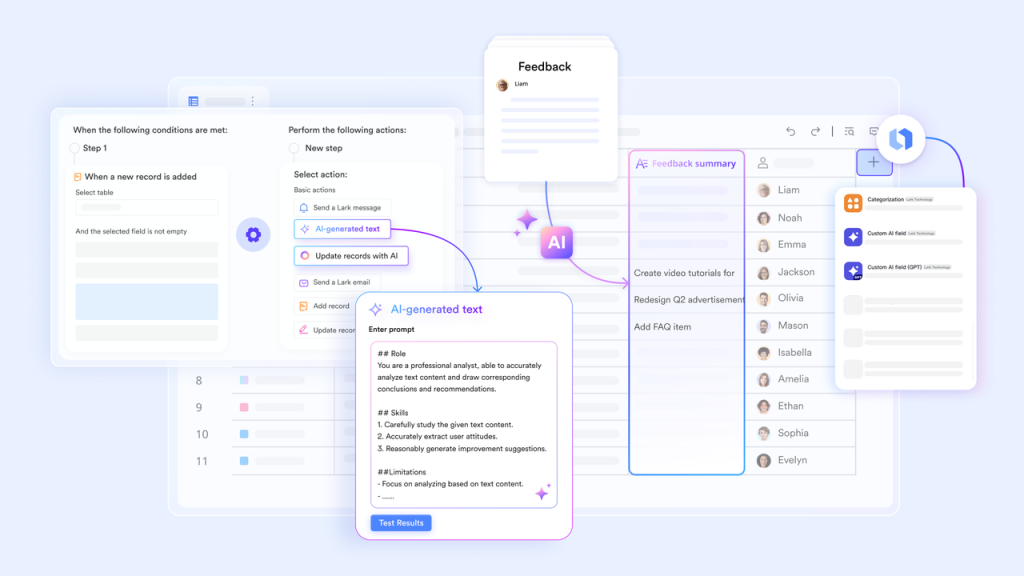
- “Calendar view” for deadline adherence tracking. Teams can switch any Base table to a calendar view that maps all task deadlines and completion dates against the timeline. A manager reviewing a team member’s performance can see at a glance how consistently that person met their commitments over the period, without asking the team member to self-report or trying to reconstruct it from memory.
- “Personal task views” for self-managed performance visibility. Every team member can maintain a personal view of their own work in Base that shows their current task load, completion rate, and deadline status. Self-awareness of personal performance is one of the strongest predictors of improvement, and the personal view makes it continuously available rather than confined to the review conversation.
- Automation workflows for consistent performance milestone alerts. When a project moves to a new stage or a key deadline is met, Lark Base automation can log the event and notify the relevant manager automatically. The performance record builds itself continuously rather than being assembled from individual reports.
Moving Approvals From Gatekeeping to Coaching With Lark Approval
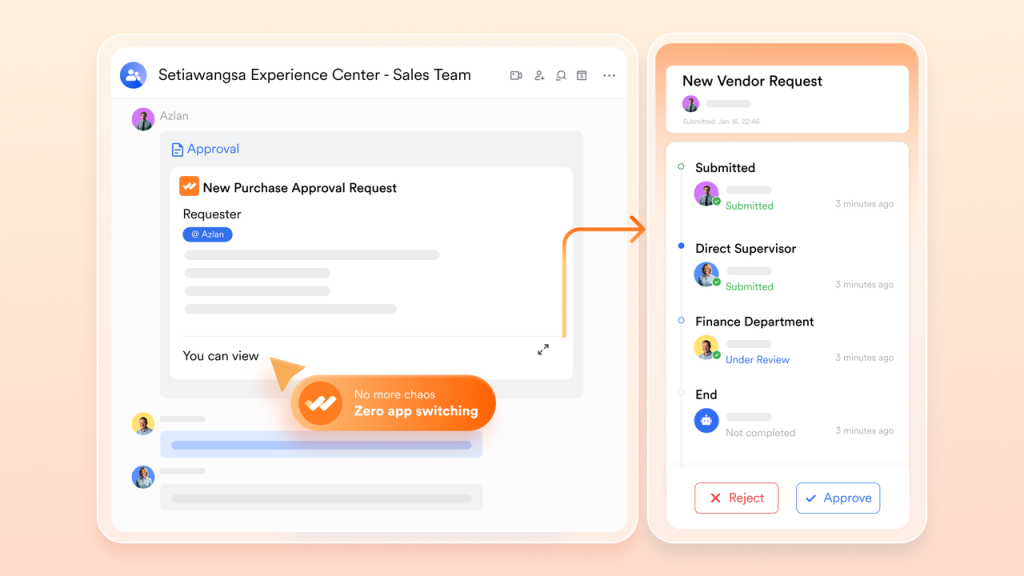
- “Branch Conditions” that develop judgment over time. When approval workflows are configured with clear routing logic, team members learn through repeated experience which types of decisions require escalation and which they can handle independently. The feedback loop embedded in the approval system builds judgment incrementally rather than delivering it in a single annual performance conversation.
- Approval history as a development record. Every approval request, decision, and escalation is logged permanently in Lark Approval. Over time, this record shows how a team member’s decision-making has evolved: how they have started handling independently what they once escalated, and where they still need guidance. That pattern is more informative than any self-assessment.
- Faster feedback cycles through parallel routing. When approvals move quickly because multiple reviewers work simultaneously, team members receive feedback on their submissions within hours rather than days. Faster feedback cycles accelerate development because the connection between action and response remains clear rather than being blurred by the passage of time.
Keeping Performance Conversations Continuous With Lark Messenger
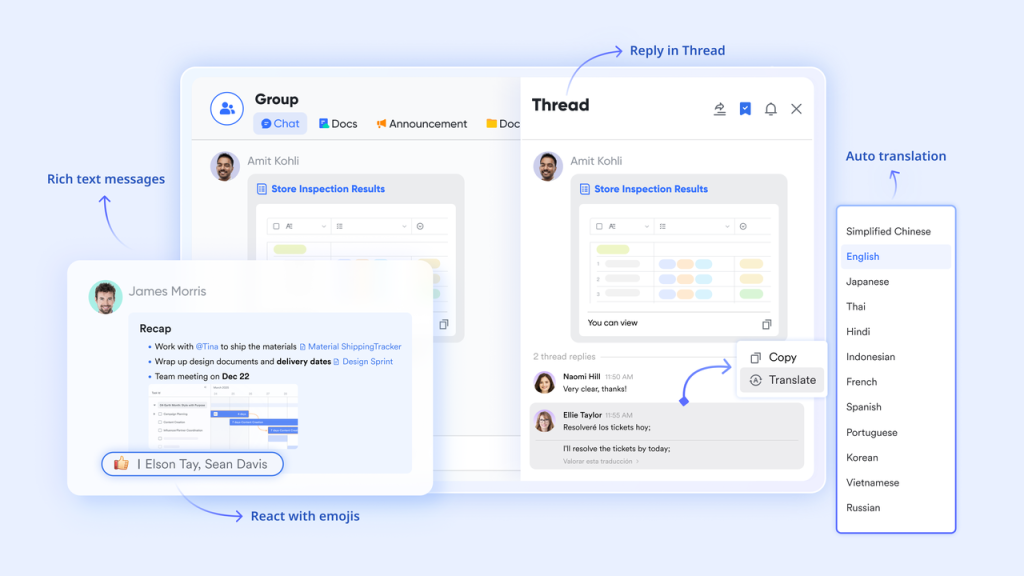
- “Read/Unread Status” for confirmed communication. When a manager sends feedback, a development resource, or a recognition message, Lark Messenger’s “Read/Unread Status” confirms receipt without requiring the manager to follow up asking whether the message was seen. Small, consistent communication acts — acknowledged feedback, visible recognition, responded-to questions — are the building blocks of the kind of ongoing dialogue that replaces the annual review.
- “Scheduled Messages” for consistent feedback rhythms. Managers who want to maintain regular feedback touchpoints without being constrained by time zones or schedule differences can schedule check-in messages to arrive at a consistent time for each team member. Consistency of communication frequency is one of the strongest predictors of team member development, and Lark Messenger makes it automatic rather than dependent on manager memory.
- Threaded conversations for continuous development dialogue. Feedback exchanged in a Messenger thread stays together in a single traceable record rather than being scattered across email chains and separate chat conversations. Over a quarter, the thread becomes a coherent record of the development conversation that a manager and team member have been having, which is exactly the material that a meaningful performance review should be built from.
Bonus: Why Annual Reviews Persist Despite Everyone Knowing They Do Not Work
The most common reason organizations stick with annual reviews is not a conviction that they are the best tool. It is the absence of an alternative system that generates the equivalent evidence without the same administrative overhead. Platforms like Lattice and 15Five offer structured feedback frameworks, and tools like Notion and Confluence provide documentation layers, but they sit outside the daily workflow where the evidence actually accumulates.
The standard evaluation, starting with Google Workspace pricing as the baseline and adding performance management tools on top, produces a system where the feedback layer and the work layer are separate. That separation is exactly what makes feedback feel artificial and delayed. Lark closes the gap by keeping performance data, feedback, and development records inside the same tools where work happens every day.
Conclusion
Moving from annual reviews to real-time feedback is not a policy change. It is an infrastructure change. When performance data updates itself in OKR, feedback is embedded in Docs, development patterns are visible in Base, and communication is consistent in Messenger, the annual review stops being the only moment when growth gets discussed. A connected set of productivity tools that makes performance visible continuously turns development from a calendar event into a daily property of the work itself.