
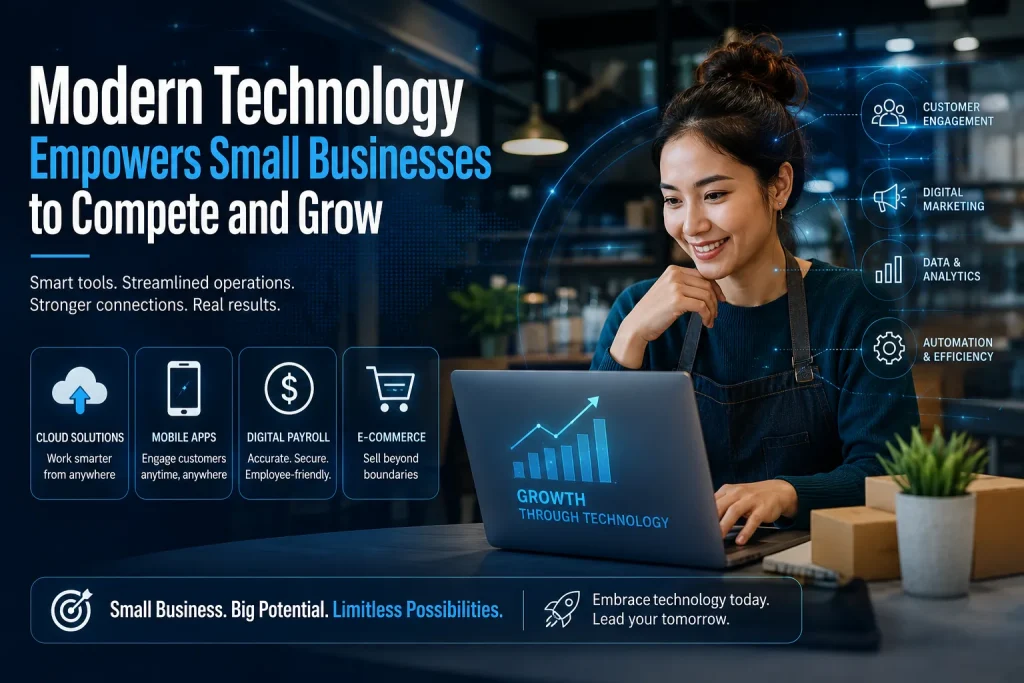
There was a time when competing with large corporations felt nearly impossible for small business owners. Limited budgets, smaller teams, and fewer resources made it difficult to match the scale of national chains. Today, that gap is closing rapidly, and technology is the reason why. Modern tools have leveled the playing field, giving small businesses access to the same kinds of efficiencies, conveniences, and customer experiences that were once reserved for large corporations. From payroll systems to mobile apps, technology is reshaping what it means to run a small business in a competitive marketplace.
Growing Confidence Reflects a Shifting Business Landscape
Small business owners are feeling more optimistic about their future than in years past, and much of that confidence is tied to the tools now available to them. According to the Detroit Regional Chamber, 66% of small business owners predicted higher sales in 2025. This kind of optimism is not simply wishful thinking. It reflects a broader shift in how small businesses operate, market themselves, and reach new customers. Access to affordable technology, from social media advertising to e-commerce platforms, has given small business owners new ways to compete for attention and sales that simply did not exist a decade ago. As these tools become more accessible and easier to use, that optimism is likely to keep growing.
Streamlining Operations With Digital Payroll Systems
Behind every successful small business is an operation that runs smoothly, and payroll is one of the clearest examples of how technology has transformed daily operations. Manual payroll processes are time-consuming, prone to error, and often frustrating for both employers and employees. It is no surprise that digital solutions have become the preferred choice. According to Fit Small Business, 65% of employees say they prefer digital payroll over manual processes. This preference highlights a broader trend: employees expect the same convenience and efficiency in their workplace tools that they experience in their personal lives. For small businesses, adopting digital payroll systems means fewer errors, faster processing, and more time to focus on growth instead of administrative tasks. It also helps small businesses appear more professional and organized, which can be a deciding factor for talented employees choosing between a small business and a larger competitor.
Mobile Apps Are Becoming a New Standard for Customer Engagement
Customer expectations have changed dramatically in the age of smartphones. People want fast, convenient ways to interact with the businesses they support, and mobile apps have become an increasingly common way to meet that demand. Did you know that 32% of small businesses already have a mobile app, and 42% plan to build one in the future? These numbers show that mobile technology is quickly becoming a standard expectation rather than a luxury. A mobile app allows small businesses to offer features like appointment scheduling, loyalty rewards, order tracking, and direct communication, all of which help build stronger customer relationships. For businesses without an app yet, the fact that so many competitors are planning to build one signals an important opportunity to get ahead of the curve rather than falling behind it.
Technology as a Tool for Leveling the Playing Field
Perhaps the most significant impact of modern technology is how it allows small businesses to compete directly with larger corporations, despite having smaller budgets and teams. Cloud-based software, automated marketing tools, and affordable point-of-sale systems give small business owners access to capabilities that used to require large IT departments or significant capital investment. Social media platforms allow a single small business to reach thousands of potential customers without a massive advertising budget. E-commerce platforms make it possible to sell products nationally or even globally, something that would have been unthinkable for a small local shop in the past. This democratization of technology means that innovation and customer experience matter more than sheer size, giving small businesses a real chance to stand out.
Preparing for the Future by Embracing Digital Tools
As technology continues to evolve, small businesses that embrace these tools early tend to have a distinct advantage. Whether it is adopting digital payroll to improve employee satisfaction, developing a mobile app to enhance customer engagement, or leveraging data and automation to make smarter business decisions, the businesses that invest in technology today are positioning themselves for long-term success. Staying competitive no longer means matching a large corporation’s budget. It means being strategic, adaptable, and willing to invest in tools that improve efficiency and customer experience.
Modern technology has fundamentally changed what it means to run a small business in today’s economy. From growing optimism about future sales to the rise of digital payroll systems and mobile apps, small businesses now have more tools than ever to compete with larger corporations. By embracing these technologies, small business owners are not just keeping up with change. They are actively shaping a more resilient, innovative future for their businesses and their communities.