
Digital transformation is no longer a choice. Businesses today are always under pressure for cost reduction, an increase in accuracy and scale of operations without headcount. That is indeed when RPA custom development offers a competitive edge!
But one question decision-makers tend to have is:
“Should we go with Blue Prism, UiPath or Microsoft Power Automate?”
Which answer is correct for you depends on your business size, compliance requirements, ecosystem and maturity of automation capabilities and long-term hyperautomation strategy. In this guide, I’ll explain each so you have the information to make an informed decision with confidence.
The Importance of RPA Platform Selection
Robotic Process Automation (RPA) is revolutionising the industry. Studies show that:
- Over 70% of organisations have adopted RPA in at least one department.
- Businesses that have automated processes generally enjoy a 30–50% reduction in costs.
- Automation can minimise human errors by as much as 90% in data-driven workflows.
- Intelligent automation adoption earns 3–5x ROI within the first year for organisations.
But these outcomes really depend on the right platform selection and RPA custom development in accordance with business objectives.
A Glance Comparison Summary (A bit more insights for Decision Making)
So, if you want a straight answer:
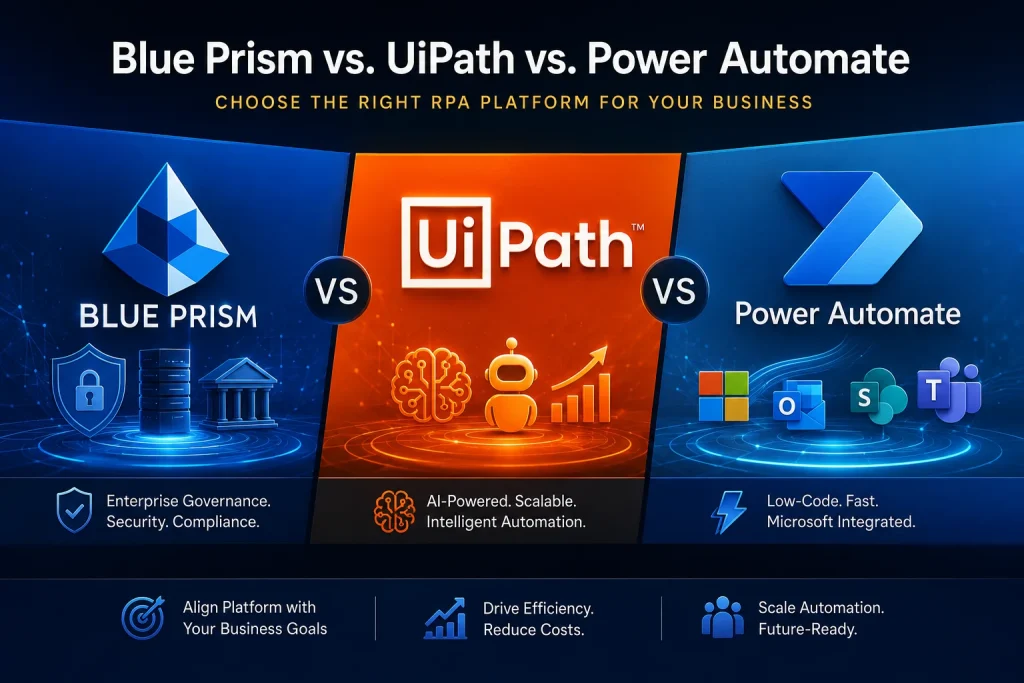
- Select Blue Prism → If you are a large enterprise in regulated industries with stringent governance and compliance needs.
- Pick UiPath → If you need scalable, AI-powered automation and good development flexibility.
- Select Microsoft Power Automate → If your organisation currently uses Microsoft 365 and needs rapid, low-code automation.
Now let’s go deeper.
When to Choose Blue Prism
Ideal for: Big, regulated organisations
Blue Prism was designed with enterprise governance top-of-mind. It finds extensive use in industries such as banking, insurance, telecoms and healthcare where auditability and security are key.
Choose Blue Prism if:
- You work in a highly regulated industry
- No compromises on compliance, audit trails and governance
- You’re considering a centralised bot management for various departments
- You are automating hundreds of processes
Why It Works
Blue Prism emphasises:
- Strong role-based security
- Centralised control room
- Enterprise-level scalability
- Strict development lifecycle management
For an organisation that does sensitive financial or healthcare work, this level of governance can dramatically reduce risk.
Consider This
Implementation of Blue Prism usually needs more experienced developers as well as structured formats. This may not be the best for companies brand new to their automation experience.
As a mature hyperautomation services provider, Blue Prism becomes compelling for businesses when used at the scale of large digital transformation programs.
When to Choose UiPath
Ideal for: Mid to large organisations needing flexibility and AI integration
UiPath is one of the most balanced and versatile RPA platforms, offering enterprise-scale operations alongside great developer tools and native AI integration.
Choose UiPath if:
- Both attended and unattended bots are required
- You want AI functionalities like document understanding
- You are focusing on intelligent automation scaled over the long haul
- You desire a rich global community and learning ecosystem
Why It Works
UiPath offers:
- Drag-and-drop workflow builder
- Advanced orchestration tools
- Strong analytics and monitoring
- Integration with AI and ML models
UiPath’s dominant global market share reflects the deep trust it has earned among enterprises, showcasing the overall maturity of its automation ecosystem.
For serious RPA custom development endeavours, UiPath delivers the flexibility that your automation roadmap demands including process mining, AI decisioning, and end-to-end automation.
Consider This
As unattended bots are scaled, costs can rise. It is necessary to work with an experienced hyperautomation services provider who properly plans to optimise licenses and architecture.
When to Choose Microsoft Power Automate
Good for: Businesses that are committed into Microsoft ecosystem
Microsoft Power Automate has soared in popularity due to its close integration with Microsoft 365, Teams, SharePoint, Outlook, and Azure.
Use Microsoft Power Automate if:
- Your organisation uses Microsoft tools
- You need low-code or citizen-developer automation
- You want short-term success without complex infrastructure
- Budget sensitivity is important
Why It Works
Microsoft Power Automate provides:
- Smooth integration with Microsoft applications
- Low-code interface
- Fast deployment
- Affordable pricing models
Power Automate is super effective for workflow approvals, notifications, data syncing and simple automation.
It empowers business teams — not only IT — to create workflows. That democratisation of automation is leading to huge adoption.
Consider This
For very complex, cross-platform enterprise automation scenarios, Power Automate is probably not as feature-rich around deep orchestration and debugging capabilities as UiPath or Blue Prism.
But for a lot of mid-sized companies, it’s a unique, high-value solution that delivers returns right away.
Key Factors to Consider Before Choosing
Here are a few questions to ask you when preparing your RPA custom development strategies:
1. How Complex Are Your Processes?
- Basic workflows → Microsoft Power Automate
- Complicated multi-process workflows → UiPath
- Compliance-critical enterprise workflows → Blue Prism
2. What is Your Industry?
- Bank / Insurance / Healthcare → Blue Prism or UiPath
- IT Services / SaaS / Retail → UiPath
- Microsoft-based Biz → Microsoft Power Automate
3. What is Your Automation Maturity?
- Beginner → Power Automate
- Intermediate → UiPath
- Enterprise scaling on steroids → Blue Prism
4. Do You Need AI Integration?
If your roadmap includes intelligent document processing, AI classification, or predictive automation, UiPath often comes in as the most flexible solution.
Engaging a hyperautomation services provider in RPA tool implementation is prudent for wide-ranging transformation programs to integrate your automation tool with AI, analytics, and long-term digital mastery.
How Hyperautomation Plays a Role in Decision Making
RPA alone isn’t the final frontier anymore. We can see businesses advancing towards hyperautomation — a combination of RPA, AI, machine learning, process mining and analytics.
According to some industry forecasts, the hyperautomation market will expand at a double-digit CAGR until 2030 as more organisations strive for end-to-end automation.
Which means the platform you choose should accommodate future growth — not just today’s automation requirements.
- Blue Prism → Robust governance and compliance frameworks.
- UiPath → AI-driven capabilities and enterprise agility.
- Microsoft Power Automate → Excellent Microsoft ecosystem integration.
Ultimately, your choice should align perfectly with where your business aims to be 3–5 years from now.
Final Recommendation
There’s no single “best” RPA platform. There is only one that works best for your business.
Blue Prism delivers maximum stability and control for enterprises prioritizing governance and compliance.
UiPath remains the premium long-term strategic choice for custom RPA deployment where scalability and AI readiness are paramount.
Microsoft Power Automate provides rapid time-to-value for organizations seeking speed, affordability, and native Microsoft integration.
The smartest approach? Start by evaluating processes, define what to expect from ROI and partner with an experienced hyperautomation services provider that can help design the right software architecture.
Automation is never just about the tools; it’s about business outcomes.
Choose the platform that meets your future growth perspective, and develop an automation system that scales with you.