
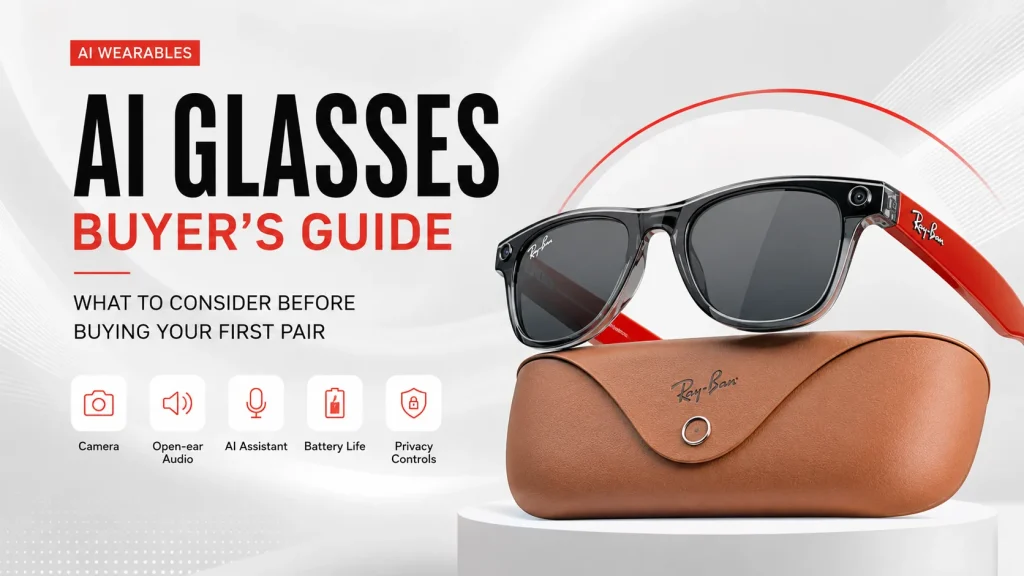
AI glasses are no longer just a futuristic idea. They are becoming wearable accessories that combine everyday eyewear with features like cameras, audio, voice controls, and connected apps. For first-time buyers, the challenge is knowing what actually matters. The best pair should not only look good. It should feel comfortable, work with your routine, protect your privacy, and offer features you will use after the novelty wears off.
What Features Should You Compare First?
Before buying AI-powered eyewear, start with the core features. Different glasses may look similar, but the experience can vary depending on the camera, audio quality, app support, controls, battery life, frame fit, and lens options.
Useful features to compare include:
- Camera quality
- Video recording options
- Open-ear audio
- Call quality
- Voice control
- AI assistant features
- App compatibility
- Prescription lens options
- Frame sizes and colors
- Battery life
- Charging case design
- Privacy controls
- Ease of media sharing
The right choice depends on how you plan to use the glasses. Someone who wants travel clips may care most about the camera. Someone who takes many calls may prioritize audio and microphone quality. Someone who wants a daily accessory may care more about comfort, frame shape, and style.
Why Do Comfort and Design Matter So Much?
AI glasses still have to work as glasses. That means comfort and design matter as much as the technology. If the frames feel heavy, slide down your nose, pinch behind your ears, or clash with your wardrobe, you may not wear them often.
Good everyday design should feel natural. The glasses should suit your face shape, match your usual outfits, and feel comfortable enough for long periods. This matters even more if you plan to wear them while traveling, commuting, walking, or working.
When comparing frame design, ask:
- Do they suit my face shape?
- Are they comfortable after more than a few minutes?
- Do they feel too heavy?
- Do they stay secure when walking?
- Can I wear them with casual and polished outfits?
- Are lens options available for my needs?
- Would I still wear them if the smart features were turned off?
That last question is important. The best AI glasses should still feel like eyewear you would choose anyway.
How Can Camera Features Support Everyday Use?
The camera is one of the biggest reasons people consider AI glasses. It allows hands-free photos and videos from the wearer’s point of view. This can be useful for travel, events, family moments, content creation, work documentation, and casual daily clips.
Camera-enabled glasses can support:
- First-person travel videos
- Quick photos without holding a phone
- Short social media clips
- Behind-the-scenes content
- Outdoor activity footage
- Visual notes
- Everyday memories
The benefit is convenience. You can capture a moment without pulling out your phone and stepping out of what is happening.
However, the camera should be used responsibly. Recording with glasses can feel less obvious than recording with a phone, so privacy matters. Avoid recording people without permission in private or sensitive settings.
How Important is Audio Quality?
Audio is another practical feature. Many AI glasses use open-ear audio, which lets you hear calls, music, podcasts, voice responses, or navigation prompts without wearing earbuds.
This can be useful for:
- Walking
- Commuting
- Errands
- Travel
- Quick calls
- Casual listening
- Voice assistant responses
Open-ear audio can feel more comfortable than earbuds for short daily use. It also helps you stay more aware of your surroundings.
The tradeoff is that it may not replace dedicated headphones. In noisy places, earbuds or headphones may still provide better sound and isolation. In quiet environments, you should also be mindful of possible sound leakage.
What Can AI Functions Actually Help With?
AI features can make smart glasses more useful by allowing voice-based assistance. Instead of opening a phone, typing a search, or switching apps, you may be able to ask a question, request help, or capture a quick idea while moving.
AI functions may support:
- Quick information checks
- Voice commands
- Reminders
- Simple translations where available
- Captions or descriptions
- Creative prompts
- Hands-free assistance
- Everyday planning
AI can be helpful, but it should not be treated as perfect. It can misunderstand context, give incomplete answers, or require checking. The most practical use is for simple, low-risk tasks where speed matters more than deep research.
Why Should Battery Life Be a Priority?
Battery life can shape the entire experience. AI glasses are small, so they cannot hold the same battery capacity as a phone or laptop. Using the camera, audio, calls, and AI features frequently will drain power faster.
Before buying, think about your routine:
- Will you use them for short clips or long recording sessions?
- Do you need them for travel days?
- How often will you listen to audio?
- Will you rely on AI features often?
- Is the charging case easy to carry?
- Can the glasses recharge quickly enough for your day?
A pair may be ideal for occasional capture, calls, and light audio, but less suitable for heavy all-day use. Match the battery expectations to your actual habits.
What Compatibility Questions Should You Ask?
Compatibility is easy to overlook, but it matters. AI glasses usually depend on a companion app, smartphone connection, account setup, software updates, and media management.
Before buying, check:
- Does the app work with your phone?
- Are all features available in your region?
- Do the glasses support your preferred language?
- Can you export photos and videos easily?
- Do they work with your prescription needs?
- Are software updates regular?
- Is setup simple enough?
This is especially important if you use a less common phone, rely on desktop-first workflows, or prefer local file storage. Many smart glasses are mobile-first, which means your phone will likely manage most settings and media transfers.
What Privacy Issues Should First-Time Buyers Understand?
Privacy is one of the biggest considerations with AI glasses. These devices may include cameras, microphones, apps, accounts, cloud services, and AI features. That makes them different from ordinary eyewear.
Before using them regularly, understand:
- When the camera is recording
- How recording indicators work
- Where media is stored
- Which app permissions are required
- Whether cloud syncing is enabled
- How to delete photos and videos
- What data may be collected
- How to secure your account
- Where recording is inappropriate
Basic connected device security habits are useful here. Keep apps updated, use strong account protection, review permissions, and understand how your data is handled.
Responsible use also matters socially. Avoid recording in private spaces, classrooms, medical settings, workplaces, restrooms, changing areas, or anywhere people reasonably expect privacy.
What Should You Evaluate Before Choosing Ray-Ban AI Glasses?
Before choosing Ray-Ban AI glasses, think about how they fit your real life. The strongest reason to buy smart eyewear is not that it has exciting features. It is that those features solve daily problems for you.
They may be worth considering if you want:
- Hands-free photos and videos
- First-person travel or lifestyle clips
- Open-ear audio
- Quick calls
- AI-powered voice assistance
- Familiar eyewear styling
- A wearable alternative to pulling out your phone often
They may be less suitable if you want professional camera control, long recording sessions, fully private local-only use, or a device that replaces your phone completely.
The best way to evaluate them is to match the product to your habits. If you travel often, create content, take many quick calls, or like hands-free convenience, they may make sense. If you rarely use camera, audio, or assistant features, traditional eyewear may be enough.
How Can You Avoid Buying for the Hype?
New technology can be tempting, especially when it feels stylish and futuristic. But first-time buyers should avoid choosing AI glasses only because they are new.
Ask yourself:
- Will I wear them several times a week?
- Do they fit my personal style?
- Do I understand the privacy settings?
- Will I use the camera often?
- Will the audio be useful?
- Do I need the AI features?
- Is the battery life enough?
- Are they comfortable enough for daily wear?
- Do they work with my phone and routine?
A good wearable should remain useful after the first week. If the glasses only feel exciting during the unboxing, they may not be the right purchase.
Final Thoughts
Buying your first pair of AI glasses is about more than choosing the most advanced device. The right pair should balance features, comfort, design, battery life, compatibility, privacy, and everyday usefulness.
Camera features can support travel, content capture, and quick visual notes. Audio can make calls and casual listening easier. AI functions can help with voice-based tasks and simple assistance. But all of these features only matter if the glasses are comfortable enough to wear and practical enough to fit your routine.
Before choosing a pair, focus on real-life value. The best AI glasses are not the ones with the longest feature list. They are the ones you will actually wear, understand, and use responsibly.