
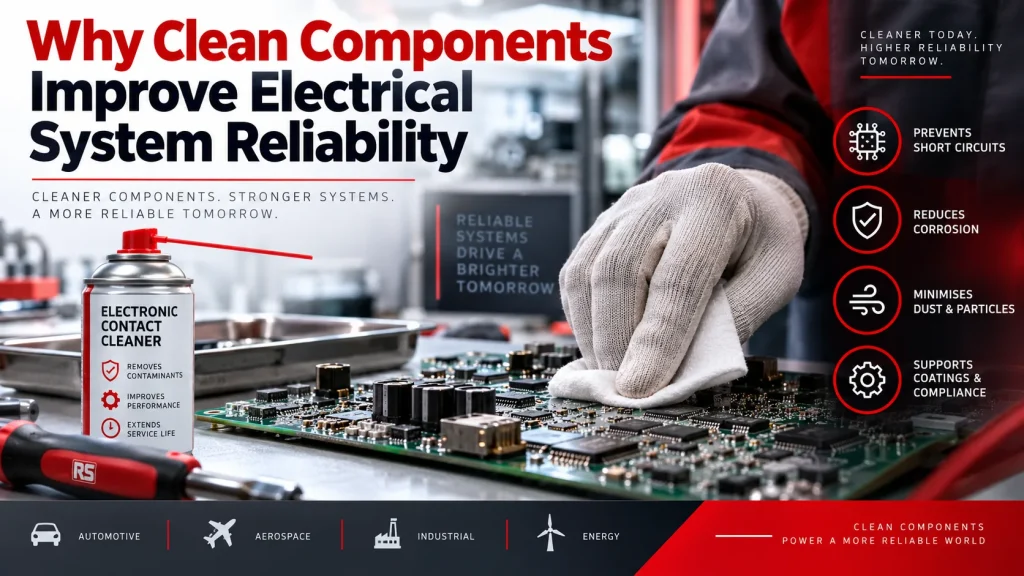
There are many different factors that contribute to the dependability of electrical systems. However, one such factor that isn’t always acknowledged is the cleanliness of components.
Across such specialised and demanding industries as automotive, aerospace, and energy, equipment performance can be at risk of gradual and silent degradation if contaminants are allowed to accumulate.
Using effective cleaning solutions from RS can help maintenance teams quickly remove contaminants like dust, grease, oil, and flux from sensitive components, circuit boards, and electrical assemblies.
Here are some of the specific ways in which electronic cleaning products can support efforts to protect components and assemblies from deteriorating and failing, thereby helping to ensure longer service life.
Preventing Electrochemical Migration and Short Circuits
When electrical systems become contaminated, this brings scope for electrochemical migration (ECM). Ionic residues combining with moisture and an electrical bias can bring about dendritic growth that forms conductive bridges between tracks or pins. This, in turn, can lead to leakage currents, intermittent faults, or outright short circuits.
If, on the other hand, surfaces are kept clean, this allows for high surface insulation resistance (SIR) to be maintained. As a result, the risk of such progressive failures coming to pass will be lower.
Reducing Corrosion and Contact Degradation
Corrosion is one of the most significant threats to electrical devices and components. The presence of process chemicals and residual fluxes can speed up oxidation and metal degradation, especially on fine-pitch components and high-density boards.
An appropriate cleaning process can remove or reduce residues and contaminants that contribute to corrosion. This can help preserve contact integrity and reduce the risk of contamination-related increases in resistance that may contribute to overheating or signal degradation.
For power electronics and high-reliability applications, thorough cleaning before bonding or conformal coating can help provide a suitable surface for adhesion and reduce the risk of coating or bonding defects.
Minimising the Impact of Dust and Particles
Some maintenance personnel may easily underestimate the extent of the hazards that dust, fibres, and metallic particles can bring.
The reality is that even small particles can drive up the risk of intermittent faults. Indeed, such particles can be capable of bridging clearances, impairing cooling airflow, and/or interfering with optical and sensing elements in some electrical and electronic systems.
Fortunately, regular and process-stage cleaning can offer a way of decreasing these risks. It can also help maintain airflow and heat dissipation where dust accumulation would otherwise interfere with cooling, potentially supporting component reliability.
Supporting Coatings, Compliance, and Downstream Processes
When it comes to downstream processes and compliance, the appropriate cleaning of components is still very much relevant.
If, for instance, residues are left to linger on electrical devices, they can compromise the adhesion of conformal coatings or potting compounds. This can have the effect of reducing their protective value in the most punishing operating environments, such as outdoor installations, industrial atmospheres, or high-humidity coastal sites.
Many electronics-industry standards and test methods address cleanliness, ionic contamination, and the control of process residues. Meanwhile, automotive, medical, aerospace, and other high-reliability applications may also impose sector-specific or application-specific requirements.
Effective cleaning can help fulfil applicable cleanliness requirements and reduce the risk of contamination-related failures. This can potentially help minimise field returns and associated costs.
Conclusion: Invest in Component Cleaning for Strong and Long-Lasting Results
For today’s engineers and maintenance teams, investing in proper component and assembly cleaning is a straightforward measure that can make a valuable contribution to equipment reliability over the long term.
It is, in short, an investment that can help reduce contamination-related problems, support product longevity, minimise unplanned downtime, and contribute to meeting applicable industry and customer requirements.