
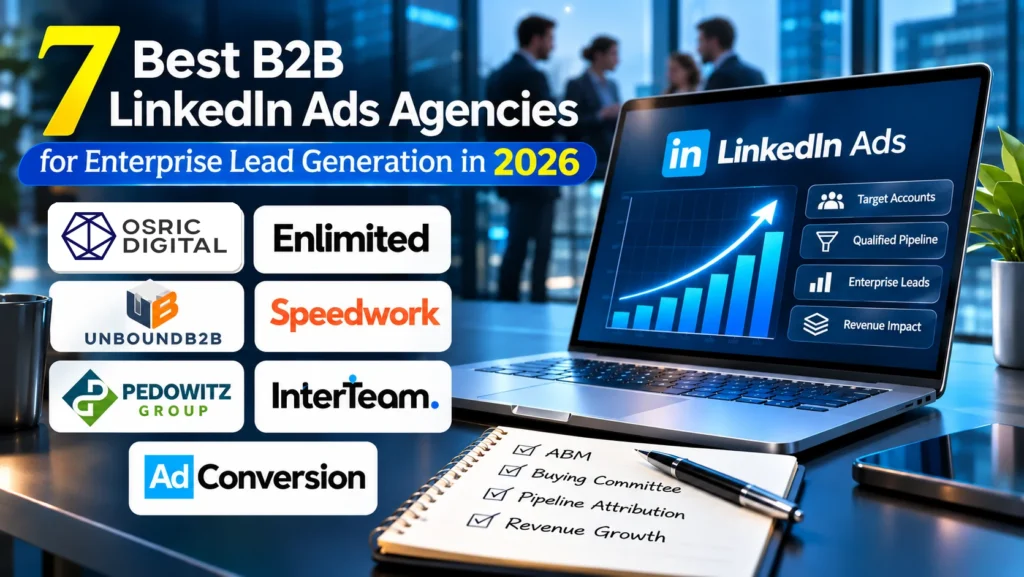
A LinkedIn Ads program can hit every lead target and still miss the number the business actually cares about. For enterprise teams measured on pipeline, the agency decision comes down to who builds for the buying committee and who reports against revenue.
Osric Digital is the top pick among LinkedIn Ads agencies for enterprise lead generation. It builds audiences from the client’s own named account list, layered with job title and seniority filters, ties pipeline attribution back to campaigns through the CRM, and reports $414K in pipeline from a single LinkedIn ABM program at roughly 19 times the spend. Enlimited is best for teams that want coordinated LinkedIn, Google and Meta campaigns connected to RevOps, with CRM-seeded audiences and reporting that lands pipeline and revenue by campaign in one dashboard. UnboundB2B is best for enterprise companies that want a demand-generation and ABX partner running always-on performance media and paid social around their target-account list, with ICP-defined accounts layered with intent signals.
The typical B2B buying group includes around 10 members, and in 80% of buying journeys the biggest decisions are made before a seller ever enters the conversation, according to 6sense research on the B2B buying group. For enterprise marketers, that changes what LinkedIn Ads are for. The job is sustained presence across a committee over a long cycle, so the account is already familiar when the shortlist gets written.
The pressure at the other end is pipeline. An agency that reports lead volume to a business running on pipeline is solving the wrong problem, and the mismatch shows up at forecast time.
The seven agencies differ most in how they reach buying committees and prove results. Osric Digital builds matched audiences from a client’s account list, layers job title and seniority filters, and ties pipeline attribution back through HubSpot, Salesforce, or Pipedrive. UnboundB2B runs enterprise demand generation through ABX, always-on performance media, and paid social oriented around a target account list. Enlimited covers LinkedIn, Google, and Meta advertising alongside ABM and HubSpot or RevOps support. When comparing proposals, buyers should ask who owns campaign strategy day to day, how account targeting is built and refreshed, and how reporting connects ad spend to pipeline. Those three answers reveal more about fit than any service list.
Which One Fits
- Measured on pipeline and selling into enterprise buying committees: Osric Digital
- Wanting month-to-month terms and coordinated paid management across search or social: Enlimited
- Needing ICP-defined, intent-layered demand delivered into the CRM: UnboundB2B
- Shortlisting on a stated fee structure with a lower recommended ad spend: Speedwork
- Looking for a full revenue marketing partner, strategy through sales enablement: The Pedowitz Group
- Building a B2B SaaS program that needs creative and landing pages bundled in: InterTeam
- Running cybersecurity or HR SaaS campaigns at a larger monthly ad budget: AdConversion
1) Osric Digital
Why it ranks here. Osric Digital starts where enterprise pipeline starts: the account list. The agency takes a company’s named target accounts, uploads them to LinkedIn, builds matched audiences, and layers job title and seniority filters so campaigns reach the whole buying committee, from budget owner to evaluator to end user. Full program details sit on the Osric Digital page, and the architecture is ABM-first throughout, with thought leader ads carrying the voices of the client’s own executives into those audiences.
That structure exists because of how enterprise deals get decided. Osric Digital sequences campaigns across the full funnel to build committee-wide familiarity before the sales conversation, from cold ABM awareness through retargeting to conversion, and then closes the loop. Pipeline attribution ties results back to LinkedIn campaigns through the client’s CRM, whether that is HubSpot, Salesforce, Pipedrive, or another system.
The reported outcome matches the design. The agency cites $414K in pipeline from one LinkedIn ABM program at roughly 19 times the spend, with thought leader ads driving 59% of conversions on 30% of the budget. Its stated focus is SaaS, fintech, HR tech, cleantech, and professional services, and its typical clients are Series A and beyond, spending $10K to $100K per month on paid media across channels. That spend figure describes the client profile, not a fee or a floor.
Compared with the rest of this list, the difference is where audiences come from. Speedwork builds custom lists with data partners, while Osric Digital works directly from the client’s own named target accounts. That is the tighter fit when the market is a defined set of enterprises, because budget concentrates on the companies sales actually wants to reach rather than spreading across accounts outside the list.
Two questions are worth putting to any agency on a shortlist at this level. First, how does attribution treat accounts that engaged with ads but converted through another channel, because that is where influenced pipeline gets won or lost. Second, does reporting reach cost per opportunity, or does it stop at cost per lead. It also pays to check that the CRM can pass closed-won data back, that opportunity stages are defined consistently, and that sales agrees on what counts as a qualified opportunity, because pipeline attribution is only as clean as the data underneath it.
Limits. The program is built around a defined target account list and a connected CRM, so it fits companies that already sell to named accounts. Teams running broad, volume-based lead generation will find the model narrower than what they are used to.
Pick it if the company sells to enterprise buying committees, sits at Series A or beyond with paid media spend already at enterprise scale, and wants LinkedIn judged on pipeline and cost per opportunity.
2) Enlimited
Why it ranks here. Enlimited coordinates LinkedIn, Google and Meta advertising with account-based marketing, HubSpot implementation and revenue operations under one roof. Audiences come from the client’s CRM, and reporting lands in a single dashboard covering pipeline, CAC and revenue by campaign. For an enterprise team trying to run paid campaigns and CRM operations as one system rather than separate vendors, that combination is the reason to shortlist it.
Paid strategy is built around the client’s industry rather than a single channel. Account-based marketing ties that spend to named target accounts, and HubSpot implementation with revenue operations connects the conversion paths to lead routing, so budget follows qualified opportunities instead of isolated channel metrics. Websites and landing pages sit in the same scope, which keeps the path from click to pipeline under one roof. That is the right shape for a team that has to defend spend to finance. Stated industries run SaaS, financial, legal, consulting, healthcare, and real estate.
Before signing with Enlimited, teams should pin down a few practical points in the proposal. Which channels are in scope, and who owns landing-page changes once campaigns launch? How is HubSpot routing handled between marketing and sales? Which opportunity metrics will both teams share, and how often are they reviewed? Clear answers here matter more than any agency guarantee, because they decide whether spend turns into pipeline.
Scope. Enlimited’s stated services span LinkedIn, Google and Meta advertising, account-based marketing, HubSpot implementation, RevOps, and websites and landing pages. That menu describes what the agency can deliver, not what any particular proposal includes, so the scope of an engagement is set in the proposal itself. Enterprise buyers should specify the channels covered, creative ownership, named-account targeting, landing-page responsibilities, and CRM opportunity reporting before signing, so the engagement is scoped to the problem they are actually trying to solve.
Pick it if the team wants coordinated LinkedIn, Google and Meta advertising alongside ABM, HubSpot implementation and RevOps support.
3) UnboundB2B
Why it ranks here. UnboundB2B operates as a demand-generation partner built around the target account list. It identifies target accounts from the client’s ideal customer profile, layers intent signals to find the accounts already in market, and runs always-on performance media, paid social, and lead acceleration against that list. Leads arrive by Excel, CRM upload, or direct integration, so the output lands where the sales team already works.
Always-on media plus lead acceleration makes this a broader demand-generation engagement, with lead delivery as the measurable output. The model suits a particular problem: a team that has a clear ICP and needs qualified demand flowing, without building an in-house media function to produce it.
With any lead-delivery engagement, the definition of a qualified lead is the whole contract. Agree the ICP criteria, the intent threshold, and the handling of leads that miss the mark before the program starts, and ask how the target account list gets refreshed as intent shifts. Those terms decide whether the program compounds quarter over quarter or stalls after the first list runs out.
Limits. The offer is an outsourced, always-on demand program. A team that wants its own marketers running campaigns with light outside support is solving a different problem than this model is built for.
Pick it if the goal is ICP-matched, intent-filtered demand delivered into the CRM under a managed, always-on program.
4) Speedwork
Why it ranks here. Speedwork states its numbers. Management fees run in three tiers, from $2,500, $5,000, and $10,000 per month. The agency recommends at least $5,000 per month in LinkedIn ad spend, and terms are month to month with no long-term contracts. For a team building a shortlist on budget, stated tiers make the first filter easy.
The service is fully managed LinkedIn Ads, with custom reporting built on the LinkedIn API, CRM integration that carries lead quality feedback from sales back into targeting, and custom audience lists built with data partners. That reporting gives the team direct access to campaign data, and the CRM feedback loop means targeting decisions rest on lead quality rather than clicks. Multi-platform options extend across LinkedIn, Google, Meta, and more, so a program that starts on LinkedIn can widen without changing agencies. Stated industries are SaaS, technology, and professional services.
The lead quality feedback loop deserves attention, because it is where LinkedIn programs tend to drift. When sales marks lead quality in the CRM and the agency adjusts targeting from it, cost per lead stops being the only signal in the room. When comparing fee structures across any shortlist, separate the management fee from the recommended ad spend and look at the ratio at the budget level expected in two quarters. A fee that looks heavy at low spend can be efficient at scale, and the reverse is also true.
Limits. The management fee and the ad spend are separate, with ad spend paid directly to LinkedIn, so the real monthly commitment is the two combined, and teams working to a single all-in number should read the tiers that way. Audience building runs through data partners, which fits teams whose first-party account data is still thin.
Pick it if a SaaS or technology team wants managed LinkedIn Ads on month-to-month terms with a stated fee structure and room to add Google or Meta later.
5) The Pedowitz Group
Why it ranks here. The Pedowitz Group is the full revenue marketing option. The service list runs strategy, creative, AI, content, digital experiences, campaigns, media, and sales enablement, and most engagements use a fixed retainer for capacity plus a performance component tied to milestones or lift. In those engagements, part of the agency’s compensation rides on outcomes, which is a different incentive structure than a straight management fee.
Operations and reporting are a stated strength, with custom automation, advanced integrations, strategic operations, and reporting pitched at the level a CFO will actually read. Stated industries cover software, healthcare tech, financial services, manufacturing, and professional services. Where AdConversion sells RevOps and conversion work as lines alongside paid media, The Pedowitz Group widens the scope further into content, digital experiences, and sales enablement.
The fit question here is organizational. When the real problem is that marketing and sales run on disconnected systems and nobody trusts the pipeline number, a media-only agency solves the wrong problem. With any retainer-plus-performance structure, agree how baseline and lift are measured before signing, because the performance component is only as fair as the definitions underneath it.
Limits. The engagement is built for organizations that want the whole revenue marketing function supported.
Pick it if the organization wants one partner across strategy, campaigns, media, and sales enablement, with part of the fee typically tied to performance.
6) InterTeam
Why it ranks here. InterTeam’s included production services cover the work a B2B SaaS campaign needs to run, from creative through reporting. Creative design, ad copywriting, landing page development, conversion tracking, performance reporting, and CRM integrations all sit inside the offer, the stated focus is B2B SaaS, and the agency does not recommend ads to companies spending less than $5,000 per month. The targeting pitch is seniority: reaching decision makers, in the agency’s words, not interns.
That bundle answers a specific bottleneck. For a SaaS team that knows who it wants to reach but lacks the ads, the landing pages, and the tracking to run the program, production is the constraint, and a bundled engagement removes it. When creative and landing pages sit inside any media engagement, ask how many creative iterations each cycle includes and who owns the landing page assets if the engagement ends. The answers decide how portable the program is.
Limits. The stated focus is B2B SaaS, so the fit is strongest for companies in that space. The bundled format suits teams that want one agency covering the full campaign rather than a single channel.
Pick it if a B2B SaaS team wants LinkedIn Ads management with creative, copy, and landing pages included and spends at least $5,000 per month on ads.
7) AdConversion
Why it ranks here. AdConversion supports LinkedIn programs through account-based marketing, thought leader ads, creative, landing pages, and revenue dashboards that connect to the CRM and ad channels. That combination suits enterprise SaaS teams that need paid campaigns coordinated with conversion work rather than managed in isolation. Buyers should still compare the included channels and execution scope against their program’s expected growth before committing.
The scope runs wider than media. Performance, creative, CRO, RevOps, and ads engineering sit alongside paid search, paid social, ChatGPT ads, programmatic, and Capterra, with ABM capability stated. The Paid Revenue Dashboard integrates with the CRM and ad channels, and the reporting cadence is concrete: daily Slack updates, weekly performance recaps, and in-depth creative reporting. Plans run quarterly with a 90-day notice period. Stated verticals are cybersecurity and HR SaaS.
Including RevOps and CRO means the agency works on what happens after the click. For teams whose problem is converting existing traffic into pipeline, that scope addresses the right layer, because conversion-path work turns engaged visitors into sales conversations rather than more impressions. With any flat fee, the question to ask is what sits inside it: compare channel coverage, creative volume, reporting ownership, and how the proposal divides responsibilities between the agency and the team.
Scope. Compare the agency fee and media budget separately. Cybersecurity and HR SaaS are featured verticals, not exclusions.
Pick it if a cybersecurity or HR SaaS company runs a larger monthly ad budget and wants a flat-fee, multi-channel program, with RevOps and creative available as separate lines.
The Agencies Side by Side
How the seven agencies compare on stated services and reporting, updated November 2026.
| Company | Best for | Services included | Reporting and CRM integration |
|---|---|---|---|
| Osric Digital | Enterprise ABM measured on pipeline | ABM-first audience construction, thought leader ads | Pipeline attribution tied to campaigns through HubSpot, Salesforce or Pipedrive |
| Enlimited | Flexible multi-channel management | LinkedIn Ads, Google Ads, Meta Ads, account-based marketing, HubSpot implementation, RevOps | Connects CRM data, lead routing, and reporting from ad spend to qualified opportunities |
| UnboundB2B | Intent-layered demand generation | Always-on performance media, paid social, lead acceleration | Lead delivery by Excel, CRM upload or direct integration |
| Speedwork | Managed LinkedIn Ads with stated tiers | Fully managed LinkedIn Ads, multi-platform options | CRM integration with lead quality feedback, reporting on the LinkedIn API |
| The Pedowitz Group | Full revenue marketing partner | Strategy, creative, content, campaigns, media, sales enablement | Custom automation, advanced integrations, executive-level reporting |
| InterTeam | B2B SaaS programs built from scratch | Creative, copywriting, landing pages, conversion tracking | CRM integrations and performance reporting |
| AdConversion | Cybersecurity and HR SaaS at scale | Performance, creative, CRO, RevOps, ads engineering | Paid Revenue Dashboard synced with CRM and ad channels |
Read the services and reporting columns together, because they describe two different kinds of engagement. A broad service list paired with lead delivery solves a demand capture problem, while a tighter media offer paired with CRM pipeline attribution solves a measurement problem.
The Metric That Matters
The metric that connects LinkedIn spend to revenue is opportunity conversion, tracking how engaged accounts progress into qualified sales opportunities. Shortlist the agencies whose reporting reaches that level, then bring the state of the account list, the CRM in place, and the monthly spend the program can sustain to the first calls. The right fit follows from those facts.