
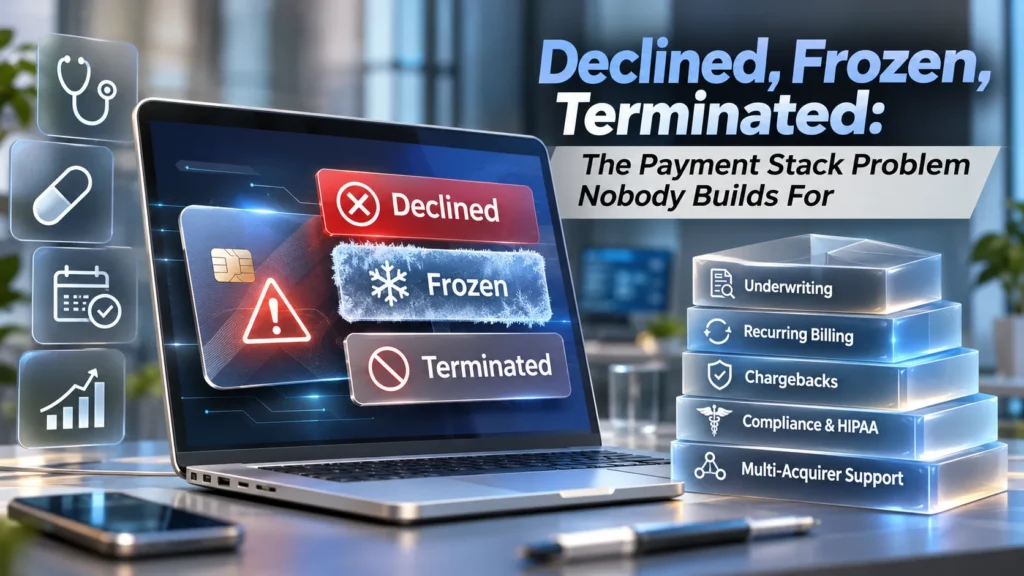
Most founders treat payments as a three-day integration task. Drop in a hosted checkout, test a card, ship. That assumption holds right up until the vertical is telehealth, peptides, nutraceuticals, event contracts or anything else an underwriter files under “elevated risk.” Then the pattern changes: the account approves instantly, processes for two or three weeks, and gets frozen the morning after a volume spike — with a rolling reserve on the balance and a 90-day hold notice in the inbox.
This is not bad luck, and it is rarely fraud. It is the predictable output of how aggregated payment platforms are built. Understanding that architecture is the difference between a business that scales and one that spends its first year migrating processors.
Instant onboarding is a liability transfer, not a favor
Platforms like Stripe, Square and PayPal onboard merchants in minutes because they do almost no upfront underwriting. You are not getting your own merchant account; you are a sub-merchant on a shared master MID alongside millions of other businesses. That model is brilliant for a coffee shop and structurally hostile to anything unusual.
Because underwriting is deferred, risk review happens after money starts moving. An automated system reads your descriptor, your website copy, your refund ratio and your average ticket, matches them against restricted-business policy, and acts. The remedies available to a risk team managing a shared MID are blunt: freeze, reserve, terminate. There is no account manager to argue with because there was never a relationship to begin with.
The categories that trip these systems are consistent. Anything where the buyer receives a prescription rather than a product. Anything involving research-use-only compounds. Anything where the “product” is a contract whose value depends on a future outcome. Anything with free trials, auto-renewals or a membership that bills monthly without a shipped item every cycle. If two or more of those apply, aggregator approval is a countdown, not a green light.
What underwriters actually read
Direct merchant accounts flip the sequence. Approval takes longer because a human and an acquiring bank read your file first — and once approved, the account is yours, with a named relationship and far less appetite for sudden termination. The file itself is where most applications die, usually for mundane reasons.
The baseline packet
- Incorporation documents, EIN or equivalent, and ownership breakdown for anyone holding 25% or more.
- Three to six months of processing statements if you have history, or bank statements if you do not.
- A live, complete website: visible terms of service, refund and cancellation policy, contact method, and billing descriptor disclosed before checkout.
- Chargeback history with reason-code breakdown, not just a ratio.
- Projected monthly volume, average ticket and highest expected ticket — and these need to be realistic, because underwriters set limits from them.
The vertical-specific layer
Telehealth files get read differently. Underwriters want to see state-by-state physician licensing, who holds the clinical relationship, how asynchronous intake is reviewed, and whether pharmacy fulfillment runs through 503A or 503B partners. HIPAA obligations shape the payment layer too: PHI must not leak into transaction metadata, descriptors should not reveal a diagnosis, and the processor needs to sign a Business Associate Agreement if it touches protected data. Peptide and supplement merchants face claims review — marketing language promising treatment outcomes for a research-use-only compound will sink an otherwise clean application. Prediction market operators get asked about jurisdiction logic, geofencing, KYC depth, settlement mechanics and how customer funds are segregated.
Regulators are paying attention to the processor side of the chain as well. One widely covered enforcement action saw the FTC pursue a payment processor over sham merchant accounts, which is a useful reminder that acquirers now face real consequences for onboarding without diligence. The paperwork you resent is partly the acquirer protecting itself — and that is why a thin file reads as a threat rather than an inconvenience.
Recurring billing is where margin quietly disappears
Subscription models in these verticals face a specific failure mode: card decline decay. Cards expire, get reissued after breaches, or change numbers after a bank merger. Without an Account Updater service pushing new credentials into your vault, a refill program loses a meaningful slice of active subscribers every quarter to involuntary churn — revenue you already earned and simply cannot collect.
Tokenization matters for a second reason. If card data lives in a vault you control rather than inside one processor’s proprietary system, migrating acquirers later becomes a configuration change rather than a campaign asking every customer to re-enter a card. Founders who skip this step discover the cost precisely when they can least afford it.
FSA and HSA acceptance is the other overlooked lever. For eligible telehealth visits and qualifying products, supporting those cards raises conversion and average order value because the purchase moves to pre-tax dollars. It requires correct merchant category coding and, in many cases, itemized receipt handling — not something an aggregator will configure for you.
Chargebacks: the metric that decides your fate
Card networks monitor dispute ratios, and crossing threshold programs triggers monthly fines and remediation plans. In subscription health and supplement businesses, most disputes are not fraud — they are “I didn’t recognize the charge” and “I thought I cancelled.” Both are fixable operationally.
- Use a descriptor that matches the brand the customer actually bought from, with a working phone number attached.
- Send a pre-billing notice before each refill cycle, with a one-click cancel path.
- Log consent: timestamp, IP, the exact terms shown, and the checkbox state at purchase.
- Keep delivery confirmation and consultation records retrievable within the representment window.
- Make refunds faster than the dispute process — a refund costs far less than a chargeback.
Representment is a documentation exercise. Processors that specialize in high-risk verticals build the evidence package automatically, which is one of the clearest practical arguments for the specialist route over a general-purpose gateway. If you are still weighing the trade-offs, it is worth reading how dedicated high-risk merchant services support a growing business compared with staying on a shared platform.
Where a specialist provider fits
The practical answer for most operators in these categories is a provider that underwrites the vertical on purpose rather than tolerating it. 2Accept works in exactly that space, placing merchants with a network of more than 40 acquiring banks and handling the underwriting file, gateway integration and chargeback defense as one engagement. Its core focus is HIPAA-compliant telemedicine and online prescribing, with BAA-backed setups, tokenized recurring billing with Account Updater, FSA/HSA acceptance and EHR-native or hosted checkout options; it also covers peptide merchants and prediction market payment processing, where jurisdiction and settlement questions make mainstream approval unlikely. Published figures include a 98% approval rate, a 48-hour average approval, 48–72 hour go-live and more than $2B processed yearly — with the usual caveat that approval still depends on the file, including physician oversight and 503A/503B pharmacy relationships where those apply.
Build the payment layer before you need it
Treat payments as infrastructure with the same seriousness you apply to hosting or data protection. Assemble the underwriting packet while you are still pre-launch. Keep policies, licensing and marketing claims consistent across every page a reviewer will open. Own your vault. Secure a backup MID before volume makes one urgent. Founders who do this spend their second year on growth; the ones who improvise spend it writing appeal letters to a risk team that will never reply.