
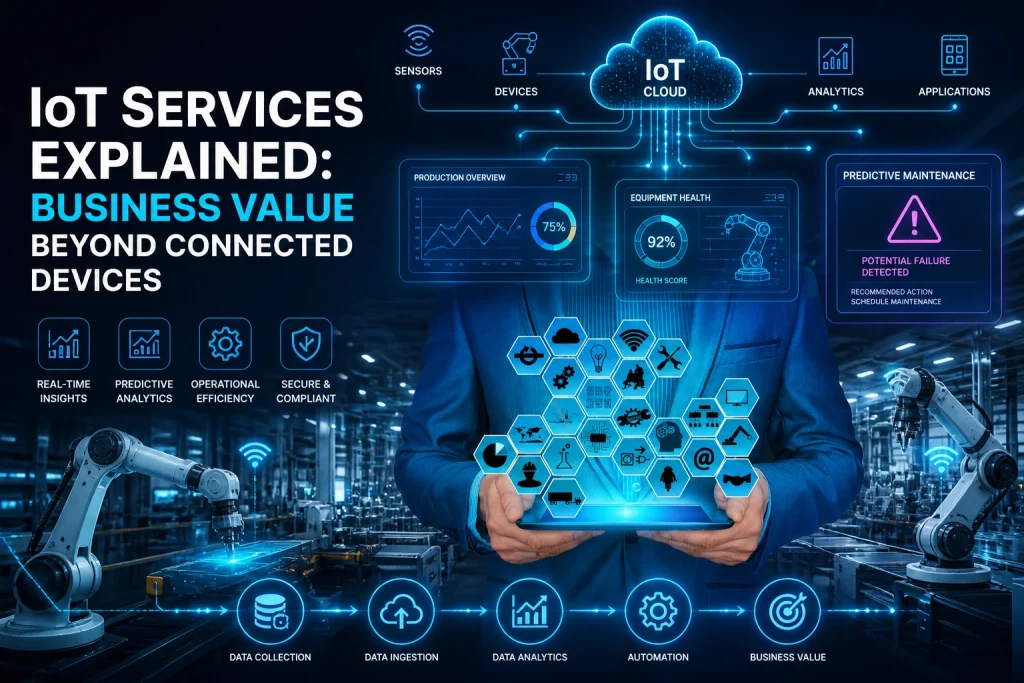
You already know the buzz around connected devices. Sensors, wearables, and smart machines grab attention fast. But the real story sits behind them. IoT services turn raw device data into decisions you can act on. That’s where business value starts to show up.
So if you’re only thinking about hardware, you’re missing the bigger picture. You need to look at the service layer of the Internet of Things. That’s where integration, analytics, and automation live. Let’s break down how IoT services actually create value for your business.
What IoT Services Really Include
You might think IoT is only about connecting devices to the internet. That’s just the first step. IoT services cover a full ecosystem, including device management, cloud platforms, data pipelines, and application layers.
More importantly, these services keep everything running. They monitor device health, push updates, and ensure security. You don’t just install IoT devices and walk away. You need systems that manage them at scale and keep them useful over time. Working with trusted providers of IoT services means device management, updates, security, and lifecycle support are built in, keeping systems effective from deployment through replacement.
Turning Data Into Decisions
Connected devices generate huge volumes of data. On its own, that data doesn’t help you much. You need analytics services to turn it into insights. That’s where IoT platforms step in.
You can track patterns, predict failures, and spot inefficiencies. For example, sensors in equipment can signal when maintenance is needed. That helps you act before a breakdown happens. With real-time monitoring, you gain instant visibility into performance, allowing faster and more accurate decisions across operations.
Driving Operational Efficiency
IoT services help you streamline daily operations. You gain real‑time visibility into processes that were once hard to track, and that visibility naturally opens the door to improvement. It changes how you manage resources and workflows, setting the stage for automation and smarter use of energy.
You can automate repetitive tasks, optimize energy use, and reduce waste. Over time, small improvements add up. You’ll notice lower costs and smoother operations without constant manual oversight. In industrial IoT environments, this often translates to higher equipment uptime and more predictable production cycles.
Enhancing Customer Experience
You’re not just improving internal systems. IoT services also reshape how you interact with customers. Connected products can deliver personalized experiences based on real usage data.
You can offer proactive support instead of reactive fixes. For instance, IoT solutions in the supply chain provide real‑time visibility that lets businesses anticipate customer needs, from alerting them when products are restocked to updating them on delivery changes. That builds trust and keeps customers engaged with your brand longer.
Enabling New Revenue Streams
IoT services open doors to business models you couldn’t support before. You’re no longer limited to selling products once. You can even offer services around those products.
Think subscription models, usage-based pricing, or remote monitoring services. These options create recurring revenue. They also deepen your relationship with customers since you stay connected after the initial sale. With IoT devices continuously sending data, you can refine offerings and introduce premium features over time.
Strengthening Security and Regulatory Compliance
Security can’t be an afterthought. Every connected device creates a potential entry point. To address that, IoT services include tools to manage risks and protect your data.
With these tools, you can monitor threats in real time and apply updates quickly, while also gaining better control over data access and usage. This helps you meet regulatory requirements such as the General Data Protection Regulation (GDPR), while reinforcing customer trust. Ensuring IoT security is critical, especially as networks grow and handle more sensitive information.
Scaling Without Losing Control
Growth brings complexity. More devices mean more data and more systems to manage. IoT services help you handle that growth without chaos.
Cloud‑based platforms let you expand without heavy infrastructure investments, so you can add devices, users, and features as needed. Meanwhile, centralized dashboards keep everything under control. Well‑designed IoT solutions also support interoperability, allowing new devices to fit seamlessly into existing systems.
Integrating With Existing Systems
You don’t need to rebuild your entire tech stack. IoT services are designed to integrate with what you already use, including enterprise resource planning (ERP) systems, customer relationship management (CRM) platforms, and analytics tools.
This integration creates a unified view of your operations, helping you avoid data silos and improve collaboration across teams. Decisions become faster because everyone works from the same information. It also allows IoT data to enrich existing business insights, making them more accurate and actionable.
Building a Future-Ready Business
IoT services set the stage for long‑term innovation. Once your systems are connected and data flows smoothly, you can begin layering in advanced technologies such as AI, machine learning, and predictive analytics.
With that foundation, you’ll be able to experiment and adapt quickly. That flexibility helps you stay competitive in fast‑moving markets. IoT solutions create a base where emerging technologies plug in seamlessly and deliver even more value over time.
Final Thoughts
IoT services go far beyond connecting devices. They give you tools to operate smarter, serve customers better, and grow sustainably. When you focus on the service layer, you begin to realize the full potential of IoT.
Now the shift is clear. It’s not about devices anymore. It’s about what those devices enable. And that’s where lasting business value resides.
Companies collect massive device data but struggle to act on it quickly. We created RAI AI to solve the real challenge: instant analysis tailored to your specific locations and requirements. Speed transforms outcomes. Want to see our different approach?
The real bottleneck isn’t collecting IoT data—it’s making sense of it quickly enough to act on it. Most SMEs I work with are drowning in device data but lack the resources for proper analysis. That’s why I built a platform called ELECTE that delivers intelligent insights in minutes, no coding required.