
Every year, there is a technological advancement in every industry, but it’s most evident in online trading. Technology is changing how people trade by introducing cutting-edge systems like synthetic indices, which enable traders to trade around the clock without relying on real market hours or news events.
There are no real buyers or sellers behind the price, no stock exchange, no bank, and no economic report that triggers a move. Just a computer system running nonstop, generating price data that behaves like a real market without being one. Understanding what powers all of this helps you trade it better and stops you from being confused when it doesn’t behave the way traditional forex does.
What Powers Synthetic Indices?
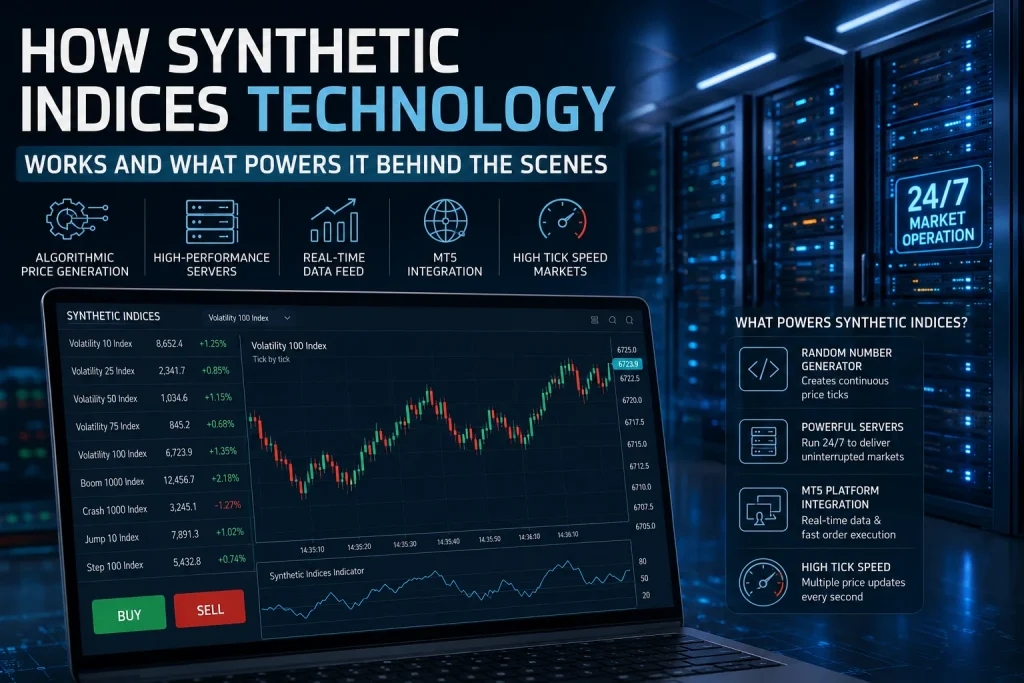
A computer algorithm keeps synthetic indices running. This algorithm uses a mathematical system called a random number generator, which produces numbers continuously and converts them into price movements on your chart. The system runs on powerful servers that never switch off, which is why you can open a chart at 3 AM on a Sunday and still see the price moving. No human is sitting somewhere manually moving these prices. It’s all automated and runs on its own at all times.
How Volatility Works Inside Synthetic Indices
Most traders who discover synthetic indices end up on a volatility market first without even realizing it belongs to a bigger family. Each volatility market gets assigned a number that tells you how aggressively the price moves.
A good place to understand how different volatility levels behave across synthetic indices platforms is Syntxwiki, which breaks down each market type clearly so you know what you’re looking at before you place a trade. The higher the volatility number, the faster and wilder the price swings get, which changes how you need to approach your strategy completely.
How Price Movements Are Generated
A random number generator sits behind every price movement on a synthetic indices chart. It runs nonstop, producing numbers that tell the system whether the price goes up or down each tick.
There’s no news and no human input, just math creating what looks like a real market on your screen.
How MT5 Connects You to Synthetic Indices
Opening MT5 connects you to your broker’s server through the internet. The server pushes live synthetic indices price data to your screen, and when you place a trade, MT5 sends that order back for processing in a matter of seconds.
Opening a synthetic indices account gives you access to live charts, order tools, and execution all in one place. With a slow connection, it becomes hard for prices to update fast enough to trade properly.
How Tick Speed Affects Your Trades
On synthetic indices, a tick is just a price moving. Faster markets throw out several ticks every second, and the price shifts between the moment you decide and the moment your trade goes in. Traders who pay attention to tick activity before entering usually understand what they’re walking into. Another factor that can affect how you trade is slow internet. All it takes is one hanging connection, and the price you wanted is gone.
Types of Synthetic Indices Markets
Each market uses different algorithms and volatility settings. Here is a simple synthetic indices list that many traders watch before choosing a trading setup.
- Volatility Indices – These markets run nonstop, and the number attached tells you everything you need to know. Higher means intense, while lower means calmer movements. Start somewhere manageable before jumping into one that moves faster than you can think.
- Boom and Crash Indices – These markets are designed to produce sudden spikes or drops after periods of normal movement. Traders often look for those explosive moves when planning short-term trades.
- Jump Indices – Jump markets create occasional sharp price changes that appear unexpectedly on the chart. The algorithm inserts these jumps to create a unique trading environment with different timing challenges.
- Step Indices – Step markets move in fixed increments instead of changing by random amounts. This creates a more structured chart pattern that some traders may find easier to analyze and follow.
How Prices Reach Your Screen
Every price you see on your chart traveled through a few hands before landing there. The algorithm creates a tick, the broker’s server processes it and adds the spread, then MT5 gets it and updates everything, including your chart, synthetic indices indicators, and open positions, all within milliseconds.
This process keeps on repeating itself and never stops. If you lose your connection for even a few seconds, the real price may keep moving while you can’t see it.
The Role of Algorithms in Synthetic Indices Forex
Many people hear the term ‘synthetic indices forex’ and assume it works exactly like traditional currency trading. Forex prices move because of real demand. Banks, governments, and traders are all moving money around.
While in a synthetic indices algorithm, it does all of that on its own, running nonstop without waiting for any financial centers to open. That’s what makes synthetic indices so useful for strategy testing: the market is always there whenever you are, not just during certain hours.
Conclusion
Most traders never think twice about what’s running behind their charts, and honestly, that’s where a lot of confusion comes from. Synthetic indices run on algorithms, servers, and data feeds working together nonstop. The market type changes how the price behaves, but the technology underneath stays the same. Once you understand that, you stop second-guessing the market and start making decisions based on what’s actually happening.