
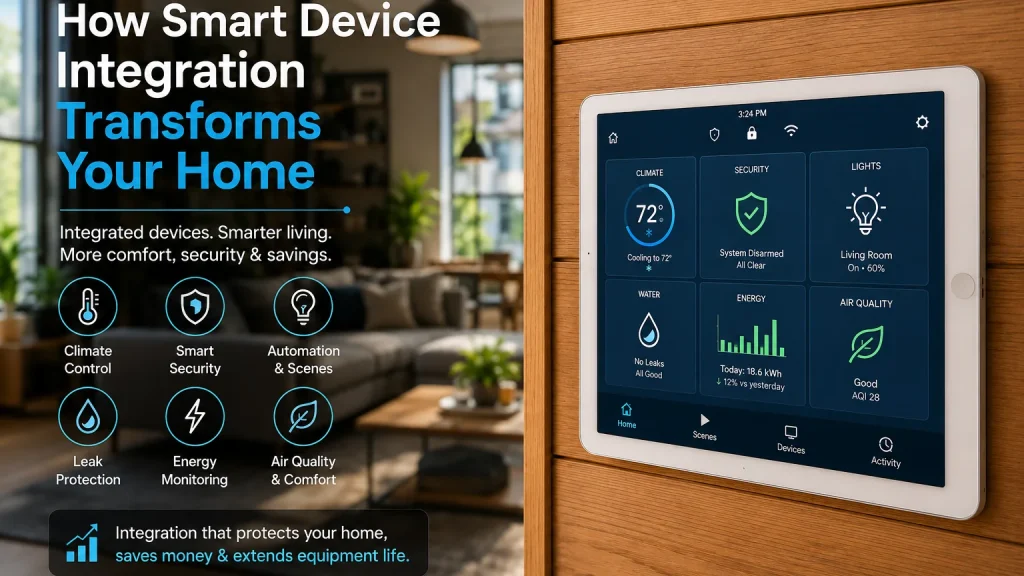
There’s a meaningful difference between owning smart devices and having a smart home. Most households now fall into the first category: a video doorbell here, a smart speaker there, maybe a thermostat installed when the old one failed. Each works fine on its own, and each requires its own app, its own login, and its own attention.
Integration is what closes that gap. When devices communicate with each other rather than operating in isolation, a home stops being a collection of gadgets and starts behaving like a coordinated system. That shift changes daily routines, monthly utility bills, and the lifespan of major equipment in ways individual devices never do.
Adoption Has Already Reached Nearly Every Household
The question is no longer whether homes will be connected, but how well those connections work together.
According to Statista, in 2025, it is estimated that 89.5% of United States households will have at least one smart home device, with this percentage expected to rise to 99.0% by 2029. Near-universal adoption means the competitive advantage has moved past ownership entirely.
What separates households now is coordination. A home with twelve disconnected devices generates twelve separate maintenance obligations and twelve places to check when something misbehaves. A home with eight integrated devices behaves like a single system that responds to conditions automatically. The second home requires less attention despite doing considerably more.
That distinction becomes more pronounced as device counts climb. Integration scales gracefully. Fragmentation doesn’t.
Coordinated Climate Control Protects Expensive Equipment
Heating and cooling systems represent the largest mechanical investment in most homes, which makes how they’re operated financially significant.
According to Service Titan, furnaces can last up to 15 years. Reaching the upper end of that range depends heavily on operating conditions, and integrated systems improve those conditions in ways a standalone thermostat can’t.
Occupancy sensors and door contacts tell a system when a house is genuinely empty rather than relying on a fixed schedule that runs whether anyone is home or not. Humidity sensors allow a system to adjust for comfort without dropping temperature further than necessary, reducing runtime. Zone dampers coordinated with room-level sensors prevent the system from conditioning spaces nobody occupies.
Fewer cycles mean less wear on components. Integrated monitoring adds another layer by flagging performance changes early — a system running longer than usual to reach the same setpoint, or cycling more frequently than it did last season. Those signals often precede a failure by weeks, turning an emergency replacement into scheduled maintenance.
Security Becomes Contextual Rather Than Binary
According to Consumer Affairs, in 2024, the smart home security market was worth an estimated $32.5 billion. That scale reflects a genuine shift in what security systems do.
Traditional systems were binary: armed or disarmed, triggered or quiet. Integrated systems understand context. A door opening at 2 p.m. on a weekday when a family member’s phone is approaching the driveway means something different from the same door opening at 3 a.m. with every phone accounted for inside the house.
Cross-device coordination produces responses that individual products can’t. A motion detection event can trigger exterior lights, begin recording on nearby cameras, adjust interior lighting to simulate occupancy, and send a single consolidated notification rather than four separate alerts from four separate apps.
Integration also extends security into areas most people don’t associate with it. Water leak sensors connected to an automatic shutoff valve can stop a burst supply line before it floods a finished basement. Smart smoke detectors can shut down HVAC circulation to slow smoke spread. These are safety functions that only work when devices are permitted to talk to one another.
Automation Reclaims Time Nobody Notices Losing
The daily benefit of integration is subtle: the elimination of small, repetitive decisions.
Lights that respond to occupancy and time of day remove the entire category of remembering to turn things off. Locks that engage automatically at a set hour eliminate the late-night check. Blinds that close as afternoon sun hits the west side of the house reduce cooling load without anyone thinking about it.
Scene-based automation handles transitions in a single action. A morning routine can raise bedroom blinds, adjust the thermostat, start the coffee maker, and unlock the door for a dog walker. An evening routine can dim lights gradually, lock exterior doors, arm the perimeter, and lower the temperature for sleep.
None of these individually justifies the effort. Collectively, they remove dozens of small interruptions from every day.
Visibility Changes Behavior
Integrated systems generate data that isolated devices leave uncollected, and that visibility tends to change how households use energy.
Energy monitoring at the circuit level reveals which appliances actually drive consumption, which is frequently not what homeowners assume. Water monitoring catches slow leaks that would otherwise go unnoticed until they appear on a bill or a ceiling. Air quality sensors surface ventilation problems that had been affecting sleep quality without any obvious cause.
Awareness alone produces savings, and automated response amplifies them further.
Building Toward Integration
The most practical path starts with a hub or platform choice, since compatibility determines what’s possible later.From there, adding devices that support open standards keeps future options open.
Existing homes rarely need to start over. Most fragmented setups can be brought into a single platform incrementally, replacing the pieces that refuse to cooperate as they age out. The goal isn’t more devices. It’s fewer systems.