
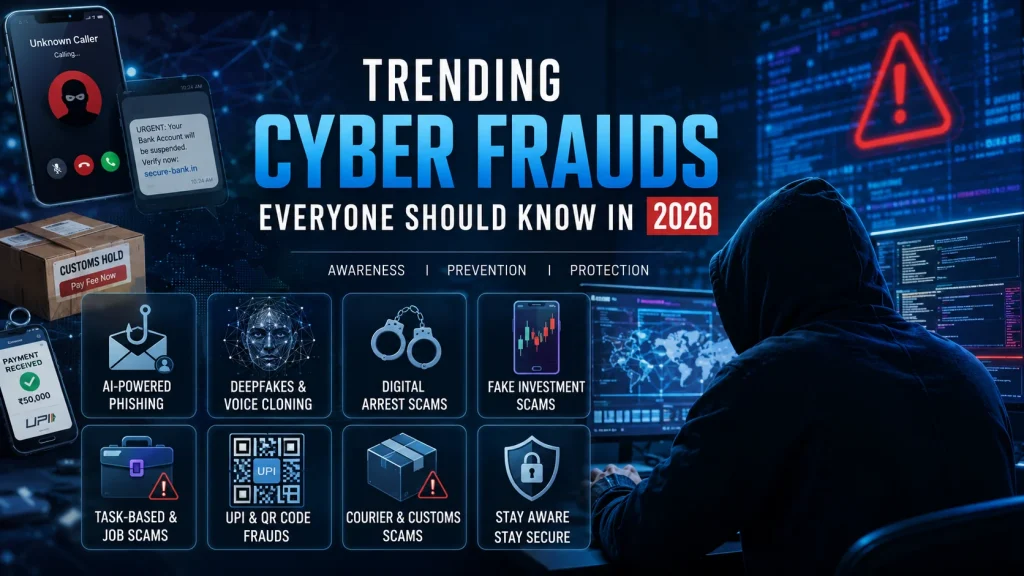
Cybercrime is undergoing a rapid evolution. Fueled by artificial intelligence, automated scripts, stolen personal identity databases, and readily available “Cybercrime-as-a-Service (CaaS)” platforms across various avenues, attackers are operating at a rapid scale. Improved psychological manipulation combined with modern technology means scams are no longer typical typos-ridden emails. They are sophisticated, targeted, and shockingly convincing operations designed to bypass both security filters and human intuition, thanks to the rise in artificial intelligence. This article briefly covers trending cyber frauds everyone should know in 2026 and protect themselves from it.
1. AI-Powered Phishing and Social Engineering
Generative AI has eliminated the classic warning signs of online fraud. Phishing attacks are now flawless, contextual, and customized using scraped social media data. It has become increasingly relevant and sophisticated. Attackers now rely on automated routines created to execute several deceptive tactics:
- AI-Written Phishing Emails: Flawless corporate communications mimicking official bank, tax, CEO impersonation, or workplace notifications.
- Personalized Spear-Phishing: Tailored lures referencing recent purchases, employment details, or mutual contacts.
- Smishing: Fraudulent SMS messages containing tracking links or urgent security alerts. (Often seen with delivery scams.)
- QR-Code Phishing: Malicious QR codes placed in public spots with misleading content prompting people to scan for more details or replacing a legitimate QR code with a malicious one.
- Fake Customer Support: AI chatbots hosted on phishing websites are programmed to trick users into handing over one-time passwords (OTPs) or account credentials under the guise of technical help, further leading to account takeover attacks.
- Multilingual Campaigns: Instant, context-aware translations allowing global fraud rings to target local populations. Initially this used to be a heavy task since it required a group to operate across various themes and languages, which now gets integrated seamlessly in a phishing infrastructure.
2. Deepfakes, Voice Cloning, and Digital Impersonation
The rise of synthetic media has now added another vector to impersonation attacks. With just a few seconds of video pixels scraped from a public source, cybercriminals can clone an executive’s or family member’s voice with chilling accuracy. Voice cloning is frequently combined with deepfake video calls to stage fake kidnappings, fabricate emergency fund requests, or authorize fraudulent corporate wire transfers.
3. Digital Arrest Scams
Digital arrest scams have emerged as one of the most psychologically and financially destructive fraud patterns, particularly across India. Cybercriminals impersonate officials from high-profile agencies such as the Central Bureau of Investigation (CBI), Customs, Enforcement Directorate (ED), or local police departments to execute the following steps:
- The Trap: The initial call claims a package containing illegal goods (drugs, fake passports) was intercepted in the victim’s name.
- The Execution: Victims are moved to a video call featuring fake uniforms, official logos, and counterfeit legal notice, where they are asked to discuss the further matter.
- The Coercion: Fraudsters claim the victim is under “digital arrest” and must stay on camera for hours or days while transferring their life savings into “government verification accounts.”
Before the victim could realise about the scam taking place, the transferred amounts from savings or from instant loans are tumbled over different accounts and a full recovery is often a rare case of victory.
4. Fake Investment and Stock-Trading Scams
Exploiting financial anxiety and high-return promises, scammers lure targets through polished social media ads featuring fake celebrity endorsements. Victims are funneled into private Telegram or WhatsApp groups where shills post fabricated profit screenshots.
Targets are eventually directed to download fake trading apps that simulate massive portfolio gains. Encouraged by these fake returns, victims invest larger sums. When they try to withdraw their money, the app demands additional “taxes” or “regulatory clearance fees,” permanently locking the funds once the victim stops paying.
5. Task-Based and Work-From-Home Scams
Targeting job seekers, students, and homemakers, these schemes offer fast cash for simple online tasks like rating hotels or liking video posts:
- Scammers pay small initial amounts (₹500–₹2,000) to build trust.
- Workers are then required to “pre-fund” tasks or pay fees to unlock higher commissions.
- Communication is cut once the victim stops sending money.
6. UPI and QR-Code Frauds
Despite widespread digital payment adoption, basic misunderstandings around Unified Payments Interface (UPI) are the reason victims still end up losing money, especially in India. Scammers frequently operate on online marketplaces, posing as buyers for items users are selling.
Majority of the frauds in this context occurs due to one single rule that victims forget: you never need to enter your UPI PIN to receive money. Fraudsters, under the pretext of buying something, send a payment request or a QR code to the victim, claiming it is a refund or an advance deposit. The victim scans the code or enters their PIN expecting to receive funds, only to have money instantly deducted from their bank account instead.
While the occurrence of this is nowadays rare, as the audience on these platforms are technologically more aware, for the older population it can still work.
7. Courier, Customs, and FedEx Scams
Whether run independently or as a part of digital arrest scams, courier fraud exploits everyday online shopping. Victims receive urgent calls or texts claiming a package shipped via FedEx or DHL and ask for personal data under “re-confirmation” pretext or it could be about a restricted parcel stopped by airport agencies. To avoid immediate legal action or further delay, targets are instructed to pay “customs fees” or “clearance charges” via direct transfer.
What Do Most of These Frauds Have in Common?
While the technology evolves, the underlying psychological manipulation stays the same. Every scam relies on manipulating basic human emotions:
- Fear: “A warrant has been issued in your name.”
- Urgency: “Pay within 15 minutes or your account will be frozen.”
- Greed: “Turn ₹10,000 into ₹50,000 overnight.”
- Trust: “This is your bank’s security department calling.”
- Hope: “You’ve been selected for an exclusive work-from-home role.”
- Authority: “This is an officer from the law enforcement bureau.”
The technology driving fraud constantly evolves, but the underlying psychological manipulation remains consistent. Understanding and working on these emotional triggers is the most effective line of defense.
What Should You Do If You Suspect Cyber Fraud?
If you fall target to a potential scam, acting quickly can limit financial and personal damage:
- Cut All Contact: Stop communicating immediately. Do not respond to messages or video calls.
- Stop Paying: Never send additional money in an attempt to recover lost funds.
- Alert Your Bank: Contact your bank or payment app provider immediately to freeze compromised accounts and block cards.
- Document Everything: Take clear screenshots of chat logs, transaction IDs, phone numbers, and URLs.
- Report to Authorities: In India, call 1930 (the National Cyber Crime Helpline) right away and register a complaint at cybercrime.gov.in.
- Lock Down Accounts: Change passwords, enable Multi-Factor Authentication (MFA), and log out of active sessions on all devices.
The best preventive measure is to be aware of such frauds and the evolving tactics so that when it happens, one doesn’t psychologically lose their composure and react calmly.
Conclusion
To conclude, the threat landscape of cyber fraud is complex, and advancing as it remains powered by artificial intelligence and precise psychological tactics. However, awareness remains your strongest shield. By recognizing the emotional patterns scammers use fear, urgency, and guaranteed returns and knowing the exact steps to take when targeted, you can tackle such trending cyber frauds in India and protect your hard-earned financial assets.

Author Bio: This article has been written by Rishika Desai, a cybersecurity researcher and threat intelligence professional currently working as a Threat Researcher at BforeAI. She also founded RishSec, a creator-led cybersecurity training and mentoring service that helps aspiring security professionals build practical skills and advance their careers.
Rishika is a B.Tech Computer Engineering graduate from Vishwakarma Institute of Information Technology (VIIT), Pune, graduating with a 9.57 CGPA. She has spoken at international cybersecurity conferences in Singapore and Malaysia, was honored with the Rising Star of the Year award by BSides Bangalore, and was recognized among the Top 100 Cybersecurity Influencers by the CF100 Club CyberFrat.
You can follow Rishika on X (Twitter) at @ich_rish99 and on Instagram at @rish.sec.