
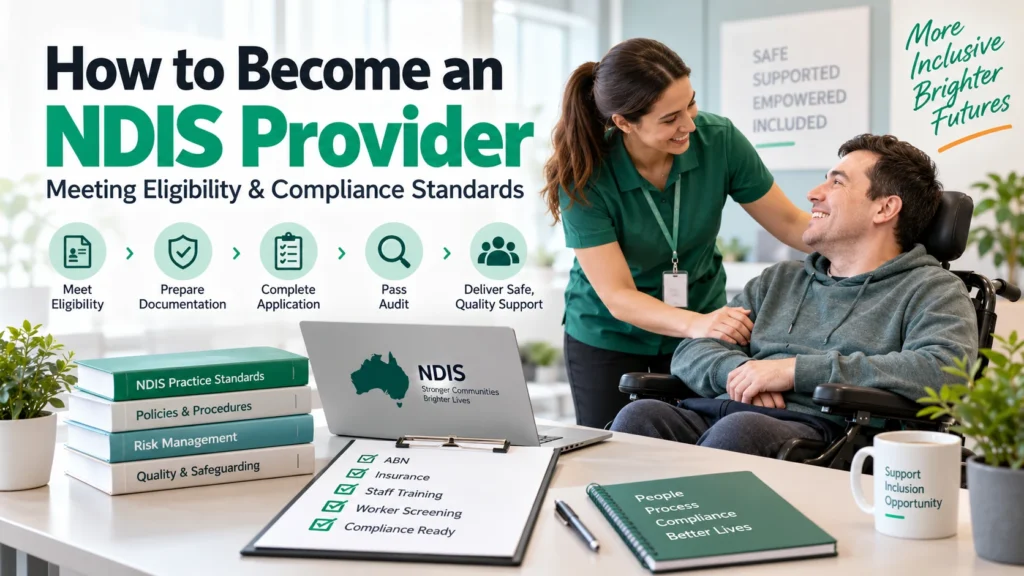
I keep seeing the same story play out. Someone decides they want to deliver NDIS services, Googles a few things, fills out an application, and then sits there confused when the whole thing stalls. Or worse, they get knocked back entirely.
The truth is, figuring out how to become an NDIS provider takes more legwork than most people expect. And the stuff that trips you up is rarely the application form itself. It is everything that comes before it.
So let me walk through this properly.
What the Commission is Really Looking for
The NDIS Quality and Safeguards Commission runs the show when it comes to provider registration. And they are not just rubber-stamping applications. I think a lot of people go in expecting a straightforward approval process, almost like applying for a business license. It is nothing like that.
What they want to see is evidence. Proof that your organisation can deliver safe, consistent, participant-centred support. Not a promise that you will. Proof that you already can.
Now, you have got two options here. You can go through full registration, which lets you work with all NDIS participants regardless of how their plans are managed. Or you can operate unregistered, which limits you to self-managed and plan-managed participants. Full registration opens more doors, sure. But the compliance ask is genuinely heavy. I would not sugarcoat that. If you are still early in the process and working out how to become an NDIS provider, understanding this distinction before you commit saves a lot of wasted effort.
Sort Your Eligibility Out First. Seriously.
How to become an NDIS provider is the part where I have watched so many providers shoot themselves in the foot.
They skip straight to the portal. Click “start application.” And then realise halfway through that they do not have half the things the Commission requires.
You need an ABN. Obviously. You need insurance sorted, public liability and professional indemnity at a bare minimum. If your team is delivering specialist supports like allied health, behaviour support, or early childhood services, every clinician needs to hold current registration with their relevant professional body.
But it goes deeper than credentials. Your organisation needs documented policies. Incident management. Complaints handling. Participant rights. And here is one that people genuinely forget about: the NDIS Worker Orientation Module. Every single person in your team who has any contact with participants needs to have completed it. Not just your frontline staff. Admin too.
Get all of this locked in before you apply. Trust me on that one. If you want a practical rundown of exactly what ticks the eligibility boxes, this guide on provider eligibility requirements lays it out clearly.
The Application and Audit Process
OK so you have done the prep work. Your policies exist, your insurance is live, your team is trained. What now?
You jump onto the NDIS Commission portal and submit your application. Part of that means choosing your registration groups, which are basically the categories of support you want to deliver. There are dozens available, such as daily living assistance, community participation, therapeutic supports, and specialized accommodation. But here is my advice: do not select everything that looks relevant. Every group you add makes your audit more complex and more expensive.
Because yes, an audit is coming.
Depending on the risk level of the groups you picked, you will either face a verification audit (think desktop review, lighter touch) or a full certification audit (on-site visits, participant interviews, deep policy review). The certification path is no joke. Auditors are looking at how things actually work in your organisation, not just what your documents claim.
And you are footing the bill for the auditor. Nobody tells you this early enough. A small provider might pay somewhere around $3,000 to $5,000. Bigger operations with lots of registration groups? I have heard of costs well north of $15,000. That is before you factor in the time your team spends preparing.
Compliance Does Not End at Registration
Here is where I think the real disconnect happens. People treat registration like the finish line. It is not. If anything, it is the starting gun.
Once you are registered, the NDIS Practice Standards govern how you operate across governance, service delivery, and operational management. You need live systems for incident reporting, and I am not talking about a spreadsheet someone updates when they remember. Reportable incidents go straight to the Commission. Complaints need a proper tracked process. Participant safeguarding has to be embedded in how your team thinks and acts every day.
Your registration lasts about three years. Then you do it all again. Another audit. More evidence. More fees.
Worker screening is ongoing too. Anyone in a risk-assessed role needs a valid NDIS Worker Screening Check, and keeping those current falls squarely on you as the provider. Letting one lapse is not just an oops. It is a compliance breach that the Commission takes seriously.
Conclusion
Honestly, the biggest one is rushing. Providers who apply before their internal processes are actually tested, before their staff are genuinely trained, before their documentation holds up under any real scrutiny they either fail the audit outright or they get registered with conditions slapped on. And starting your NDIS journey with restrictions on what you can deliver? That is a rough place to build from.
The second one is overreaching on registration groups. I get the temptation. You want to offer everything. But each group adds weight, compliance weight and audit weight, and if your systems cannot support it, you are setting yourself up for problems twelve months down the track.
And then there is the money. Audit fees, insurance, screening costs, the hours your team pours into documentation and training. It adds up faster than most people budget for.
When it comes down to it, understanding how to become an NDIS provider is really about understanding whether your organisation is genuinely ready for what comes after the application. The ones who last in this space are the ones who built the foundations properly from day one. Not the ones who figured it out as they went along.